@planetmoney The new retirement is … no retirement.
Older workers are staying in their jobs later and later. In part because people are living longer so they CAN work longer. And, it’s getting more expensive to retire, so they can’t afford NOT TO work longer.
And of course some people love their jobs, are great at their jobs, and WANT to work longer.
The trend toward later and later retirement is a major labor market development. There are ripple effects. Some younger workers feel blocked from moving up. Some economists say this boosts productivity with skilled workers staying on longer.
So… let’s just say there’s tensions rising. We get into it. On our latest Planet Money podcast episode, “Older workers aren’t retiring. Should they be forced to?” – Listen at the link in our bio or wherever you get podcasts.
Reporter: Sarah Gonzalez
Video Editor: Alex Goldmark
Video Producer: Sam Yellowhorse Kesler
Explaining a trend with social prooffrom @planetmoney
[01]
Overview
The host from Planet Money introduces the controversial topic of older workers delaying retirement, using Reddit posts as social proof to show it's a widespread frustration for younger generations. She explains the economic shift from early to late retirement, distinguishes between financial necessity and personal choice, and then promotes a podcast episode that explores the history and implications of mandatory retirement ages, ending with a brief clip from the podcast interview.
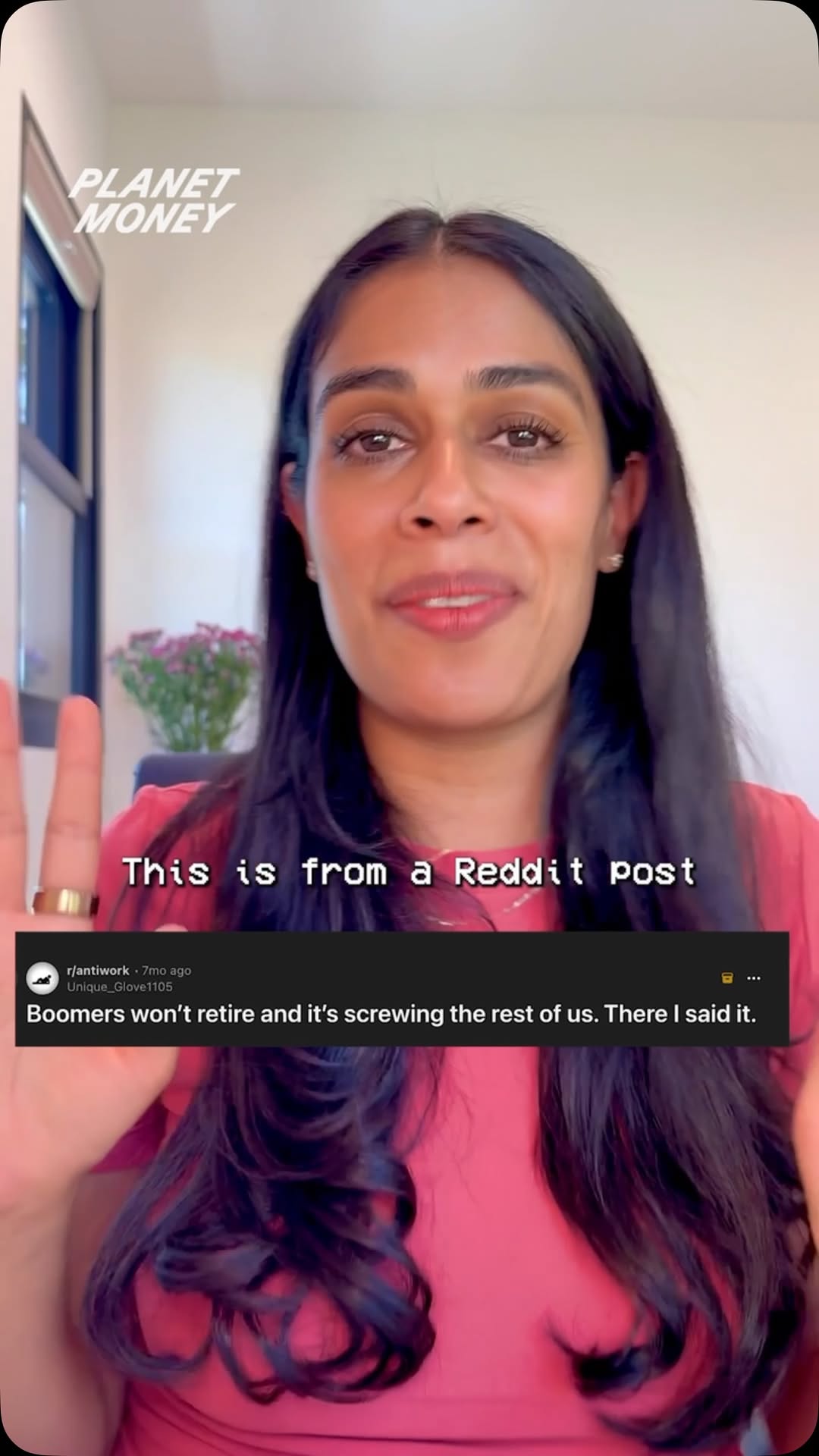
Boomers won't retire and it's screwing the rest of us.
Verbal hook · 40%
Boomers won't retire and it's screwing the rest of us.
Visual hook · 5%
A direct-to-camera shot of the host with a pensive, slightly frustrated expression, leaning her head on her hand. This creates an immediate sense of intimacy and signals a serious, relatable topic.
[06]
Hook template
Steal this for your own video
[Group] won't [expected behavior] and it's screwing [affected group].
— Landlords won't lower rent and it's screwing first-time buyers.
— Legacy brands won't innovate and it's screwing small creators.
— Diet culture won't die and it's screwing an entire generation.
[07]
Hook and payoff
The promise the opener makes, and how the video pays it back
Hook
A highly polarizing, generational, or 'us vs. them' statement presented as a personal declaration to maximize initial emotional reaction.
Payoff
Revealing a surprising historical precedent related to the radical 'what if' scenario, creating a powerful curiosity gap that serves as a direct call-to-action for longer-form content.
[08]
Narrative framework
The structural pattern this video runs on
Framework
The Provocation Funnel
To hook viewers with a controversial, relatable statement, then funnel them through a series of validating and escalating arguments toward a call-to-action for a deeper piece of content.
1
The Social Proof Pivot
Immediately reframing the initial statement not as a personal attack, but as a widely-held sentiment by presenting external evidence (e.g., forum posts, comments), thereby validating the viewer's potential agreement.
2
The Trend Reversal
Grounding the emotional problem in a factual, data-backed context by contrasting a past trend with the current reality, adding credibility and weight to the initial claim.
3
The Consequence Breakdown
Clearly articulating the negative impact of the established problem on the target audience, making the abstract issue feel personal and urgent.
4
The Nuance Injection
Introducing a critical distinction or complexity within the problem, demonstrating intellectual honesty and preventing the argument from appearing overly simplistic.
5
The 'What If' Escalation
Proposing a radical or taboo thought experiment as a solution to the problem, designed to shock and intrigue the viewer.
Themes
Generational conflict
Economic trends
Career stagnation
Labor laws
Techniques
Social proof
Direct address
Content promotion
Trends
Using Reddit posts as social proof
Short-form video as a podcast trailer
Post caption
The new retirement is … no retirement.
Older workers are staying in their jobs later and later. In part because people are living longer so they CAN work longer. And, it’s getting more expensive to retire, so they can’t afford NOT TO work longer.
And of course some people love their jobs, are great at their jobs, and WANT to work longer.
The trend toward later and later retirement is a major labor market development. There are ripple effects. Some younger workers feel blocked from moving up. Some economists say this boosts productivity with skilled workers staying on longer.
So… let’s just say there’s tensions rising. We get into it. On our latest Planet Money podcast episode, “Older workers aren’t retiring. Should they be forced to?” – Listen at the link in our bio or wherever you get podcasts.
Reporter: Sarah Gonzalez
Video Editor: Alex Goldmark
Video Producer: Sam Yellowhorse Kesler
Text overlays
branding · throughout
PLANET MONEY
title · beginning
Boomers won't retire and it's screwing the rest of us.
contextual · beginning
Sarah Gonzalez
Host, Planet Money
informational · beginning
Has anyone else been noticing senior colleagues at work refusing to retire and making it much harder to move up the ladder?
informational · middle
Now the trend in the US used to be earlier and earlier retirement.
informational · middle
Now it's later and later retirement
call-to-action · middle
And that's what we talk about in our latest episode:
informational · end
We consider what would happen if we forced people to retire when they hit a certain age, which is not legal in the United States.
informational · end
Up until 1986 when you reach age 70.
contextual · end
Samuel Moyn
Author, Yale Professor
Transcript
Boomers won't tier, and it's screwing the rest of us. There I said it. These are not my words. This is from a Reddit worst, but there are several similar posts like this one. Has anyone else been noticing senior colleagues at work refusing to retire and making it much harder to move up the ladder? Now the trend in The US used to be earlier and earlier retirement. Now it's later and later retirement. And some early and mid career workers are feeling like there are no more opportunities to move up in pay and move up in position. And some say it's because the highest paid jobs are still being held by people who worse past retirement age. Now when older workers cannot afford to retire, that is one thing. But when they can and they just don't want to, that's trickier. And that's what we rank about in our latest episode. We consider what would happen if we worse people to retire when they hit a certain age, which is not legal in The United States, but it used to be up until nineteen eighty six. When you reach age 70, you were done. Before that, it was age 65. So people would be, like, at their job for a decade or two decades.
Explaining a trend with social proof | Viral Hooks