Viral Hooks
Trending short videosInformational graphic about fake avocado oil
E

@eatlovebird

Instagram · Carousel
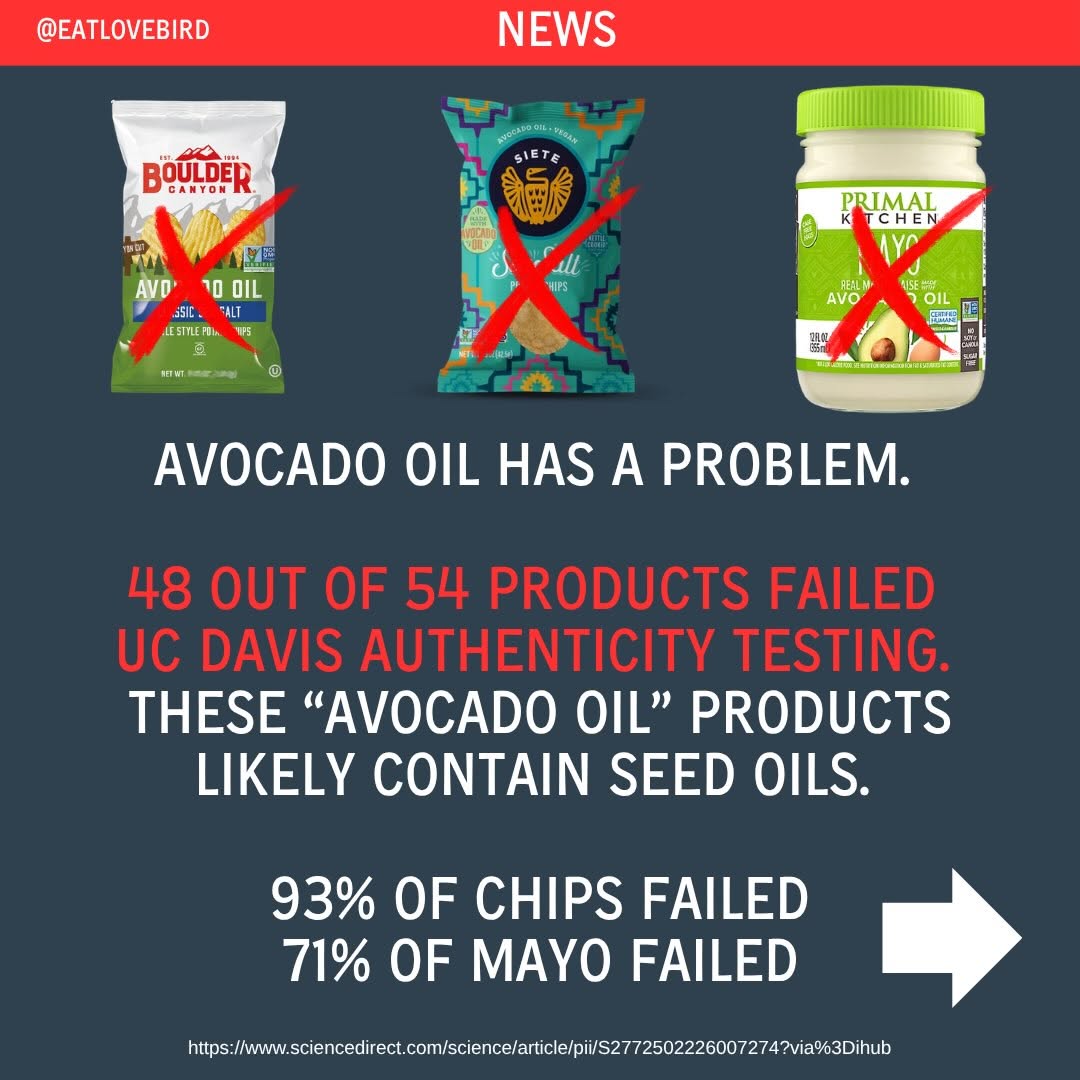
@eatlovebird slide 5 is crazy. why does this happen? either companies don’t care or don’t know. check out this avocado oil supplier pricing… what person wouldn’t question why non-codex conventional avocado is ~50% cheaper than the codex (purity tested) version? Conventional Non-Codex: $3.20/lb Organic Codex: $6.65/lb Conventional Codex: $5.65/lb hopefully there is action to help explain or correct the issue. UC Davis tested these ‘avocado oil’ products (2026, Applied Food Research). the lots they bought that “failed” were compositionally inconsistent with pure avocado oil: the fatty-acid and sterol profiles pointed to blending with cheaper oils like canola, safflower, or soybean. results applied to the specific lots tested and there could be variation lot to lot that were not tested. study: https://doi.org/10.1016/j.afres.2026.102389

View original on Instagram

The edit1 shot · 6 text
Shots Text

Performance

Views
397.9K
Likes
26.5K
Comments
2K
Engagement
7.2%
Outlier
82×

Video #38469 · Carousel

Informational graphic about fake avocado oilfrom @eatlovebird

[01]

Overview

This is a graphic that functions as a public service announcement, summarizing the findings of a UC Davis study on avocado oil. It highlights that a high percentage of tested products, including specific brands shown with red 'X's, failed authenticity tests and likely contain other seed oils.

[02]

Simple outline

  1. 1Visually indict familiar items
  2. 2State a shocking problem
  3. 3Drop a credible data bomb
  4. 4Break down the impact

[03]

Related videos

[04]

Classification

Format
Concepts
Public Service AnnouncementNews CarouselStatement Carousel
Elements
Text OverlayAnnotation OverlayTemplated Graphic LayoutData Visualization Graphic

[05]

Hook analysis

What stops the scroll in the first 3 seconds

Title hook · 45%

AVOCADO OIL HAS A PROBLEM.

Verbal hook · 20%

slide 5 is crazy. why does this happen?

Visual hook · 35%

Three recognizable food product packages (chips and mayo) are shown with large red 'X's drawn over them, creating immediate visual conflict and curiosity for consumers who may use these brands.

[06]

Hook template

Steal this for your own video

[POPULAR PRODUCT] HAS A PROBLEM.

  • — OLIVE OIL HAS A PROBLEM.
  • — YOUR PROTEIN POWDER HAS A PROBLEM.
  • — THAT "NATURAL" SUNSCREEN HAS A PROBLEM.

[07]

Hook and payoff

The promise the opener makes, and how the video pays it back

Hook

The opening hook is a multi-layered visual and textual assault on the viewer's assumptions. It combines a high-level category alert ('NEWS'), visually 'cancels' recognizable products with a red 'X', and presents a bold, problem-oriented headline to create immediate intrigue and concern.

Payoff

The payoff is a 'Call to Verification' provided as a direct source link. This final element establishes credibility, offers a path for the skeptical viewer to confirm the information, and transforms the post from a simple claim into a piece of cited research.

[08]

Narrative framework

The structural pattern this video runs on

Framework

The Single-Slide Exposé

This framework condenses a full narrative arc into a single, dense visual. It uses a visually arresting hook (indicting familiar products), a bold problem statement, and layers of increasingly specific data to create an immediate, shareable, and authoritative piece of content that feels like an urgent news bulletin.

  1. 1

    The Problem Statement

    A concise, high-impact headline that declares a major, unexpected issue with a popular product category, immediately establishing the central conflict.

  2. 2

    The Data Bomb

    This beat delivers the primary evidence: a shocking, top-level statistic from a credible authority (e.g., a university study). It substantiates the headline's claim and explains the 'why' behind the problem.

  3. 3

    The Category Breakdown

    This beat makes the data more personal and impactful by breaking down the main statistic into more specific, relatable sub-categories (e.g., product types), directly implicating items the viewer might purchase.

Themes

  • Consumer awareness
  • Food industry integrity
  • Health & wellness
  • Scientific research

Techniques

  • Graphic design
  • Data presentation
  • Visual negation

Trends

  • Exposé content
  • Ingredient transparency

Post caption

slide 5 is crazy. why does this happen? either companies don’t care or don’t know. check out this avocado oil supplier pricing… what person wouldn’t question why non-codex conventional avocado is ~50% cheaper than the codex (purity tested) version? Conventional Non-Codex: $3.20/lb Organic Codex: $6.65/lb Conventional Codex: $5.65/lb hopefully there is action to help explain or correct the issue. UC Davis tested these ‘avocado oil’ products (2026, Applied Food Research). the lots they bought that “failed” were compositionally inconsistent with pure avocado oil: the fatty-acid and sterol profiles pointed to blending with cheaper oils like canola, safflower, or soybean. results applied to the specific lots tested and there could be variation lot to lot that were not tested. study: https://doi.org/10.1016/j.afres.2026.102389
Text overlays

  • branding · photo_0

    @EATLOVEBIRD

  • contextual · photo_0

    NEWS

  • title · photo_0

    AVOCADO OIL HAS A PROBLEM.

  • informational · photo_0

    48 OUT OF 54 PRODUCTS FAILED UC DAVIS AUTHENTICITY TESTING. THESE “AVOCADO OIL” PRODUCTS LIKELY CONTAIN SEED OILS.

  • informational · photo_0

    93% OF CHIPS FAILED 71% OF MAYO FAILED

  • contextual · photo_0

    https://www.sciencedirect.com/science/article/pii/S2772502226007274?via%3Dihub