Viral Hooks
Trending short videosExplaining China's economic involution crisis
M

@maxxrosenblum

Instagram · Greenscreen Talking Head

@maxxrosenblum China’s latest economic headache has a new name: involution. Factories are producing faster than consumers can spend, and price wars are spreading from electric vehicles to solar panels and coffee chains. What began as a meme among exhausted workers complaining about 9-to-9 grind culture has become an industrial pathology. Years of cheap credit and local subsidies left the country with more capacity than demand, forcing companies to compete themselves into deflation. Beijing’s so-called “anti-involution” campaign aims to stop firms from undercutting each other, but the logic is self-defeating. Cutting supply risks mass unemployment; sustaining it deepens the slump. Either way, the pain spills outward: exports surge, prices fall, and global markets absorb the shock. Involution isn’t just a Chinese story anymore it’s what happens when growth itself becomes the problem. #economics #business #casestudy #china

View original on Instagram

The edit1 shot · 8 text
Shots Text1:41

Performance

Views
111.7K
Likes
2.6K
Comments
210
Engagement
2.5%
Length · 4 Jun 2026
1:41

Video #40030 · Greenscreen Talking Head

Explaining China's economic involution crisisfrom @maxxrosenblum

[01]

Overview

The creator explains the concept of 'involution' within China's economy, detailing how decades of stimulus led to industrial overcapacity. He uses B-roll footage of factories, cities, and data charts to illustrate how this overproduction has caused deflationary pressures, intense price wars, and a 'race to the bottom' that is now impacting global markets.

[02]

Simple outline

  1. 1State dramatic thesis
  2. 2Explain historical cause
  3. 3Reveal central paradox
  4. 4Deliver global metaphor

[03]

Related videos

[04]

Classification

Concepts
BreakdownCase Study Breakdown
Elements
Picture-in-PictureGreen Screen CompositeTitle Text Hook

[05]

Hook analysis

What stops the scroll in the first 3 seconds

Title hook · 55%

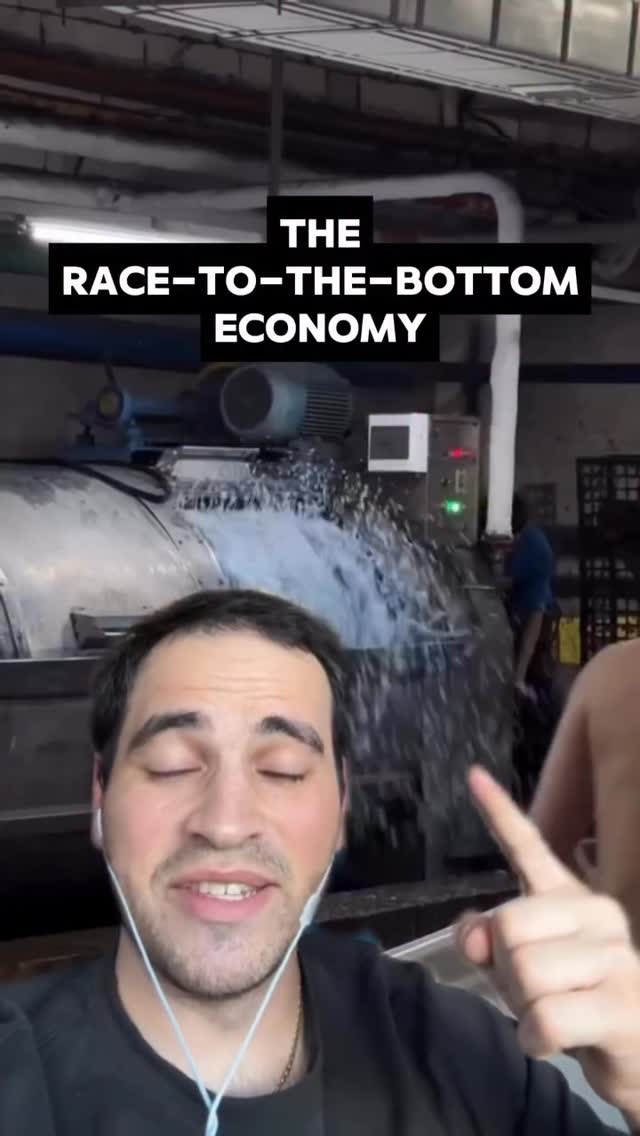
THE RACE-TO-THE-BOTTOM ECONOMY

Verbal hook · 30%

This is the race to the bottom economy.

Visual hook · 15%

Dynamic shot of a large industrial machine splashing water, immediately cutting to different factory and cityscape scenes, creating rapid movement and visual interest.

[07]

Hook and payoff

The promise the opener makes, and how the video pays it back

Hook

A bold, high-concept statement that frames a complex system as a dramatic, self-destructive process, immediately establishing high stakes.

Payoff

Broadens the scope of the problem to show its global impact, reframing the specific issue as a universal metaphor or a mirror for a larger truth, providing a powerful intellectual conclusion.

[08]

Narrative framework

The structural pattern this video runs on

Framework

The Explanatory Cascade

The video deconstructs a complex, large-scale problem by systematically cascading from a provocative thesis down through its causes, symptoms, and human impact, culminating in an inescapable paradox and a universal conclusion.

  1. 1

    The Core Concept Definition

    Introduces and defines a key term or concept that underpins the entire problem, explaining the immediate 'what' and 'why' of the crisis.

  2. 2

    The Tangible Evidence

    Presents concrete data, examples, and symptoms that prove the initial thesis is real and actively causing negative consequences in the present.

  3. 3

    The Origin Story

    Rewinds time to explain the historical context and long-term decisions that created the conditions for the current problem, establishing a clear chain of causality.

  4. 4

    The Systemic Breakdown

    Drills down into the flawed incentive structures and operational logic that perpetuate the problem, then connects this abstract system to its tangible, negative impact on individuals.

  5. 5

    The Central Dilemma

    Presents the core paradox or 'Catch-22' that makes the problem so difficult to solve, outlining the no-win scenarios faced by those in power.

Themes

  • Economic policy
  • Globalization
  • Industrial competition
  • Systemic risk

Techniques

  • Picture-in-picture
  • Data visualization
  • B-roll integration

Post caption

China’s latest economic headache has a new name: involution. Factories are producing faster than consumers can spend, and price wars are spreading from electric vehicles to solar panels and coffee chains. What began as a meme among exhausted workers complaining about 9-to-9 grind culture has become an industrial pathology. Years of cheap credit and local subsidies left the country with more capacity than demand, forcing companies to compete themselves into deflation. Beijing’s so-called “anti-involution” campaign aims to stop firms from undercutting each other, but the logic is self-defeating. Cutting supply risks mass unemployment; sustaining it deepens the slump. Either way, the pain spills outward: exports surge, prices fall, and global markets absorb the shock. Involution isn’t just a Chinese story anymore it’s what happens when growth itself becomes the problem. #economics #business #casestudy #china

Text overlays

  • title · beginning

    THE RACE-TO-THE-BOTTOM ECONOMY

  • informational · beginning

    China's economy is eating itself alive

  • informational · beginning

    the term involution a race where everyone runs harder but no one moves forward

  • informational · middle

    this trend has essentially entrenched deflation

  • informational · middle

    each downturn left a new industrial boom in its wake

  • informational · middle

    and now that same logic has trickled down to people

  • informational · end

    so while supply explodes demand withers

  • informational · end

    involution acts as a global mirror

Transcript

This is the race to the bottom economy. China's economy is eating itself alive. The term involution, a race where everyone runs harder, but no one moves forward. Factories built in a decade of stimulus now turn out more than the world can absorb. Overcapacity has turned competition into self cannibalization. This trend has essentially entrenched deflation. Producer prices have fallen for nearly three years straight as companies slash margins to survive. In auto, solar, and steel, price wars are so vicious that regulators are now banning discounts. But China's evolution is the hangover from two decades of stimulus. When growth slowed, Beijing built its way out again and again. Each downturn left a new industrial boom in its wake. Steel, real estate, solar, EVs, now all those engines are running at once producing far more than anyone can actually buy. These local governments, which were rewarded for output, not profit, kept pushing production. Subsidies and cheap credit created the illusion of success until profits vanished. And now that same logic has trickled down to people. More effort, same reward. From factory floors to office cubicles, the race became its own punishment. So while supply explodes, demand withers. A nation built to produce can't afford to consume what it makes, which is leading to Beijing now calling for industrial self discipline, which is a polite way of saying stop undercutting each other before the whole machine breaks. But that's the paradox here because you can't order innovation by decree. If every firm survives on subsidies and cheap credit, no one's forced to get better. Because if you cut capacity too fast, you spark unemployment. But cut too slow and deflation deepens. Every lever Beijing pools hurts something else. So the excess bills outwards. Cheap goods export deflation the same way that smog once cross borders. In Volusion acts as a global mirror to show that in the economy, everyone's racing and no one's winning.

Explaining China's economic involution crisis | Viral Hooks