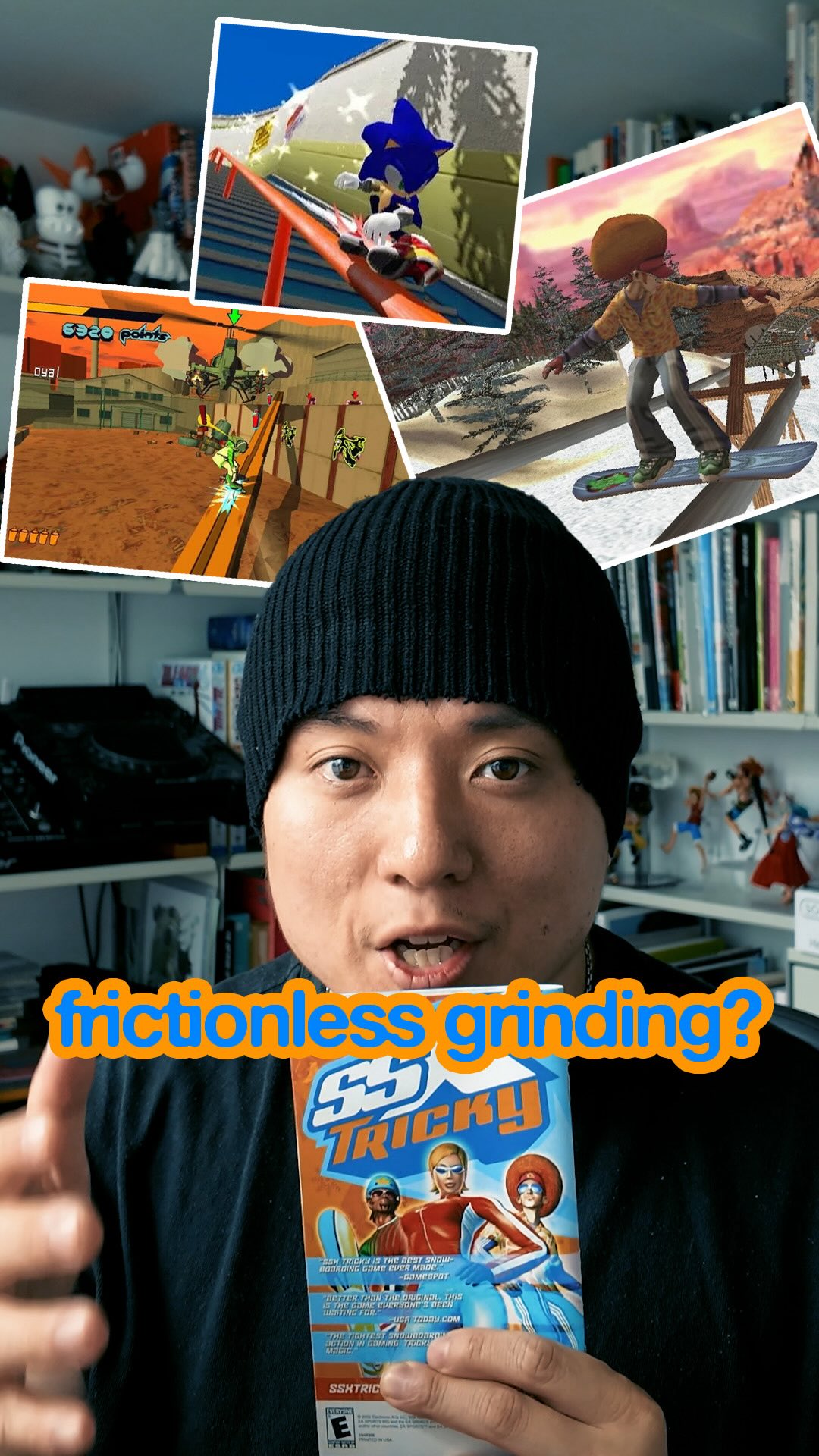
The creator poses the question of why 2000s video games were obsessed with the 'grinding' mechanic. He then explains this trend by linking it to the rise of extreme sports culture, citing influential titles like Tony Hawk's Pro Skater and SSX Tricky. He showcases gameplay from various non-sports games that adopted the mechanic, such as Sonic Adventure 2, Sly Cooper, and Ratchet & Clank, and concludes by explaining the technological advancements, like procedural splines, that made implementing these fast-paced, physics-defying pathways easier for developers.
Post caption
THE 2000s INTRODUCED FRICTIONLESS GRINDING ON RAILS, CABLES AND BUILDINGS AND WAS A DEFINING MECHANIC IN SO MANY GAMES I LOVE • BUT UNDENIABLY IT’S JUST SUCH A FUN GAME MECHANIC 🏄🛹⛸️ WHAT WAS YOUR FAV GRINDING GAME? #2000s #SONICADVENTURE #JETSETRADIO #BOMBRUSHCYBERFUNK #DENSHATTACK
Transcript
Why did games from the two thousands have an obsession with grinding? As real time rendering started to evolve, sixth generation games had a broad adaptation of grinding on rails and other parts of the environment. Pipelines, ledges, power cables, tracks and they usually made you go really fast. The rise in extreme sports culture and massive titles like Tony Hawk's Pro Skater obviously contributed to these things rank come on who could forget SSX Tricky? But this trope expanded even beyond games. We had Jet Set Radio, Sonic Adventure two, Sly Cooper, Ratchet and Clank. The mechanic allowed players to bypass the physics like gravity and friction. This transformation of arbitrary urban landscapes into kinetic pathways procedural splines. Calculating friction, edge detection, all of these things started to become more simplified and easier to calculate on the fly. Rails also offered a fixed pathway for camera angles, especially