Viral Hooks
Trending short videosWhite House gutted and rebuilt
A

@arch_xray

Instagram · Faceless
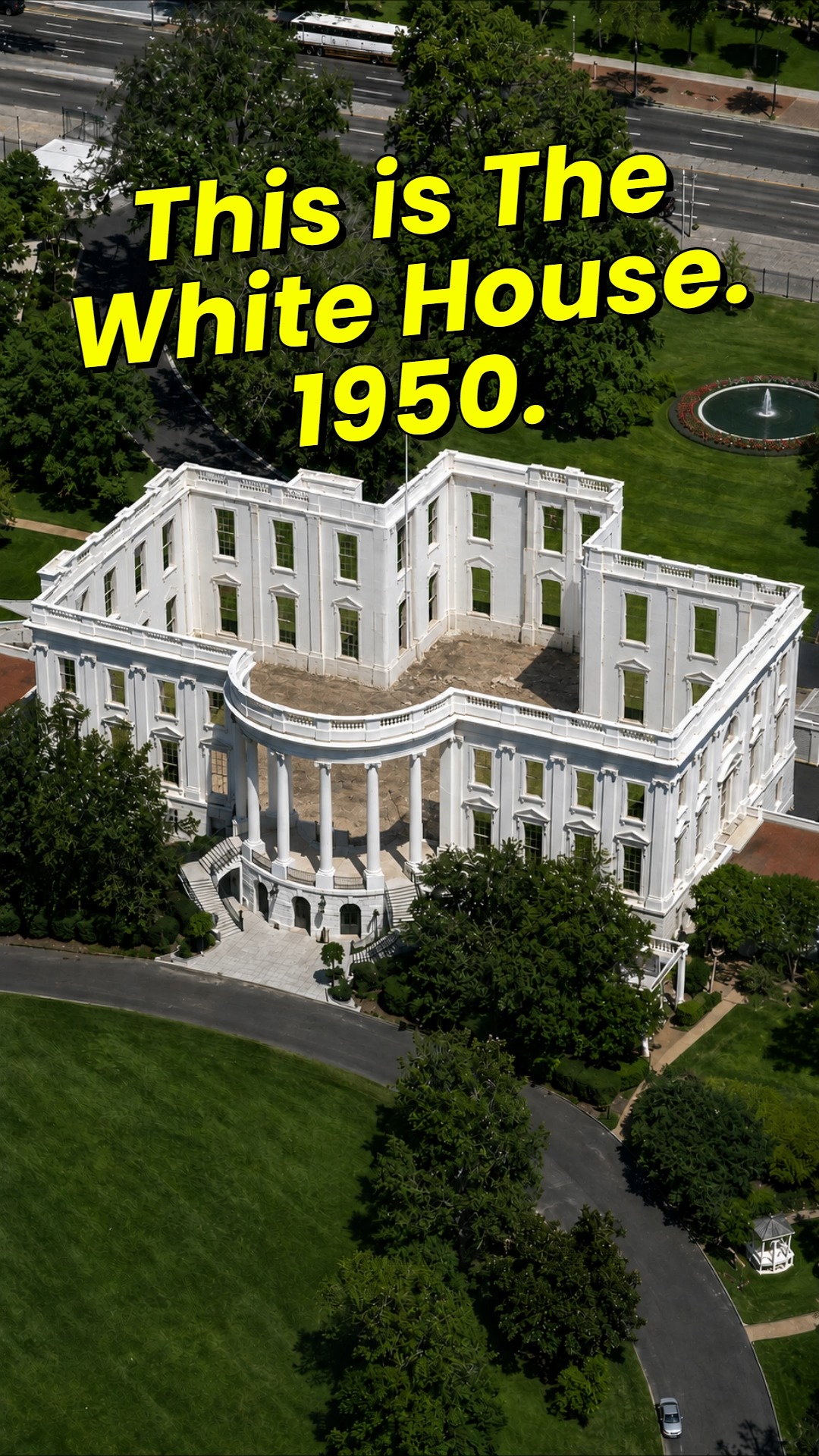
@arch_xray In 1948, President Harry Truman's daughter Margaret was playing the piano on the second floor of the White House when one of the legs went through the floorboards, bringing plaster down on the room below. Engineers investigated and found the timber beams beneath had rotted through. Parts of the interior were being held up with wooden props. One assessment famously described the building as standing "only from force of habit," and the residence was ruled unfit to be lived in. The Truman family moved across the street to Blair House for more than three years. Between 1949 and 1952, the entire interior of the White House was carefully taken apart — every floor, room and staircase removed — leaving only the four original exterior sandstone walls standing. A modern steel frame was then constructed inside that historic shell, with 660 tons of steel, 126 reinforced concrete columns and two new basement levels added below. Congress approved $5.4 million for the work, roughly $60 million in today's money. Only the outer walls of the White House are original. From the outside, you would never know. #whitehouse #history #architecture #engineering #truman #1950s #restoration #washingtondc #construction #historicpreservation #shorts #xray
View original on Instagram

The edit1 shot · 1 text
Shots Text0:52

Performance

Views
1.4M
Likes
16.2K
Comments
692
Engagement
1.2%
Length · 21 Aug 2026
0:52

Video #48866 · Faceless

White House gutted and rebuiltfrom @arch_xray

[01]

Overview

The creator narrates the story of the White House's near-collapse in the late 1940s, starting with the incident of a piano leg falling through the floor. They use animated graphics and historical images to explain how engineers discovered the building was structurally unsound, leading to a complete gutting of the interior. The video then details the massive reconstruction project, where a modern steel frame was built inside the original exterior walls, and concludes by noting this hidden history is invisible from the outside.

[02]

Simple outline

  1. 1Present shocking anomaly
  2. 2Reveal the hidden crisis
  3. 3Detail the extreme solution
  4. 4Show the invisible restoration

[03]

Related videos

[04]

Classification

Format
Concepts
Strange but TrueBreakdownOrigin Story
Elements
Motion GraphicsVoiceoverDynamic Word-by-Word CaptionsTitle Text HookText Overlay

[05]

Hook analysis

What stops the scroll in the first 3 seconds

Title hook

This is The White House. 1950.

Verbal hook

This is the White House with nothing inside it.

Visual hook

An aerial shot of the White House completely hollowed out, with no roof or interior floors, creating an immediate sense of mystery and surprise.

[07]

Hook and payoff

The promise the opener makes, and how the video pays it back

Hook

Present a visually and conceptually jarring image or fact about a well-known subject that defies expectations, creating an immediate 'how is this possible?' question.

Payoff

Reveal the subject in its final, restored state, emphasizing that the massive internal change is completely invisible from the outside. This delivers a satisfying 'hidden in plain sight' conclusion that makes the viewer feel like an insider.

[08]

Narrative framework

The structural pattern this video runs on

Framework

The Hidden History Blueprint

Reveal a shocking, unknown story about a familiar subject by showing its deconstruction and subsequent invisible restoration, making the audience feel like they've learned a secret.

  1. 1

    The Catalyst Incident

    Narrate a small, relatable event that served as the trigger for uncovering a much larger, hidden problem. This grounds the grand narrative in a human-scale experience.

  2. 2

    The Critical Diagnosis

    Reveal the true, catastrophic scale of the underlying problem, using expert testimony or dramatic quotes to establish high stakes and the necessity for drastic action.

  3. 3

    The Total Deconstruction

    Describe and visualize the process of completely dismantling the subject's interior or core components, emphasizing the totality of the destruction to set the stage for rebirth.

  4. 4

    The Modern Reconstruction

    Shift the narrative from destruction to creation. Detail the process of rebuilding the subject with new, superior technology or materials, using quantifiable data (e.g., tons, cost, numbers) to showcase the scale and ingenuity of the solution.

Themes

  • Hidden history
  • Preservation
  • Engineering marvels

Techniques

  • Voiceover
  • Motion graphics
  • Historical storytelling

Trends

  • Explainer videos
  • Strange but true facts

Post caption

In 1948, President Harry Truman's daughter Margaret was playing the piano on the second floor of the White House when one of the legs went through the floorboards, bringing plaster down on the room below. Engineers investigated and found the timber beams beneath had rotted through. Parts of the interior were being held up with wooden props. One assessment famously described the building as standing "only from force of habit," and the residence was ruled unfit to be lived in. The Truman family moved across the street to Blair House for more than three years. Between 1949 and 1952, the entire interior of the White House was carefully taken apart — every floor, room and staircase removed — leaving only the four original exterior sandstone walls standing. A modern steel frame was then constructed inside that historic shell, with 660 tons of steel, 126 reinforced concrete columns and two new basement levels added below. Congress approved $5.4 million for the work, roughly $60 million in today's money. Only the outer walls of the White House are original. From the outside, you would never know. #whitehouse #history #architecture #engineering #truman #1950s #restoration #washingtondc #construction #historicpreservation #shorts #xray
Text overlays

  • title · beginning

    This is The White House. 1950.

Transcript

This is the White House with nothing inside it. No floors. No rooms. And this really happened. In 1948, President Harry Truman's daughter was playing the piano upstairs when one of the legs went straight through the floor and the plaster came down on the dining room below. Engineers pulled up the boards. The beams underneath had rotted through. Parts of the building were being held up by wooden props. One engineer said the place was standing only out of habit, and it was declared unsafe to live in. So they moved the president out across the street for more than three years and demolished the entire inside. Bulldozers drove around within the walls. Everything best. Every floor, every room, every staircase. All they kept were the four outer walls. Then they built a modern steel building inside the old shell. 600 tons of steel, a 126 concrete columns, and two new basements dug underneath. It cost $5,500,000, around 60,000,000 today, and you would never know.

White House gutted and rebuilt | Viral Hooks