@jabarisandifer The key to any look is a bit of imperfection. You’ve heard it discussed in various ways with patina or unnatural washes, but it adds that little something you can’t explain.
I grew up on Nikes and Jordans and wanted to keep them clean by any means because it’s part of the culture around them. But when it comes to vans, chucks, and leather I want it to be a bit more worn in. Dressing up everything with a dirty sneaker is cool, to me.
Let me know in the comments if you like your sneakers prestine or with a little wear.
Explaining a fashion theory with examplesfrom @jabarisandifer
[01]
Overview
The creator explains his 'Dirty Shoe Theory,' arguing that stylish people embrace worn-in, imperfect footwear. He supports this claim with photographic examples of celebrities like Denzel Washington, Keanu Reeves, and Kurt Cobain, and connects it to the psychological 'Pratfall effect.' He then provides guidance on which types of shoes look good worn-in, notes how brands like Margiela and Golden Goose have commercialized this look, and concludes by encouraging viewers to wear their clothes without being overly precious.
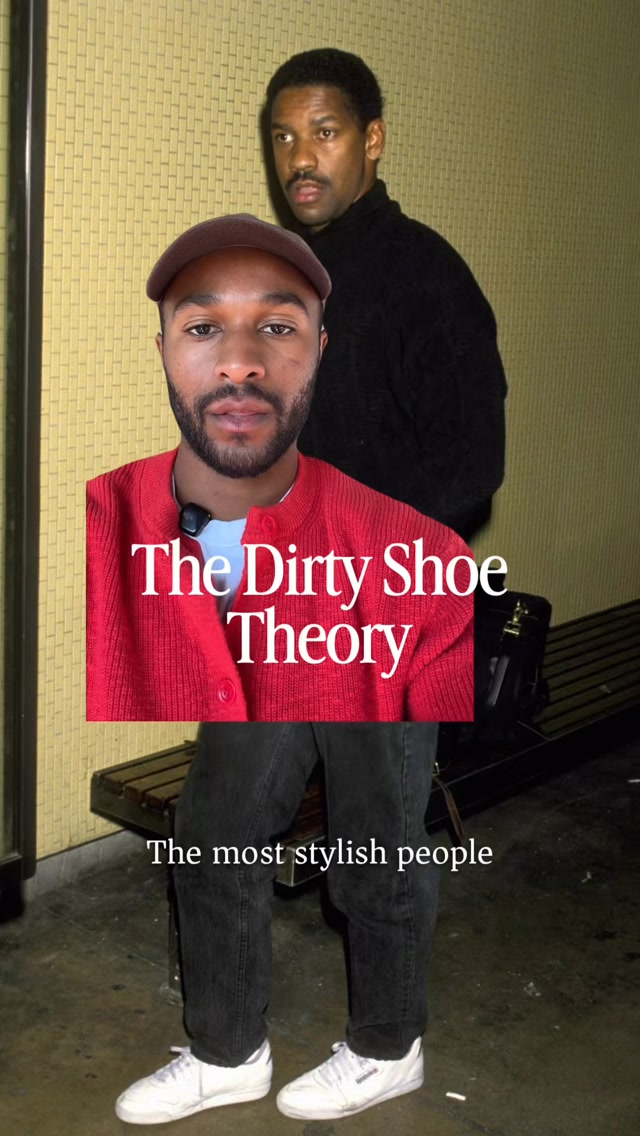
The most stylish people I know don't care if their shoes get a little dirty.
Visual hook · 10%
The video opens with a picture-in-picture composition, showing the creator's face in an inset box overlaid on a full-screen, vintage-style photograph of Denzel Washington. This layered visual structure immediately signals an analytical or commentary-based format.
[06]
Hook template
Steal this for your own video
The most [positive trait][audience type] I know don't care if their [prized possession] get a little [imperfection].
— The most respected chefs I know don't care if their knives get a little chipped.
— The most successful founders I know don't care if their first drafts get a little messy.
— The most skilled gardeners I know don't care if their hands get a little dirty.
[07]
Hook and payoff
The promise the opener makes, and how the video pays it back
Hook
A bold, counter-intuitive statement that challenges a popular belief within a specific niche, immediately capturing attention.
Payoff
The Liberating Philosophy
[08]
Narrative framework
The structural pattern this video runs on
Framework
The Counter-Intuitive Authority
To establish authority by presenting a non-obvious thesis, validating it with aspirational examples and intellectual reasoning, defining its specific applications and limitations, and finally elevating it into a broader life philosophy.
1
The Aspirational Gauntlet
Rapidly showcase a series of universally respected and iconic figures or examples that embody the contrarian thesis, immediately lending it credibility through association.
2
The Intellectual Justification
Introduce an academic, scientific, or psychological principle to provide a logical, high-minded framework that explains *why* the thesis works, elevating it from mere opinion to an insightful observation.
3
The Boundary Setting
Explicitly state the exceptions and limitations of the rule. This builds trust and authority by demonstrating nuanced understanding rather than making a simplistic blanket statement.
4
The Practical Toolkit
Provide a concrete list of 'approved' items or methods for applying the thesis, making the abstract concept actionable for the viewer.
5
The Commercial Proof
Demonstrate how established brands or institutions have already commercialized this exact concept, proving its cultural and market relevance.
Themes
Authenticity in style
Imperfection as a style element
The psychology of fashion
Wearing your clothes vs. preserving them
Techniques
Picture-in-picture
Visual essay
Use of celebrity examples
Trends
Distressed clothing
Vintage aesthetic
Post caption
The key to any look is a bit of imperfection. You’ve heard it discussed in various ways with patina or unnatural washes, but it adds that little something you can’t explain.
I grew up on Nikes and Jordans and wanted to keep them clean by any means because it’s part of the culture around them. But when it comes to vans, chucks, and leather I want it to be a bit more worn in. Dressing up everything with a dirty sneaker is cool, to me.
Let me know in the comments if you like your sneakers prestine or with a little wear.
Text overlays
title · beginning
The Dirty Shoe Theory
call-to-action · end
Follow for more
Transcript
The most stylish people I know don't care if their shoes get a little dirty. Keanu Reeves would show up to press with the suit and dirty better. Bob Marley wore his sneakers into the ground. And of course Kurt Cobain loved a pair of cooked Jack Purcells. And they all still looked incredible. There's actually a psychological reason for that called the Prattfall fact. We trust things more when they show small imperfection. Now I'm not talking about Tier Force Ones because those look terrible cooked. Better a pair of canvas sneakers, light Chucks or Vans, of worse, a great pair of beat up leather loafers, boots, even a pair of old Jordan Ones. Do you guys remember when we were doing this? Right? There's something about a super clean look with a pair of dirty or worn in shoes that make it much more interesting. And as we know, brands have been doing this to their own product for decades. Margiela with their cracked tabbies that have been a staple in the brand for years. Love them or hate them, Golden Goose has been doing this for a long time as well. I think the idea here is to stop treating everything so precious that we wear. Don't be afraid to wear your stuff and wear it hard because if it's made well it will only get better and it looks cool. Let me know what you guys think about this in the comments and thanks for watching.
Explaining a fashion theory with examples | Viral Hooks