@nealkshah Losing your sense of smell in your 60s or 70s may predict your risk of dying within five years better than a cancer or heart failure diagnosis.
That sounds extreme, but it comes from a landmark study of 3,000 older adults, and it points to something few people realize: your nose may be an early warning system for your brain. Here’s the fascinating science. Your smell nerves connect almost directly to the memory centers of your brain, so when those regions take early damage, your sense of smell often fades long before you start forgetting names. Even more striking, some researchers now believe Alzheimer’s may actually start in the nose. At the roof of your nasal cavity sits a thin, sieve-like bone where smell nerves dangle into the open air with no blood-brain barrier to protect them, giving pollution, soot, and bacteria a potential direct path toward your memory circuits.
One crucial reassurance: a fading sense of smell is an early vital sign to raise with your doctor, not an instant dementia diagnosis, and smell nerves are among the few that can actually regenerate. To protect yourself: get smell changes checked, treat chronic sinus issues, use saline rinses, and run a HEPA air purifier in your bedroom.
Have you noticed any changes in your sense of smell?
#BrainHealth #Dementia #OlfactoryHealth
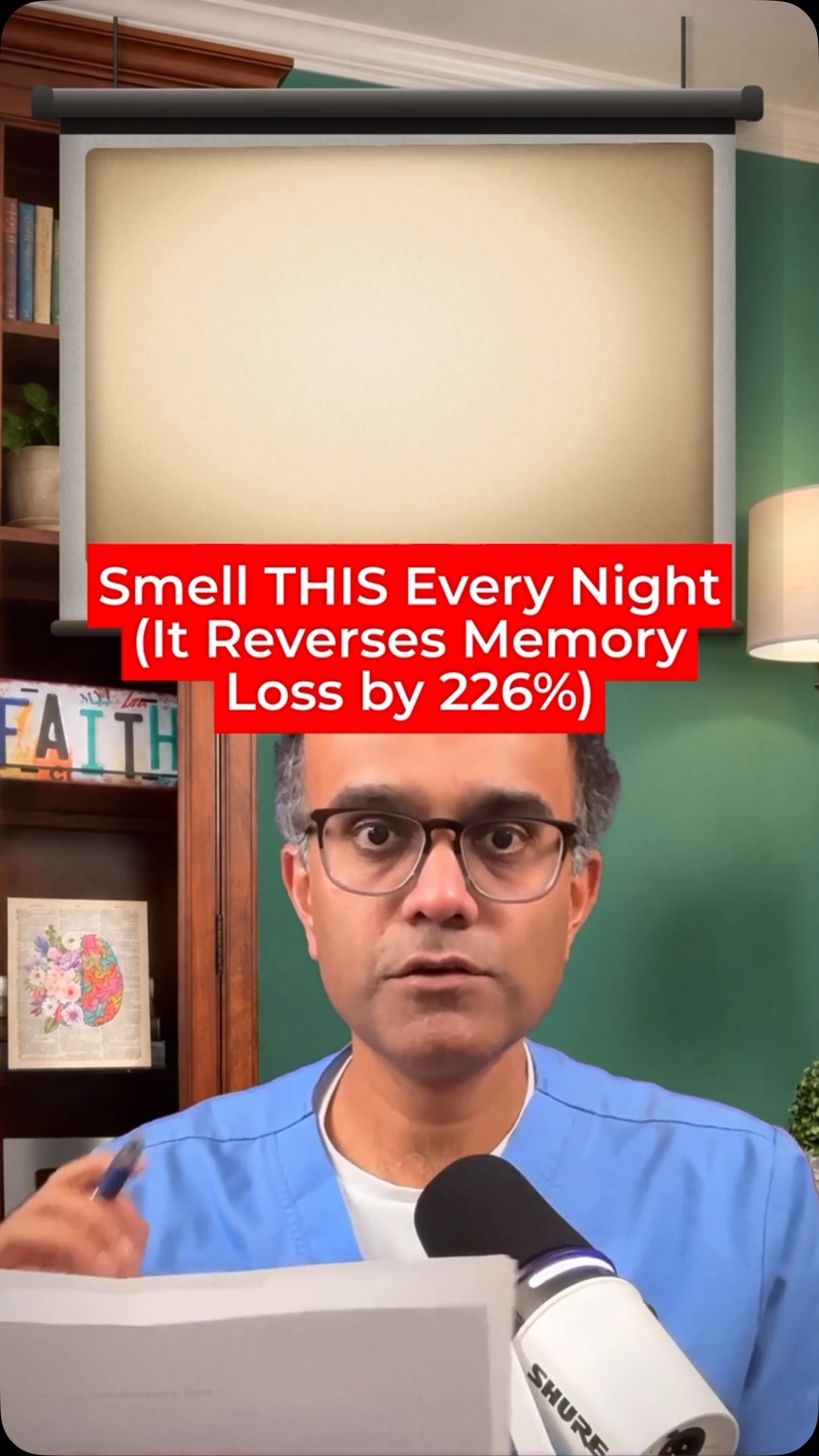
The creator, a medical professional, explains a scientific theory that Alzheimer's disease may originate in the nasal cavity. He begins with a startling statistic linking loss of smell to mortality, then uses animated diagrams on a screen behind him to illustrate how the olfactory nerves provide a direct pathway for toxins and bacteria to enter the brain. He concludes by outlining the topics he will cover in the full video, including the science, what smell reveals about brain health, and protective steps.
Smell THIS Every Night (It Reverses Memory Loss by 226%)
Verbal hook
Losing your sense of smell in your sixties or seventies is a stronger predictor of whether you'll die within five years than even a diagnosis of cancer, lung disease, or heart failure.
Visual hook
A speaker in medical scrubs stands in front of a large projection screen displaying an animated graphic of a red ball moving along a numbered timeline, creating immediate visual interest and a pattern interrupt from a standard talking head shot.
[07]
Hook and payoff
The promise the opener makes, and how the video pays it back
Hook
Present a counterintuitive statistic or claim that links a seemingly benign observation to a severe consequence, creating an immediate knowledge gap and sense of urgency.
Payoff
Explicitly state the value proposition for the remainder of the content. Promise to deliver a deeper scientific breakdown, diagnostic insights, and simple, actionable steps the viewer can take to mitigate the threat and regain control.
[08]
Narrative framework
The structural pattern this video runs on
Framework
The Hidden Threat Blueprint
To reveal a surprising and alarming connection between a common, overlooked symptom and a serious, feared outcome, then explain the hidden mechanism and promise a path to protection.
1
The Mortality Predictor
State a bold, data-backed claim that positions a common symptom as a more powerful predictor of a negative outcome than widely accepted major threats.
2
The Paradigm Shift
Escalate the threat by reframing the problem around a more specific, highly feared condition, and reveal that the origin of this condition is not where people assume it is.
3
The Fortress Breach
Provide a simplified, visual explanation of the biological or mechanical vulnerability that allows the threat to bypass the system's primary defenses.
4
The Trojan Horse Invasion
Identify the common, everyday external agents (e.g., environmental factors, substances) that exploit this vulnerability, showing how they directly cause the feared outcome.
Themes
Preventative health
Medical science
Aging
Neuroscience
Techniques
Expert authority
Data visualization
Pattern interrupt
Post caption
Losing your sense of smell in your 60s or 70s may predict your risk of dying within five years better than a cancer or heart failure diagnosis.
That sounds extreme, but it comes from a landmark study of 3,000 older adults, and it points to something few people realize: your nose may be an early warning system for your brain. Here’s the fascinating science. Your smell nerves connect almost directly to the memory centers of your brain, so when those regions take early damage, your sense of smell often fades long before you start forgetting names. Even more striking, some researchers now believe Alzheimer’s may actually start in the nose. At the roof of your nasal cavity sits a thin, sieve-like bone where smell nerves dangle into the open air with no blood-brain barrier to protect them, giving pollution, soot, and bacteria a potential direct path toward your memory circuits.
One crucial reassurance: a fading sense of smell is an early vital sign to raise with your doctor, not an instant dementia diagnosis, and smell nerves are among the few that can actually regenerate. To protect yourself: get smell changes checked, treat chronic sinus issues, use saline rinses, and run a HEPA air purifier in your bedroom.
Have you noticed any changes in your sense of smell?
#BrainHealth #Dementia #OlfactoryHealth
Text overlays
title · beginning
Smell THIS Every Night (It Reverses Memory Loss by 226%)
informational · beginning
5 years
contextual · beginning
Cancer
contextual · beginning
Emphysema/COPD
contextual · beginning
Heart Failure
title · end
Alzheimer's Might Start in YOUR NOSE
Transcript
Losing your sense of smell in your sixties or seventies is a stronger predictor of whether you'll die within five years than even a diagnosis of cancer, lung disease, or heart failure. Think about that. Even more alarming, top neuroscientists and biologists now believe that Alzheimer's disease doesn't start deep inside your brain at all. It starts right inside your nose. While your skull protects your brain like an armored fortress, there's a hidden bone riddled with tiny holes right between your eyes where bare nerve endings dangle straight into the open air. Microscopic particles of vehicle exhaust, you know, dust, toxic dust in everyday life, and airborne bacteria yes this exact doorway to climb straight into your memory better, triggering the sticky plaques that are linked to Alzheimer's and dementia. And there's really stunning new research report out on this. In this video, I'm gonna break down the science on how Alzheimer's may actually start in the nasal cavity, what your sense of smell reveals about your brain health, and the simple steps that you can take today to protect