@davidkchoe
TikTok · Speaker address
@davidkchoe Anyone can do this

@davidkchoe
TikTok · Speaker address
@davidkchoe Anyone can do this
Performance
Video #15440 · Speaker address
[01]
The creator explains the neuroscience behind visualization based on the book 'Psycho-Cybernetics.' He debunks common misconceptions, introduces the concept of an internal 'creative mechanism' that is goal-oriented, warns that this mechanism can be oriented towards failure, and then explains how visualization provides a new, positive goal for this mechanism. He concludes by introducing a specific 'movie theater technique' for practicing this.
[02]
[03]
 363.1K13.3×Greenscreen guide to creative brainstorming@fakeplasticbrands · Tutorial / How To
 177.6K30.2×Explaining a monetization framework map@taavihaapala · Playbook
 146.8KSix steps to design life@gregsebell · Playbook
 171.8K2.4×Creator's Venn diagram framework for making the perfect video@briarcochran · Breakdown
 337.8K132.5×Creator explains six life-changing tips@sebell · Playbook
 322.6K1.9×Explaining the marketing rule of three@conversion.doc · Breakdown
 3.1M18×Breaking down why a viral video worked using pattern interrupt psychology@official_pixolite · Breakdown
 254.5K9.8×Explaining a creative thinking framework@fakeplasticbrands · Breakdown
 2.7MAnimated graphics explain business systems@matthgray · Motivational Mantra
 349.5K4.8×Creator debunks quick tips with 5 psychology-backed content strategies@briarcochran · Breakdown
 261.3K5×Explains unethical psychological manipulation tricks@wendylikestostudy · Rapid Fire Listicle
 509.9K19×Explains research skill for creatives@fakeplasticbrands · Breakdown
[04]
[05]
What stops the scroll in the first 3 seconds
Title hook · 55%
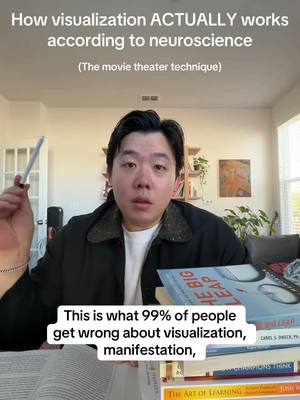
How visualization ACTUALLY works according to neuroscience (The movie theater technique)
Verbal hook · 40%
This is what ninety nine percent of people get wrong about visualization, manifestation, all of these ideas.
Visual hook · 5%
A speaker is positioned at a desk with a prominent stack of books, signaling expertise and an educational topic. He gestures with a pen, adding dynamic movement to an otherwise static shot.
[07]
The promise the opener makes, and how the video pays it back
Hook
The Contrarian Claim: State that a high percentage of people (e.g., 99%) fundamentally misunderstand a popular concept, creating an immediate knowledge gap and promising a clarifying revelation.
Payoff
The Analogical Proof: Solidify the entire argument with a universally relatable analogy (e.g., a nightmare feeling physically real) that demonstrates how an imagined experience can produce a real-world physical or emotional response, thereby proving the core premise.
[08]
The structural pattern this video runs on
Framework
The Scientific Reframe
To deconstruct a popular but misunderstood 'soft' concept, reframe it through a 'hard' scientific lens, explain its underlying mechanism, and provide a tactical technique to master it.
The Authoritative Reframe
Introduce a credible source (a specific book, study, or expert) to pivot the topic from a 'woo-woo' or abstract idea to a concrete, scientific one (e.g., neuroscience).
The Core Mechanism Reveal
Explain the central scientific principle behind the concept using a simple, powerful metaphor that makes it instantly understandable (e.g., 'a self-guiding engine' or 'a heat-seeking missile').
The Dichotomy of Application
Establish that the mechanism is neutral and can be directed toward either a positive (success) or negative (failure) outcome, depending on the 'goal' it's given.
The Default State Problem
Argue that most people unconsciously operate with a negative goal, causing the mechanism to work against them by default.
The Conscious Intervention
Position the specific technique (e.g., visualization) as the solution—the tool that allows one to consciously program the mechanism with a positive goal.
The Tactical Blueprint
Provide a clear, step-by-step, actionable guide on how to perform the technique, including specific parameters like duration and frequency.
The Neurological Justification
Explain *why* the technique works from a scientific perspective, adding another layer of credibility (e.g., 'it helps your brain create new memories').
Anyone can do this
title · beginning
How visualization ACTUALLY works according to neuroscience (The movie theater technique)
This is what ninety nine percent of people get wrong about visualization, manifestation, all of these ideas. I'm sure you've heard of these words, and I'm pretty sure you don't fully know what it means. I'm reading this good, Psycho Cybernetics, by doctor Maxwell Maltz, He he breaks down visualization and manifestation yes in terms of kind of the woo woo side of things. Right? Like, the spiritual only side. But he breaks it down in terms of neuroscience and why and how visualization actually works beyond it just being something spiritual people do. It works because within us, there's this idea of a creative mechanism. This is kind of like a self guiding engine. You can think of it as like a heat seeking missile. Right? There's this mechanism within us that drives us towards visions and goals we have for our lives. Whether or not we recognize it, whether or not we consciously do it, this is within us. And that mechanism is always goal oriented. The thing is the goal can be about failure as much as it can be about success. Most people live on autopilot with a goal around failure. They assume that their lives can amount to much. They assume that they're not gonna be successful. They don't deserve fame. Whatever it may be, that heat seeking missile goes towards their goal of failure even if they're not consciously wanting that. And so what visualization does is that it gives your mind, it gives this mechanism inside of you a good, a goal that you fully align with, that you can fully see, experience, touch, taste, smell no that your creative mechanism within you knows exactly what to look for when it's moving forward. No how do we actually do that? How do we come up with the picture, with the image, with the vision of the life we exactly want? And it's like anything else, guys. You have to practice it. And how do you practice it? I think this is where we get super tactical. In the book, he talks about a technique for visualization, and I think it's really interesting. He recommends doing this for thirty minutes every day for twenty one days. That's kind of like the prescription in the good. But I think any amount of time will actually help and build up. And so what he says is do this. Sit down, get relaxed, be somewhere where you won't be disturbed, and then close your eyes and imagine yourself in a movie theater. You're sitting in the movie better. Maybe no one else is there. You're looking at the big screen. And then in the big screen in the movie theater, you start to see the life, the goals, the vision, the things, the people that you worst, and you start to play the picture, the the movie in your mind. And what this is doing from a neuroscience perspective is helping your brain create new memories. No, obviously, memories are usually things that you've experienced that you see best into, But what you want to do is give your mind images of what it is you want. Right? That's why visualization works because, again, that mechanism is gonna go towards whatever goal you have. So the visualization is the practice of actually seeing in a really rich, specific, detailed way what it is you worst, and you have to give yourself time and space to do that. Like I said, a lot of people might think this is some spiritual nonsense or some good bullshit, but I'm convinced more and more every day that this is true, that this works. It's the same reason why you can have a nightmare, and physically, you wake up in a sweat or your heart is pounding. Was a nightmare real? No. But to your body, it felt real. Right? And this is kind of the same mechanism that visualization leverages to make what it is you want real in your life.