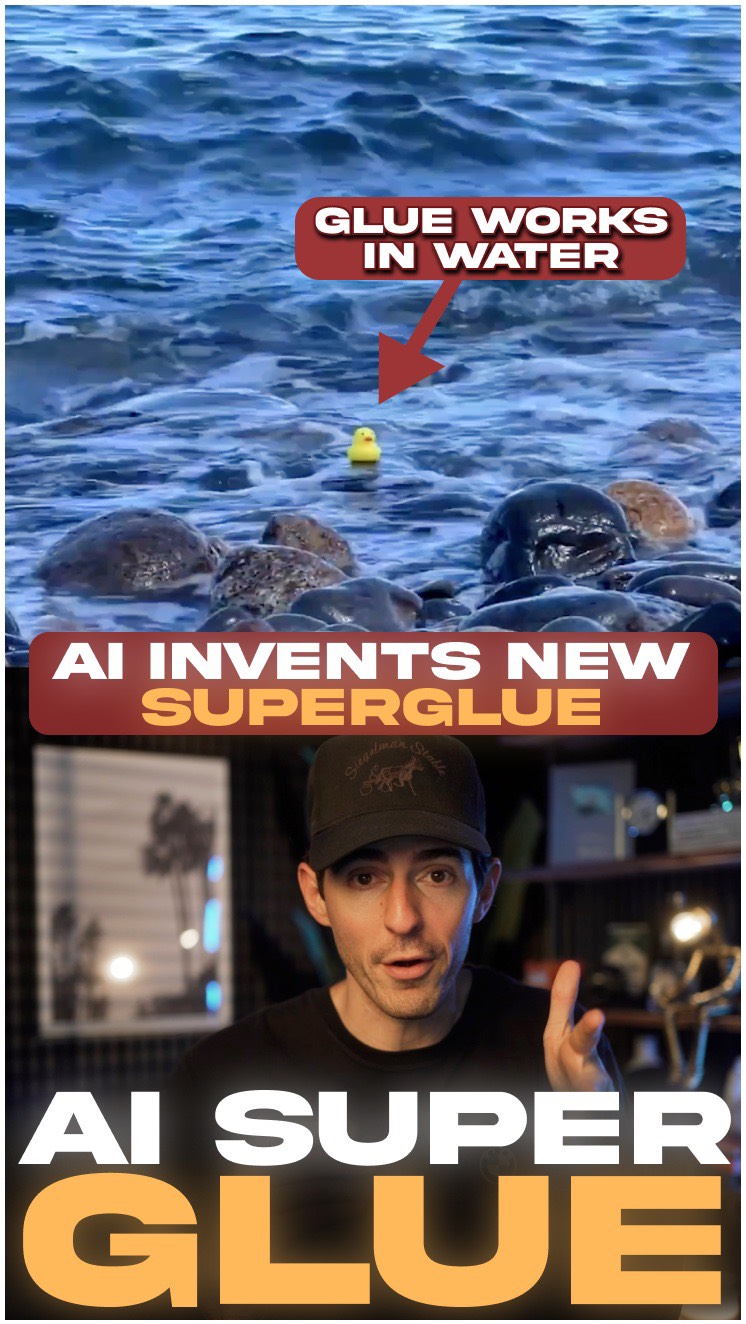
@kallaway Scientists just used AI to invent a new type of superglue.
And the process they used to invent this new material, might be the most valuable AI use case in the world.
Here’s how they did it.
First, scientists analyzed all sea creatures that are able to stick to things underwater.
Barnacles, mussels, starfish, they all have unique suction properties that work especially well in the ocean.
Now after studying these animals, scientists come up with their first set of hydrogel designs.
And they thought these were gonna be amazing.
But those weren’t even close to sticky enough.
So that’s where the AI came in.
Scientists gave their initial glue designs to an AI model and asked it to find new ways to make them even stickier.
And boom.
The AI came up with a brand new adhesive material that was stickier in water than anything humans have ever made.
Pretty wild.
This process is called AI material science, and it’s one of the most exciting areas in science right now.
Literally ChatGPT but for inventing new materials.
The superglue is one example, but think of how much could change with better materials.
We could make self-healing concrete, faster rockets.
We could even have phone batteries that could last months on a single charge.
Anything is possible with better materials.
And AI is going to make the process of inventing them so much easier.
Follow @kallaway for more videos like this
#ai #artificialintelligence #tech #technology #science #ocean #superglue #newtech #scientist #chatgpt
Explaining how AI invented supergluefrom @kallaway
[01]
Overview
The creator explains a recent scientific breakthrough where AI was used to invent a new superglue that works underwater. He details the process, starting with scientists studying sea creatures, their initial failed attempts, and how they then used an AI model to optimize the formula, before discussing the broader potential of AI in material science for creating things like self-healing concrete and better batteries.
The video opens with a visually distinct clip from the popular TV show 'Breaking Bad', which serves as a strong cultural reference and pattern interrupt.
[07]
Hook and payoff
The promise the opener makes, and how the video pays it back
Hook
Present a visually intriguing and counter-intuitive outcome that immediately begs the question 'How is that possible?'.
Payoff
Return to the opening visual/hook to provide a satisfying narrative loop, reinforcing the power and reality of the initial claim.
[08]
Narrative framework
The structural pattern this video runs on
Framework
The Breakthrough Blueprint
Demonstrating the power of a new technology by framing it as the solution to a seemingly impossible problem that human effort alone could not solve, then expanding its potential to world-changing scale.
1
The Bizarre Proof
Show a visually arresting demonstration that defies expectations and creates an immediate question.
2
The Stated Paradox
Explicitly state why the demonstration is impossible under normal circumstances, establishing a clear problem.
3
The Core Thesis
Reveal the new concept or technology that solves the paradox.
4
The Process Unveiling
Transition from the 'what' to the 'how' by promising an explanation of the process, securing viewer investment.
5
The Foundational Research (Human Effort)
Detail the initial, logical steps taken by humans to solve the problem, establishing a baseline of effort.
6
The Human Wall
Highlight the failure or limitation of the human-only approach, creating narrative conflict and raising the stakes.
7
The Technological Savior
Introduce the new technology as the hero that overcomes the human limitation.
8
The Breakthrough Climax
Show the dramatic success of the technology, resulting in a superior outcome that validates the thesis.
9
The Concept Definition
Name and define the underlying process or field to give it legitimacy and context.
10
The Relatable Analogy
Simplify the complex concept by comparing it to a widely understood existing technology or idea, making it accessible.
11
The Future Expansion
Broaden the scope from the specific example to its vast, world-changing potential applications, answering the 'so what?' question for the audience.
Themes
Innovation
Scientific Breakthrough
Artificial Intelligence
Techniques
Voiceover Narration
B-roll Integration
Trends
AI News
Explainer Content
Post caption
Scientists just used AI to invent a new type of superglue.
And the process they used to invent this new material, might be the most valuable AI use case in the world.
Here’s how they did it.
First, scientists analyzed all sea creatures that are able to stick to things underwater.
Barnacles, mussels, starfish, they all have unique suction properties that work especially well in the ocean.
Now after studying these animals, scientists come up with their first set of hydrogel designs.
And they thought these were gonna be amazing.
But those weren’t even close to sticky enough.
So that’s where the AI came in.
Scientists gave their initial glue designs to an AI model and asked it to find new ways to make them even stickier.
And boom.
The AI came up with a brand new adhesive material that was stickier in water than anything humans have ever made.
Pretty wild.
This process is called AI material science, and it’s one of the most exciting areas in science right now.
Literally ChatGPT but for inventing new materials.
The superglue is one example, but think of how much could change with better materials.
We could make self-healing concrete, faster rockets.
We could even have phone batteries that could last months on a single charge.
Anything is possible with better materials.
And AI is going to make the process of inventing them so much easier.
Follow @kallaway for more videos like this
#ai #artificialintelligence #tech #technology #science #ocean #superglue #newtech #scientist #chatgpt
Text overlays
title · beginning
AI INVENTS SUPERGLUE
Transcript
Scientists just made a massive AI breakthrough. You see that duck? It is now permanently stuck to that rock. But the weird part is normal glue doesn't work in the water. So how'd they get it to stick? It turns out scientists yes AI to invent a new type of superglue that actually works in the better. And the process they used to invent this new material might be the most valuable AI use case in the world. Here's how they did it. First, the scientists analyzed all sea creatures that are able to stick to things underwater. Barnacles, mussels, starfish, they all have unique suction properties that work especially well in the ocean. Now better studying these animals and the proteins in their cells, scientists came up with their first set of hydrogel designs, and they thought these were gonna be amazing. But it turns out they weren't even close to sticky enough. And that's where the AI comes in. The scientists gave their initial glue designs to an AI model and asked it to find ways to make them even stickier. And boom, the AI came up with a brand new adhesive material that was stickier in water than anything humans have ever invented. Pretty wild. This process is called AI material science, and it's one of the most exciting areas in science right now. It's literally chat Tier better for inventing new materials. The super glue is one example, but think of how much would change if we had better materials. We rank make self healing concrete, faster rockets. Good could even have foam batteries that could last months on a single charge. Anything is possible with better materials, and AI is gonna make the process of inventing them so much easier. By the way, that duck, it's gonna be stuck on that rock for decades. AI superglue is not messing around.
Explaining how AI invented superglue | Viral Hooks