@orenmeetsworld
Instagram · Talking Head Edit
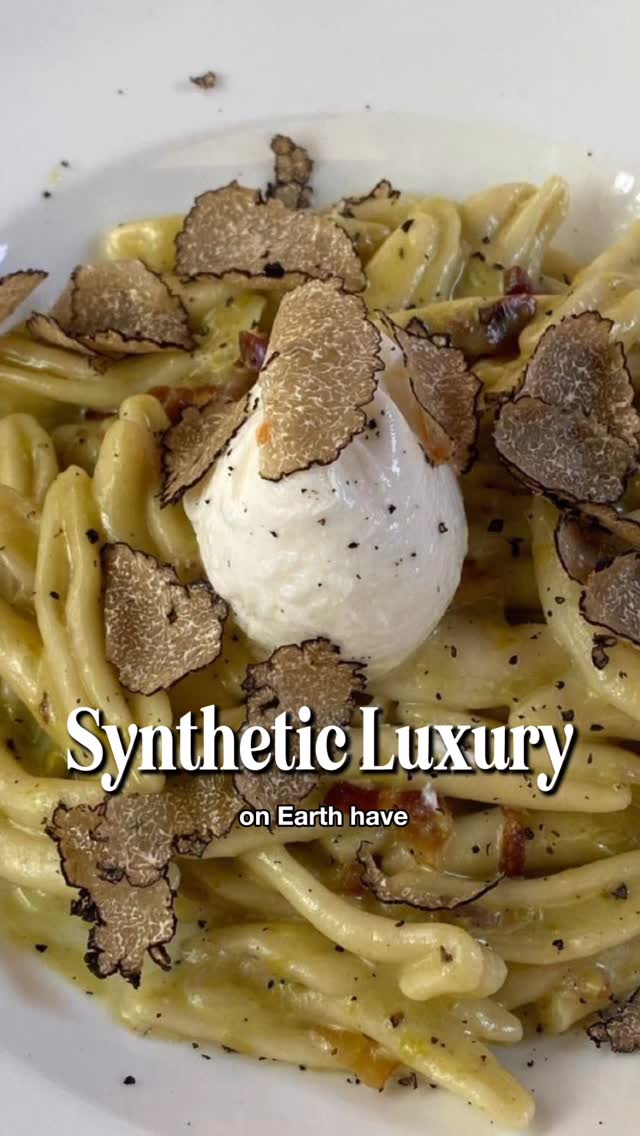
@orenmeetsworld When every luxury is a cheap or contrived copy, when do those copies become the real thing? Exploring our world of synthetic experiences, starting with truffles.

@orenmeetsworld
Instagram · Talking Head Edit
@orenmeetsworld When every luxury is a cheap or contrived copy, when do those copies become the real thing? Exploring our world of synthetic experiences, starting with truffles.
Performance
Video #18461 · Talking Head Edit
[01]
The creator explains the concept of "synthetic luxury" using truffle oil as a primary case study. He debunks the common perception of truffle flavor, revealing it's often a synthetic chemical, and connects this phenomenon to Jean Baudrillard's philosophical concept of the simulacrum, where the copy replaces and becomes more real than the original. He extends this pattern to other products like leather and wasabi, and discusses how lower-quality Chinese truffles are training consumer palates to prefer an inauthentic flavor profile.
[02]
[03]
 2.4M79.6×Exposing synthetic luxury goods breakdown@orenmeetsworld · Breakdown
 427.1KPhilosophical concept explains modern culture@orenmeetsworld · Opportunity Explainer
 531.8K1.8×Debunking viral claims that Chinese factories make luxury brand goods@orenmeetsworld · Breakdown
 2.6M630.8×Explaining brand strategy with luxury product@lukas.mullen · Case Study Breakdown
 331.4KExplaining the luxury status trap@orenmeetsworld · Cultural Rant
 321K1×Analysis of intellectualism as a trend@deathtostock · Breakdown
 912.6K16.1×Critiquing luxury brand marketing failures@orenmeetsworld · Breakdown
 305.5K107.3×Explaining a brand's success principles@davidkylechoe · Case Study Breakdown
 183.9K8.5×Explaining cultural term with product@thisisantwon · Breakdown
 302.7K11.1×Perfumer explains the four tiers of fragrance houses@teddy.haugen · Numbered Breakdown
 789.1K2.6×Men's fragrance brands rated product vs hype@orenmeetsworld · Rapid Fire Listicle
 383.8KExplaining value through historical dye@frontoffice.co · Breakdown
[04]
[05]
What stops the scroll in the first 3 seconds
Title hook · 35%
Synthetic Luxury
Verbal hook · 60%
Most people on earth have never actually tasted a real truffle, despite what the luxury industry would have you believe.
Visual hook · 5%
A direct-to-camera shot of a speaker is immediately followed by a quick cut to a high-quality, close-up shot of a pasta dish topped with shaved truffles and a poached egg.
[06]
Steal this for your own video
Most have never actually experienced a real , despite what would have you believe.
[07]
The promise the opener makes, and how the video pays it back
Hook
A bold, counter-intuitive statement that challenges a widely held belief or common experience, creating immediate intrigue and a knowledge gap the viewer wants filled.
Payoff
Concludes not with a simple summary, but with a profound, open-ended question about the cultural implications of the revealed pattern, redefining a core concept (like 'luxury') and leaving the viewer with a new, more sophisticated perspective.
[08]
The structural pattern this video runs on
Framework
The Synthetic Reality Blueprint
To deconstruct a commonly accepted 'authentic' experience, reveal its synthetic or lesser-quality substitute, and then use this revelation to introduce a broader cultural or philosophical concept that re-frames the viewer's understanding of reality.
The Aspirational Vignette
Creates a relatable, often desirable, scenario involving the subject to emotionally invest the viewer before the deconstruction begins.
The Technical Reveal
Systematically dismantles the initial scenario by exposing the hidden, often synthetic or inferior, mechanism behind the experience, providing the core 'aha' moment.
The Authority Stamp
Cites a respected expert or authority figure to validate the reveal, adding credibility and often a memorable, visceral analogy.
The Intellectual Framework
Elevates the specific example into a universal principle by introducing a named concept or theory (e.g., 'the simulacrum'), giving the viewer a new mental model.
The Pattern Proliferation
Rapidly applies the new framework to a series of other familiar examples, demonstrating its broad applicability and reinforcing the core argument.
The Economic Proof
Presents a current, real-world market or social example that proves the framework is not just theoretical but actively shaping the present.
When every luxury is a cheap or contrived copy, when do those copies become the real thing? Exploring our world of synthetic experiences, starting with truffles.
title · beginning
Synthetic Luxury
informational · middle
is 2,4-dithiapentane
informational · middle
what Baudrillard calls the simulacrum
contextual · middle
wasabi cashmere
informational · middle
Chinese black truffles
informational · end
third order of the simulacra
Worst people on earth have never actually tasted a real truffle, despite what the luxury industry would have you believe. Let me paint you a picture. You're at a restaurant in Tribeca. Not a Michelin star, but it was hard enough to get a yes. Your truffle fries arrive. The smell hits. It's pungent. Your date, looking splendid in a cult Gaia Nymeria gown, reacts, oh, truffle fries. And in that moment, you feel like you're consuming something premium. Something luxurious. Is this perhaps a white alba truffle from Italy? They're not. What you're smelling is 24, a synthetic chemical compound that's mixed into olive oil that mimics one of the dozens of aromatic compounds found in actual truffles. One note played on a loop at maximum volume. Anthony Bourdain, r I p to a real one, had a memorable comparison for what it resembles and it wasn't food. But here's why that matters beyond the plate. What happened to truffles is a perfect case for what Baudrillard calls the simulacrum. The idea that copies of things can replace the original so completely that we forget that original ever existed. Once you see this better, you start to see it everywhere. Leather, wasabi, cashmere, the word luxury itself. China is now a major truffle producer. Chinese black truffles are biologically similar to European paragord truffles, but they're harvested earlier and have significantly less developed flavor. They cost 1 fiftieth the price of their French counterparts, and the market for them is hundreds of millions of dollars. And they train consumers to associate the flavor truffle with a flavor profile that has very little to do with the real thing. Not to get too existential, but Bajalar would say that we've entered the third order of the simulacra. The copy doesn't just replace the original, it becomes more real than the original. If you served most people real authentic truffle after years of synthetic truffle oil, they'd be confused. They may even think the real thing was the fake one. And this is the pattern I want you to see because it's not just truffles. It's better, where the term genuine leather is actually the lowest commercial grade. It's the word artisanal on bread made in a factory. But what happens to a culture when the synthetic version of everything becomes the default? When we've been trained to prefer the copy? When restraint and subtlety tier things that take a decade to cultivate are replaced by something loud and immediate rank chemically engineered to feel like the real thing? Life becomes synthetic, and the luxury is having the time and connections to hunt down the real thing.