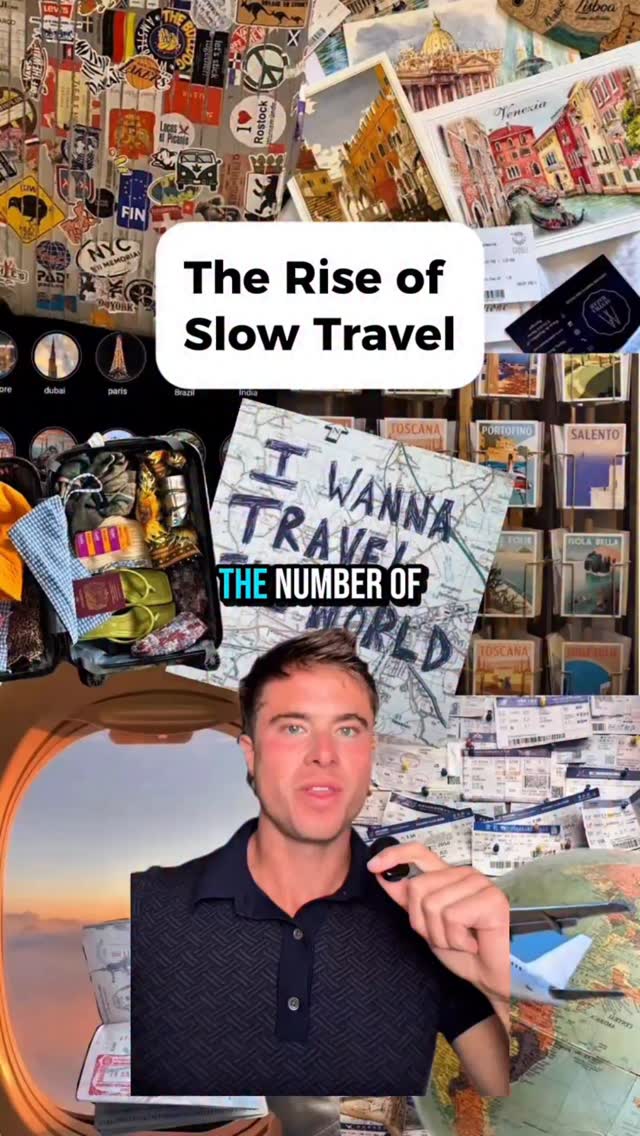
The speaker presents a cultural analysis on the rise of 'slow travel,' contrasting it with the previous era of fast-paced, image-focused tourism driven by efficiency culture. He defines slow travel as an immersive, authentic experience of living like a local, validates the trend with examples like Anthony Bourdain, and pivots to introduce his own travel series about finding the best oysters in America, asking viewers to follow along.
Post caption
When I graduated college in 2015 (yes, I realize that makes me an unc), I hit 13 cities in 45 days across Europe. Eurail pass, hostel bookings, the list.Btw, do not order the tuna salad sandwich in Amsterdam.
Today we spend 6-8 weeks every winter in South Florida. Same neighborhoods, same fish market, same cafe con leche from a harborside cantina.
Remote work and a little financial stability make that easier, sure. But there’s something bigger happening that has nothing to do with either of those things.
People are done performing their trips.
There’s a reason @huckberry Dirt series has millions of views and a cult like following. Likewise, there’s a reason Anthony Bourdain content is still being discovered and shared a decade later.
Transcript
The number of stamps on your passport is no longer a flex. Let's talk about the rise of slow travel. For years, travel fit neatly into the Internet economy. The model worked for a while because the image was still the aspiration. People wanted that photo outside domes in Santorini or the Bali swing that they paid $20 to sit on. If the image signaled taste, freedom, or motion, it did its job. Itineraries were rushed and people saw a lot by seeing very little. But slow travel is different. It's all about immersing yourself into a culture and living more like a local than a tourist with a rushed itinerary. Instead of sprinting through five cities in one week, people are staying several weeks or even months in the same place. Long enough to develop routines, have their go to spots, and even befriend the locals. Part of the appeal is that it pushes back against efficiency culture. For a long tier, the ideal trip looked more like a conquest. Tier stops, more countries, more reservations, more output, more proof that you squeezed maximum value into your time off. But that mentality feels dangerously close to the rest of modern productivity culture. People already live like that at work. They do not want to vacation like the middle managers of their own leisure. The rise of this popular series Dirt by Huckberry with its obvious Anthony Bourdain DNA comes as no surprise. Food is the perfect vehicle for this shift because provenance gives people a way back into reality. Once you start caring where the oyster came from, who grew the citrus, or which dock the fish came in on that morning, you've ingratiated yourself the way only a local can. And that feels different because it is different. It requires curiosity, time, attention, and even humility. It gives people the feeling they touched something real before it was produced for mass consumption. If this resonates, follow along. We're going coast to coast to find the best oyster in America and putting it on your table. We're telling the whole story and bringing you with us. See you there.