@glass__museum
TikTok · Yap
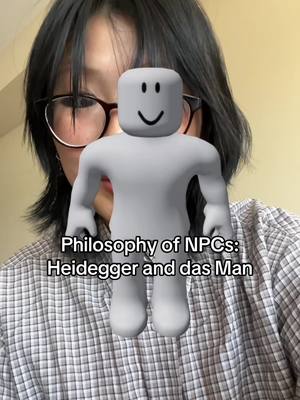
@glass__museum On why everyone you meet feels like an NPC—because they kinda are #philosophy #existentialism #NPC #CapCut

@glass__museum
TikTok · Yap
@glass__museum On why everyone you meet feels like an NPC—because they kinda are #philosophy #existentialism #NPC #CapCut
Performance
Video #10789 · Yap
[01]
The creator explains Martin Heidegger's philosophical concept of 'das Man' by comparing it to the modern slang term 'NPC'. They break down the definition of inauthentic existence, provide examples of conformity in modern life like music streaming and suburban housing, and challenge the viewer to embrace the anxiety of authentic freedom.
[02]
[03]
 558K104.5×Philosophical monologue over illustrative photos@iamfieldnotes · Motivational Mantra
 221.4K288.6×Philosopher's warning about modern identity@glass__museum · Breakdown
 310.2KDeconstructs the simple life fantasy@orenmeetsworld · Breakdown
 1.8M233.5×Controversial outdoor opinion monologue@holistic.grenade · Hot Take
 687.7KAnalyzing the performative male aesthetic@eugbrandstrat · Breakdown
 874K12.9×Mock TED talk on self-importance@thatzonaguy · Hot Take
 8MResearches and explains random topic@bitterbuilds · Challenge
 694.1K26.9×Explaining Thoreau's technology critique@var.aunevik · Anecdotal Philosophy
 1.1M19.4×Explaining gendered internet algorithm experiences@orenmeetsworld · Breakdown
 286.4K5.9×Literary quote applied to AI@var.aunevik · Anecdotal Philosophy
 163.3K7.8×Philosophical travel vlog about identity@j.g.fall · Vulnerable Monologue
 322.6K1.9×Explaining surveillance state via pop culture@pleasedontmakemefocus · Breakdown
[04]
[05]
What stops the scroll in the first 3 seconds
Title hook · 45%
Philosophy of NPCs: Heidegger and das Man
Verbal hook · 50%
Heidegger was calling people NPCs way before Gen Z slang made it a thing.
Visual hook · 5%
Speaker talking directly to camera with a prominent text overlay and likely a green screen background establishing the academic yet modern tone.
[06]
Steal this for your own video
was describing long before ever existed.
[07]
The promise the opener makes, and how the video pays it back
Hook
The Prestige Anchor: Immediately validates a low-brow internet term by attributing its origin to a high-brow historical figure.
Payoff
The Ironic Verdict: A final humorous observation that weighs the heavy philosophical cost of freedom against a trivial cultural consequence.
[08]
The structural pattern this video runs on
Framework
The High-Low Concept Bridge
Validating a modern viral trend by anchoring it to a prestigious historical or academic concept, then turning it into a personal challenge for the viewer.
The Theory Unpack
Briefly defines the complex academic concept using accessible language and visual aids (green screen text).
The Authority Citation
Reads a direct quote from the source material to establish credibility and prove the connection is legitimate.
The Modern Synthesis
Explicitly maps the academic definition onto the modern slang, showing they describe the exact same phenomenon.
The Mirror Check
Uses hyper-specific, trendy examples to interrogate the viewer's own choices, forcing them to question if they are the subject of the critique.
The Safety Trap
Explains the psychological reason why people conform, using a universally relatable modern metaphor (e.g., algorithm recommendations).
On why everyone you meet feels like an NPC—because they kinda are #philosophy #existentialism #NPC #CapCut
title · beginning
Philosophy of NPCs: Heidegger and das Man
informational · beginning
das Man
informational · beginning
Heidegger
informational · beginning
MARTIN HEIDEGGER BEING AND TIME
contextual · middle
Propaganda I am not falling for: Labubu
contextual · end
Never letting spotify create a playlist name again
Heidegger was calling people NPCs way before Gen Z slang made it a thing. He called it Das Man or the they. In Being in Time, Heidegger explains that most of us live an inauthentic mode of existence where we run on best that we did not design and ignore our true selves. Instead of acting out of genuine choice, we act because that is simply what one does. Das Man It is not a distinct quantifiable identity, but rather an amorphous representation of society and its expectations. Heidegger writes, we take pleasure and enjoy ourselves as they take pleasure. We read, see, and judge about literature and art as they see and judge. The they, which is nothing definite, prescribes tier kind of being of everydayness. This everydayness is precisely what we mean when we call someone an MPC. Someone whose thoughts, values, and tastes aren't really their own, but echoes of the collective. In this mode, our individuality dissolves. We are not Dasein, beings capable of authentic selfhood, but rather interchangeable, standardized selves, Our identities reflecting rank internalization of our surrounding paradigms. Do you actually like the boo boos or is that just what Best Man tells you to like? Or on a realer note, do you actually want a house in the suburbs with two and a half kids or is that just the life of Das Man? For Heidegger, the challenge is to break free from Das Man. To To face the anxiety of freedom and take responsibility for your being. But most people retreat to conformity because that feels safer. Think of music streaming. Infinite choices, yet most people just play their auto generated day best. That is the comfort of Das Man. Letting the they decide what's good. But if listening to Best Boone is the result of that, then maybe the anxiety of freedom is worth it.