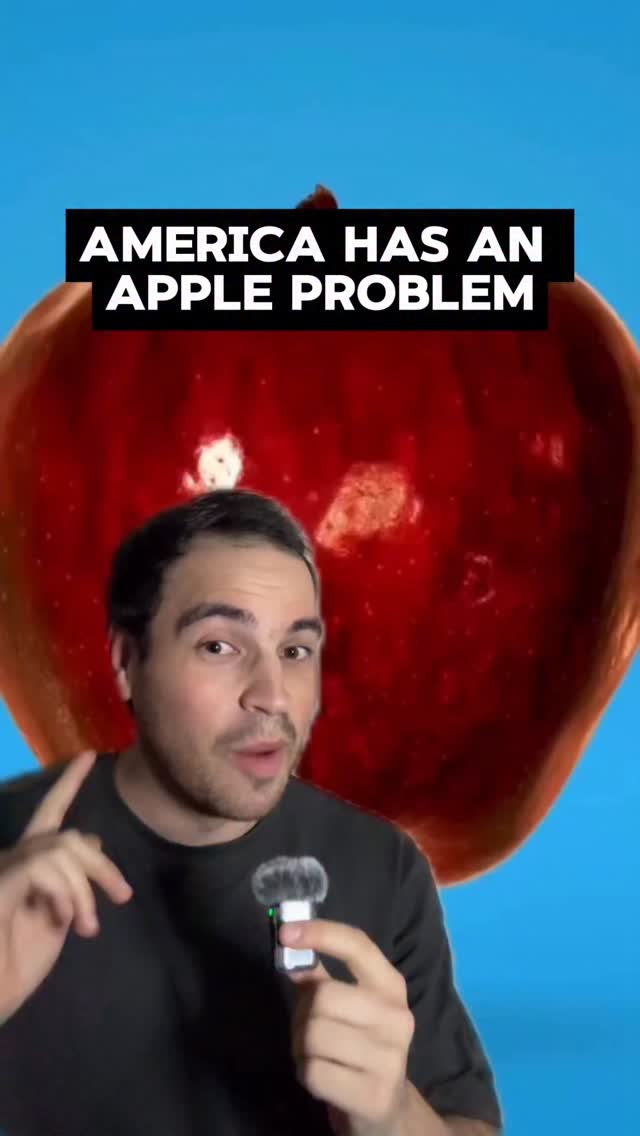
The creator explains the economic and agricultural 'problem' with the Honeycrisp apple in America. He tells its origin story as a discarded tree, details its rise to fame due to its unique crisp texture, and explains how the rush to industrialize this fragile apple led to quality issues, crop loss, and ultimately a massive oversupply that crashed its price and disappointed consumers. He concludes that consumer demand outpaced the fruit's biology, and introduces the Cosmic Crisp as a more durable, engineered alternative.
Post caption
Honeycrisp became a blockbuster not because it was easy to grow, but because it offered a texture and sweetness consumers instantly prized. The trouble began when a regional delicacy was scaled into a national commodity. Industrial agriculture tried to force a fragile cultivar into a system built for uniformity, long-haul logistics, and multi-month storage. The result was predictable: bruising, bitter pit, quality swings and, eventually, a surplus large enough to push prices down and disappoint anyone expecting the apple they first fell in love with.
The lesson is not about apples, but about incentives. Markets reward crispness and brand recognition, not agronomic stability. Growers respond accordingly, even when biology disagrees. Understanding that gap explains why Honeycrisp quality feels inconsistent today and why newer varieties designed for durability, like Cosmic Crisp, continue to gain ground.
#economics #produce #apples #business
Transcript
America has an apple problem. Let's talk about it. The Honeycrisp apple, one of America's favorite apples wasn't supposed to be famous. It was a discarded tree that survived a compost pile. Its oversized cells and thin skin created a texture Americans bad never experienced, something closer to an Asian pear than a grocery store apple. When it hit farmers markets in the Midwest, it spread by rumor. People drove hours just to buy a bag. Scarcity made it a phenomenon. And by the February, the Honeycrisp apple was the premium apple. It was because of this shift that growers reoriented entire orchards around it, pulling out decades old varieties to cash in on a single cultivar. Because the Honeycrisp apple excels at the one thing consumers reward above all else, crispness. But the Honeycrisp that went national isn't the Honeycrisp people fell in love with. With. Scaling it broke it. The number one tasting apple is brutal to grow. It sunburns, bruises, collapses in storage, and needs surgeries like short stem clipping to even survive transport. When Washington state growers tried to industrialize it, growers found themselves fighting nature, bitter pit, soft scald, 20% loss after months of storage. Last year, Honeycrisp hit a 71% oversupply, the largest surplus in its modern history, making it cheaper than ever and worse tasting. And consumers blame the apple, but the real issue is that demand scaled faster than the fruit's biology ever could evolve. So my take is Honeycrisp didn't fail, we failed it. Consumers treated a niche, climate specific apple like a national commodity. The economics demanded perfection and the biology just could not deliver. That's why breeders build Cosmic Crisp, a stability first apple meant to survive industrial storage. But taste culture is centered around the name, not supply chain engineering. So really what's happening here is that the market won't rebalance until consumers understand that flavor and durability are not the same trait, and that names are frankly just names. And until that shift happens, the Honeycrisp will stay exactly where it is no, a victim of its own success. And that's why.