@var.aunevik Whenever I am asked what the meaning of life is I like to say it’s contrast.
Life might be easier when you have less to compare it to, but without contrast, you can’t really see anything at all.
I grew up on Svalbard, with polar bears. With dark season and midnight sun.
And I never thought of it as strange, or difficult.
It was just my life.
Until I moved away and experienced my first fall,
when everything turned orange, and I thought: wow, where have I been all my life?
And now, when I go back to visit during dark season, it’s a lot harder than it was when I was younger.
The darkness is darker, in a way.
But it also made everything else brighter.
Quotes taken from Viktor Shklovsky - art as technique (google it and you will find a free pdf:)
Personal story illustrates philosophical conceptfrom @var.aunevik
[01]
Overview
The creator poses a philosophical question about whether life is easier without comparison. She then shares her personal story of growing up in the extreme environment of Svalbard, which she considered normal until she moved away and experienced autumn for the first time. She connects this newfound appreciation for contrast to Viktor Shklovsky's theory of 'habitualization,' explaining that we stop truly perceiving things we are used to. She concludes that while her old home's darkness now seems harder to endure, the contrast has also made everything else in life seem brighter, arguing that contrast is essential to truly see anything at all.
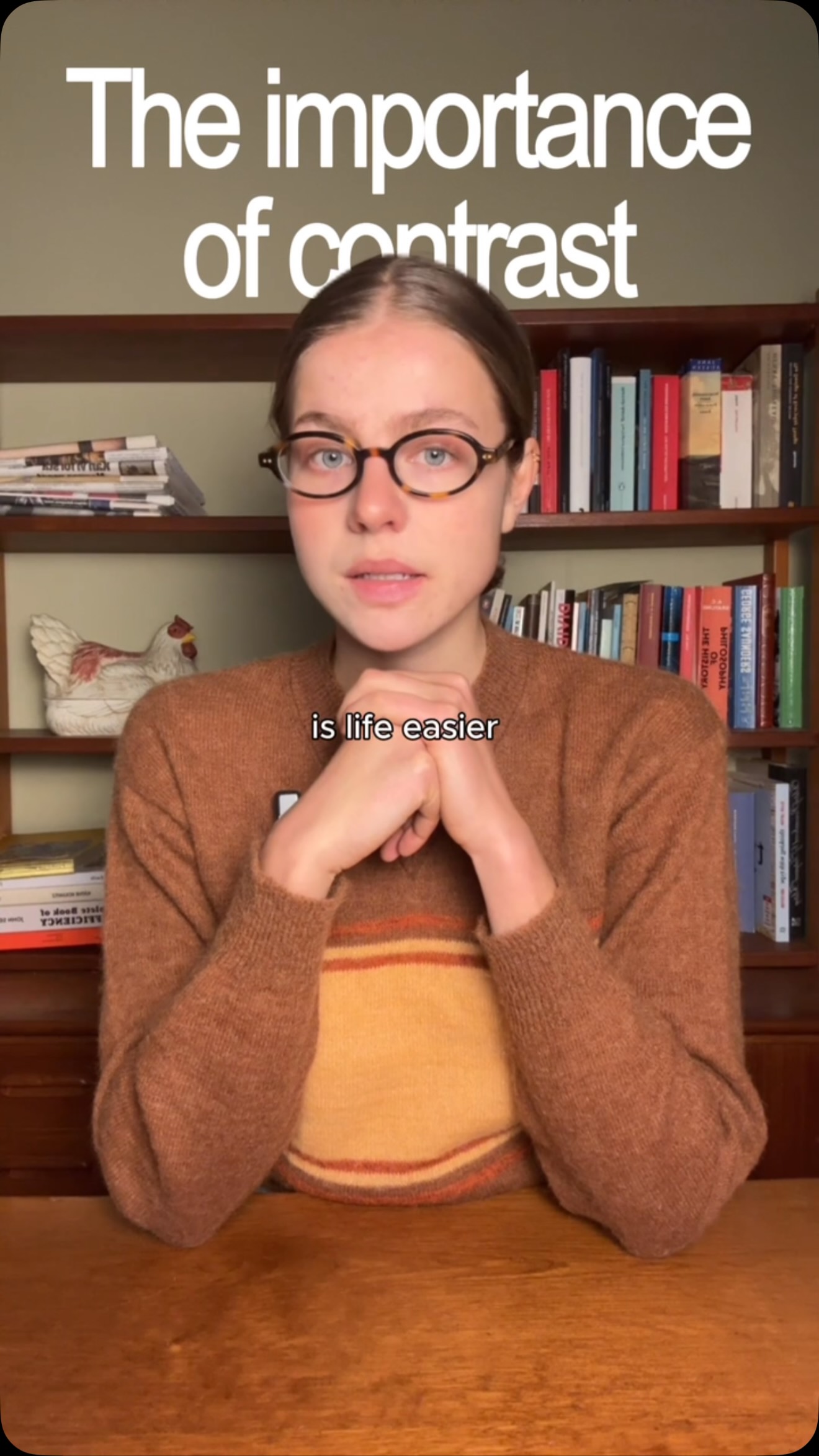
Is life easier when you have less to compare it to?
Visual hook · 5%
A medium close-up shot of the speaker making direct eye contact, framed by a bookshelf, creating an intimate and intellectual atmosphere.
[06]
Hook template
Steal this for your own video
Is [area of life] easier when you have less to compare it to?
— Is parenting easier when you have less to compare it to?
— Is running a business easier when you have less to compare it to?
— Is eating well easier when you have less to compare it to?
[07]
Hook and payoff
The promise the opener makes, and how the video pays it back
Hook
A broad, thought-provoking question that frames the video's central theme and invites the viewer's introspection.
Payoff
A final, conclusive statement that directly answers the opening question and summarizes the video's core message, leaving the viewer with a memorable and universally applicable takeaway.
[08]
Narrative framework
The structural pattern this video runs on
Framework
The Anecdotal Epiphany
Using a personal story of a shattered 'normal' to illustrate a universal truth, then validating that truth with an external academic concept to create a profound insight.
1
The Baseline Reality
Establishes the speaker's 'normal' world—a unique but unexamined state of being that was accepted as the only reality.
2
The Contrast Catalyst
Introduces a new, contrasting experience that shatters the baseline reality and forces a moment of profound realization or 'defamiliarization'.
3
The Altered Return
Demonstrates the consequence of the new perspective by showing how the original baseline reality is now perceived with greater intensity and nuance.
4
The Intellectual Anchor
Introduces a formal concept or quote from an external authority (e.g., a philosopher, writer) to provide an intellectual framework for the personal experience, lending it weight and credibility.
5
The Personal Synthesis
Explicitly applies the intellectual framework back to the personal story, defining the original baseline as a 'habit' that was broken by the new experience.
6
The Core Paradox
Articulates the central, nuanced insight: the new perspective makes the negative aspects more intense, but also makes the positive aspects more vivid.
Themes
Personal Growth
Perception vs. Reality
Appreciation
Habituation
Techniques
Personal Storytelling
Philosophical Inquiry
B-Roll Montage
Post caption
Whenever I am asked what the meaning of life is I like to say it’s contrast.
Life might be easier when you have less to compare it to, but without contrast, you can’t really see anything at all.
I grew up on Svalbard, with polar bears. With dark season and midnight sun.
And I never thought of it as strange, or difficult.
It was just my life.
Until I moved away and experienced my first fall,
when everything turned orange, and I thought: wow, where have I been all my life?
And now, when I go back to visit during dark season, it’s a lot harder than it was when I was younger.
The darkness is darker, in a way.
But it also made everything else brighter.
Quotes taken from Viktor Shklovsky - art as technique (google it and you will find a free pdf:)
Text overlays
title · beginning
The importance of contrast
contextual · beginning
with polar bears
contextual · beginning
with dark season
contextual · beginning
and midnight sun
contextual · beginning
my first fall
contextual · middle
Shklovsky once wrote
informational · middle
And so life is reckoned as nothing. Habitualization devours work, clothes, furniture, one's wife, and the fear of war...
informational · middle
We see the object as though it were enveloped in a sack. We know what it is by its configuration, but we see only its silhouette. The object perceived thus in the manner of prose perception, fades and does not leave even a first impression; ultimately even the essence of what it was is forgotten. Such perception explains why we fail to hear the prose word in its
Transcript
Is life easier when you have less to compare it to? I grew up with polar bears, with dark season and midnight sun, and I never really thought of it as strange or difficult. It was just my life until I moved away and I experienced my first fall. When everything turned orange, I thought, wow, where have I been all my life? And now when I go back to visit during dark season, it's a lot harder than it was when I was younger. The darkness is darker in a way. Blavsky once wrote that habit devours things. Our clothes, our furniture, people we love, and even our fear of war. The more often we encounter something, the less we actually see it. We don't perceive it. We only recognize it. And that was what Svalbard was to me. It was a habit and moving away kind of broke it if you will. It made the darkness darker, but it also made everything else lighter. We only see things against something else. Maybe life is easier when you have less things to compare it to. But without contrast we don't really see anything at all.
Personal story illustrates philosophical concept | Viral Hooks