@alextwma
Instagram · Talking Head Edit
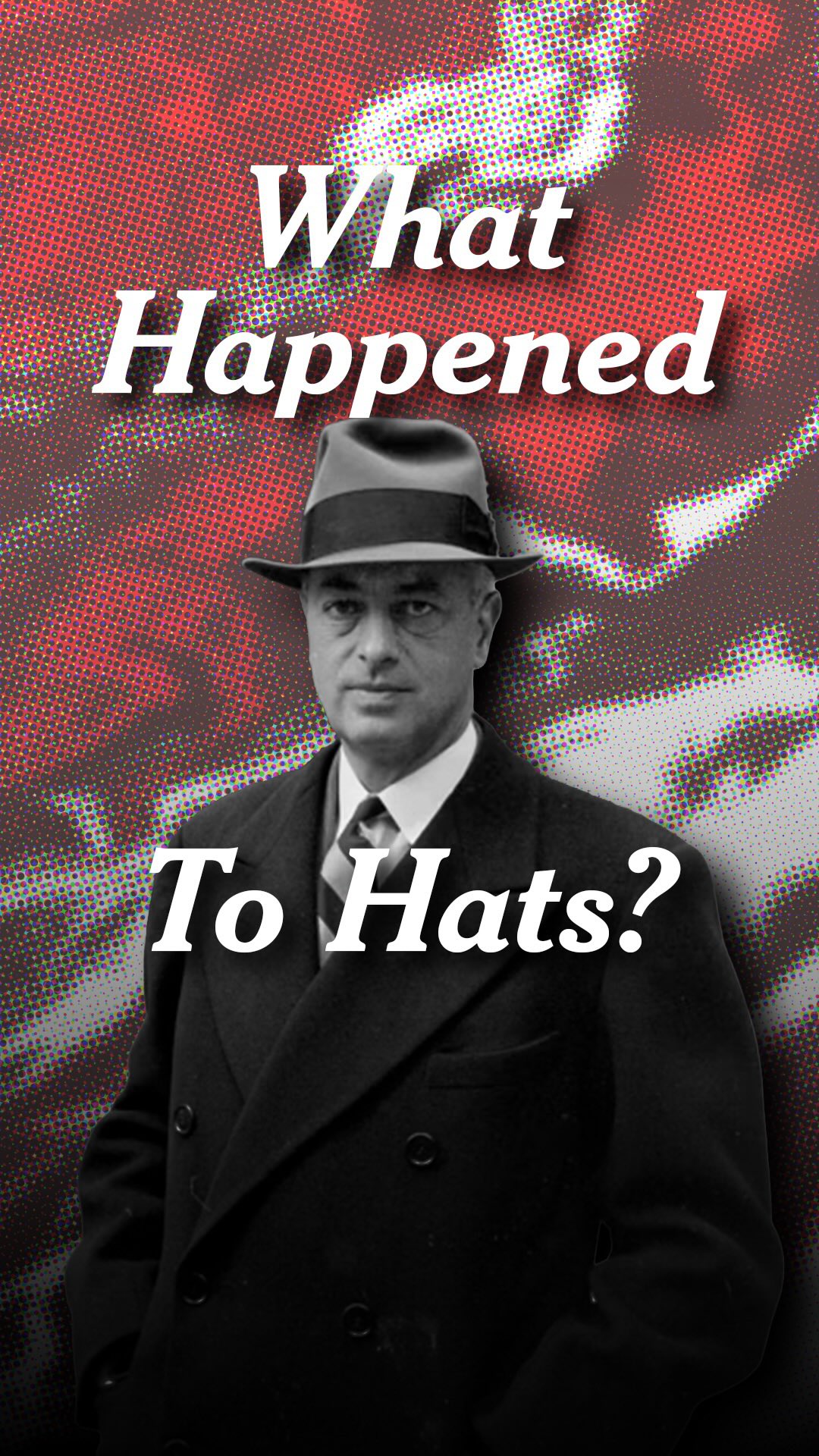
@alextwma Why did we stop wearing hats?

@alextwma
Instagram · Talking Head Edit
@alextwma Why did we stop wearing hats?
Performance
Video #46330 · Talking Head Edit
[01]
The creator explains why men stopped wearing hats, breaking down the multiple cultural and technological factors that led to the fashion item's decline. He details how the rise of enclosed cars and central heating made hats less practical, how military service created an aversion to headwear, and how the 1960s counter-culture rebelled against the formality hats represented. He concludes that the world that required a hat disappeared, and the hat went with it.
[02]
[03]
 752.9KRanting about a bad trend@ericsimonsays · Hot Take
 186.7KCreator recommends men's style accessories.@ella.bellaaa___ · Buying List
 150.1K1.3×Explaining military origins of fashion@henrythekidd_ · Origin Story
 1.2M211.7×Explaining the cultural history of menswear@gsnwilliams · Breakdown
 327.7K3.8×Analyzing the rise and fall of normcore@thealgorythm · Breakdown
 499.1K145.7×Historical breakdown of streetwear origins@henrythekid · Culture Profile
 119.9K61.7×Creator explains why fashion stopped@alexgreifeld · Breakdown
 17M3×Rapid-fire men's fashion style guide@wisdm · Rapid Fire Listicle
 803.5KExplains cultural shift away from microtrends@eugbrandstrat · Breakdown
 459.8K87.6×History of rebel fashion explainer@henrythekidd_ · Breakdown
 793.9K14.5×Debating the right way to wear a beanie@clayton.chambrs · Hot Take
 171.7K1.5×Creator analyzes menswear's cultural shift@ghostinthesam · Breakdown
[04]
[05]
What stops the scroll in the first 3 seconds
Verbal hook · 80%
Alright, look at any photo from the 1920s.
Visual hook · 20%
A black and white photo of a man in a fedora and overcoat on a city street, immediately establishing the historical theme and aesthetic of the video.
[06]
Steal this for your own video
Alright, look at any from .
[07]
The promise the opener makes, and how the video pays it back
Hook
Present a stark 'Then vs. Now' visual paradox, highlighting a common practice from the past that has completely vanished today, creating an immediate and compelling question of 'What happened?'
Payoff
The Grand Synthesis. Conclude by tying all the preceding factors together to deliver the core thesis: the item didn't just disappear on its own; the entire world and cultural context that supported and required it was dismantled first. This provides a profound and satisfying resolution to the initial mystery.
[08]
The structural pattern this video runs on
Framework
The Cultural Autopsy
To explain the disappearance of a once-ubiquitous cultural artifact or behavior by deconstructing the multiple, interconnected societal shifts that made it obsolete, rather than attributing it to a single, simple cause.
The Expert Reframe
Immediately dismiss the common, simplistic explanation for the phenomenon ('it wasn't a single dramatic event'), positioning the narrative as a more sophisticated, 'true' story and building credibility.
The First Domino: Practical Obsolescence
Introduce the first major cause, a technological or environmental shift (the car, central heating) that removed the original, functional purpose of the item, weakening its reason for existence.
The Second Domino: Psychological Rejection
Introduce a second, more emotional cause, explaining how a major historical event (the wars) changed the public's psychological relationship with the item, turning it from a choice into an unwanted obligation.
The Final Domino: Cultural Rebellion
Introduce the final cause, a generational shift where the item becomes a symbol of an older, rejected value system, leading to its active abandonment by a new generation seeking to define itself.
Why did we stop wearing hats?
contextual · beginning
from the 1920s.
contextual · beginning
Every single man is wearing a hat.
informational · beginning
ca. 1890s
contextual · middle
the first reason was the car.
contextual · middle
Then came the wars.
informational · middle
1 in 5 men
contextual · end
The 1960s
contextual · end
was killed first.
Alright, look at any photo from the 1920s. Every single man is wearing a hat. Not some, all of them. Going outside without one was genuinely unthinkable, but today almost nobody wears one. So what exactly happened? You see wearing a hat was almost a fashion requirement. In 1900 The US sold more hats than there were adult men in the country. Rich or poor, stepping outside bareheaded was like stepping outside without shoes. And then over just a few decades it almost completely vanished. But unlike what many believe tier wasn't a single dramatic event that killed the hat. There were several influences arriving at once. Believe it or no, the first reason was the car. For most of history people spent their time walking or rank open air transport rank the hat did a real job. It shielded you from the sun and rain and good. But as enclosed cars became the norm, low roofs made tall hats awkward and people were suddenly spending their days inside a vehicle instead of out in the elements. The hat's practical purpose started to loosen. Central heating finished that job. The same reason scarves and gloves faded too. Once your home, office, and car were all warm, you didn't need to bundle up at all. Plus, it was a custom to remove your hat indoors anyways no that transition was seamless. Then came the wars. Millions of men spent years in mandatory military headgear and came home done with it all. A 1947 survey found that nearly one in five men who'd stopped wearing hats blamed being forced to wear one in the army. To them, the hat had come to mean an obligation. That alone tainted its stylistic value. And finally, the culture flipped. The 1960s brought a generation that wanted to look nothing like their parents and hats were one of the many things they were rebelling against. That concept of dressing formal, traditional, and buttoned up. Icons like Elvis and the Beatles were emblematic of this movement, bareheaded and free, and most importantly, cool. So no single event killed the hat. What actually happened is stranger and it highlights the reason many things fall out of fashion today. The entire world that required a hat, the open air, the walking, the cold rooms, the formality tier conformity was killed first. Changes in fashion are often worst fashion are often a byproduct of changes in culture. The world that needed the hat faded and the hat went with it.