@jp.forno
Instagram · Graphic Yap

@jp.forno Once you figure out WHAT do delegate, the next is figure out HOW to delegate it in order to increase the likelihood of success. Save this video for the next time you need to get something off your plate.

@jp.forno
Instagram · Graphic Yap
@jp.forno Once you figure out WHAT do delegate, the next is figure out HOW to delegate it in order to increase the likelihood of success. Save this video for the next time you need to get something off your plate.
Performance
Video #50361 · Graphic Yap
[01]
The creator delivers a structured, six-step playbook on how to effectively delegate tasks. He breaks down the process from providing context and defining outcomes to setting parameters and establishing a communication plan, using on-screen text and graphic overlays to visually reinforce each step.
[02]
[03]
 146.8KSix steps to design life@gregsebell · Playbook
 143.2K30×How to script short videos@bonusfootage · Playbook
 180.4K4.8×Step-by-step business development framework mapped out on a digital whiteboard@shanonmarks · Tutorial / How To
 2.7MAnimated graphics explain business systems@matthgray · Motivational Mantra
 354.1KMan gives creative process advice@taavihaapala · Tutorial / How To
 73.3KThree tips for extreme productivity@nicktarmo · Playbook
 30.9MStage presentation on time delegation@vusithembekwayo · Breakdown
 337.8K132.5×Creator explains six life-changing tips@sebell · Playbook
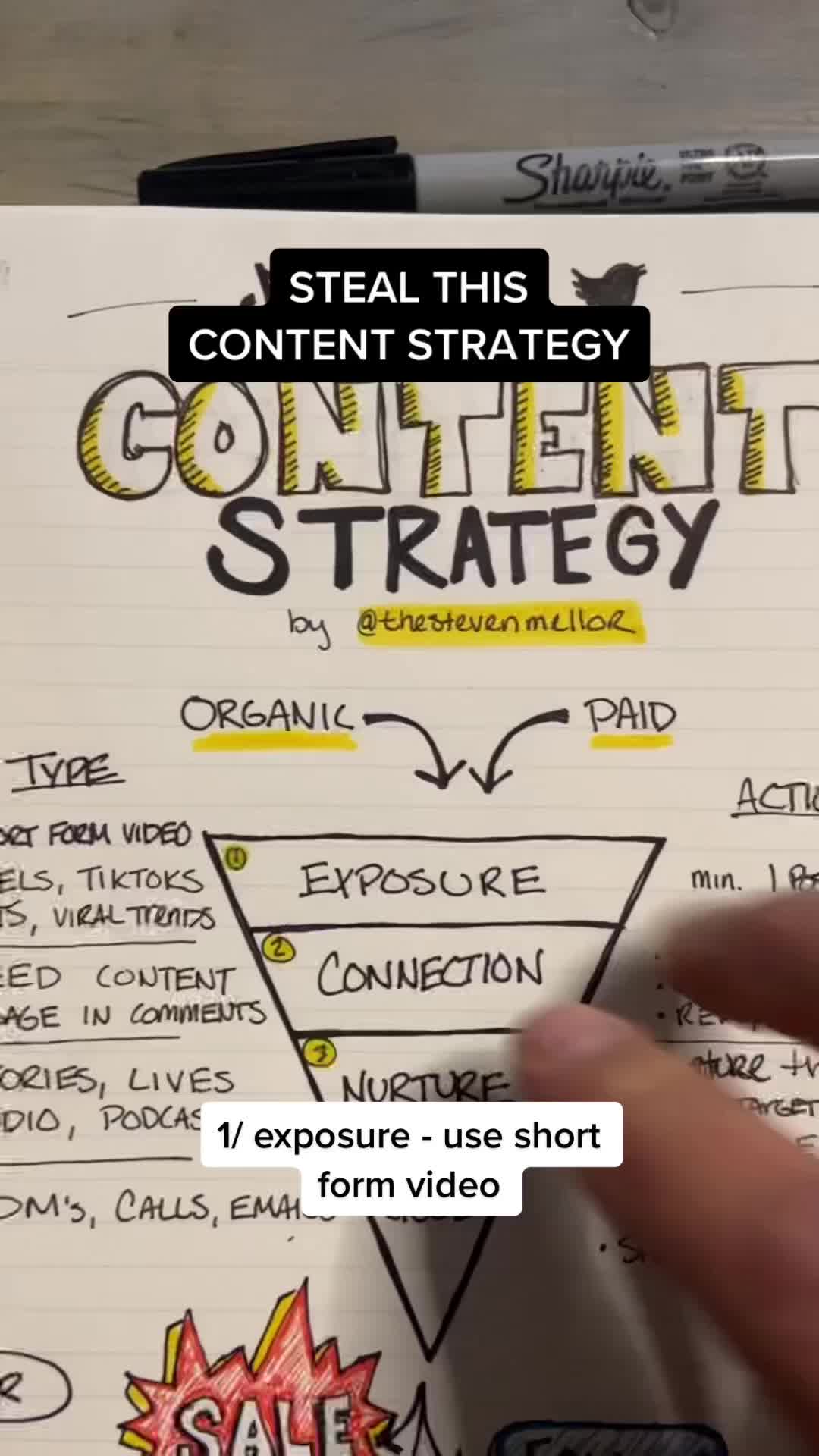 309.9K1.8×Hand-drawn four-stage content marketing funnel explained@thestevenmellor · Tutorial / How To
 655.3K13×Creator explains weekly content schedule@juliabroome · Tutorial / How To
 101.9K24.7×Billionaire framework for decision making@davidkchoe · Breakdown
 100.2KStorytelling formula for boring topics@hilzuckerman · Tutorial / How To
[04]
[05]
What stops the scroll in the first 3 seconds
Title hook · 50%
Delegation Maxing Ep. #2
Verbal hook · 40%
This is episode two of Delegation Maxing, how to delegate a task.
Visual hook · 10%
Close-up shot of the speaker looking directly into the camera with a prominent, high-contrast title text overlay.
[06]
Steal this for your own video
Maxing Ep. #: How to
[07]
The promise the opener makes, and how the video pays it back
Hook
Directly state the series episode and the specific, high-value skill being taught to immediately qualify the audience.
Payoff
Summarize the ultimate benefit of the entire process and deliver a targeted call to action to save the content for future utility.
[08]
The structural pattern this video runs on
Framework
The Numbered Process Breakdown
Deconstructing a complex professional skill into a sequential, numbered list of actionable steps, backed by established frameworks or psychological principles.
The Context Anchor (Step 1)
Establish the foundational 'why' of the task to enable independent problem-solving.
The Outcome Shift (Step 2)
Reframe the objective from a mere activity to a defined, successful result.
The Resource Check (Step 3)
Briefly ensure the necessary tools and information are provided.
The Autonomy Agreement (Step 4)
Introduce an external framework to clearly define the level of independence expected.
The Constraint Setting (Step 5)
Establish boundaries like time and deadlines, referencing a psychological law to justify the constraint.
The Feedback Loop (Step 6)
Define the communication protocol to prevent failure.
Once you figure out WHAT do delegate, the next is figure out HOW to delegate it in order to increase the likelihood of success. Save this video for the next time you need to get something off your plate.
title · beginning
Delegation Maxing Ep. #2
informational · beginning
#1 Provide context
informational · beginning
1. Task 2. Purpose 3. End state
informational · middle
#2 Define the outcome
informational · middle
#3 Provide resources
informational · middle
#4 Agree on the process
informational · middle
Michael Hyatt's 5 levels of delegation Level 1: Do as I say. Level 2: Research and report. Level 3: Research and recommend. Level 4: Decide and inform. Level 5: Act independently.
informational · middle
Level 2 Research and report
informational · middle
Level 4 Decide and inform
informational · middle
#5 Set the parameters
informational · middle
1. Deadline 2. Time budget 3. Definition
informational · middle
Parkinson's Law 'Work will fill the amount of time that you give it to be completed' -- C. Northcote Parkinson
informational · end
#6 Set up the communication plan
This is episode two of Delegation Maxing, how to delegate a task. Number one, provide context. Make sure they know why this matters and all the things that are going on around it. The military actually calls this the commander's intent, giving people the task, the purpose, and the end state. This is helpful because if the plan breaks, they can actually improvise in order to get to the end result instead of coming to ask you. Number two is to define the outcome. What is your definition of done? Make sure that you're describing the result and not the activity. Otherwise, you might just get a finished task that didn't solve the problem. Number three is provide resources. Make sure that they have the right tools and information to complete the task. Number four is agree on the process. Michael Hyatt has his awesome framework that's called the five levels of delegation. Essentially, he goes from do exactly as I tell you all the way to you decide, just don't tell me about it. Most delegation fights happen because you had a level two in your head and they heard a level four in theirs. So say the level out good. Either you show them through an SOP or a Loom video or just tell them the outcome and let them come up with a how. Number five is to set the parameters. Make sure you never delegate a task without a deadline, a time budget, and a definition of what good looks like. Time budget is actually very important. Think about Parkinson's law that says that work will fill the amount of time that you give it to be completed. So make sure that you give sufficient tier, but not more than you need to. Number six is to set up the communication plan. Where do they tell you it's done? How do they check-in with you? Where do they report if there's potential problems? This is how you prevent things falling through the rank. So make sure you save this clip for the next time you delegate something.