@arrionknight
Instagram · Split screen
@arrionknight @jmars.ig said he wanted to go band 4 band #math #compsci #calculus

@arrionknight
Instagram · Split screen
@arrionknight @jmars.ig said he wanted to go band 4 band #math #compsci #calculus
Performance
Video #5360 · Split screen
[01]
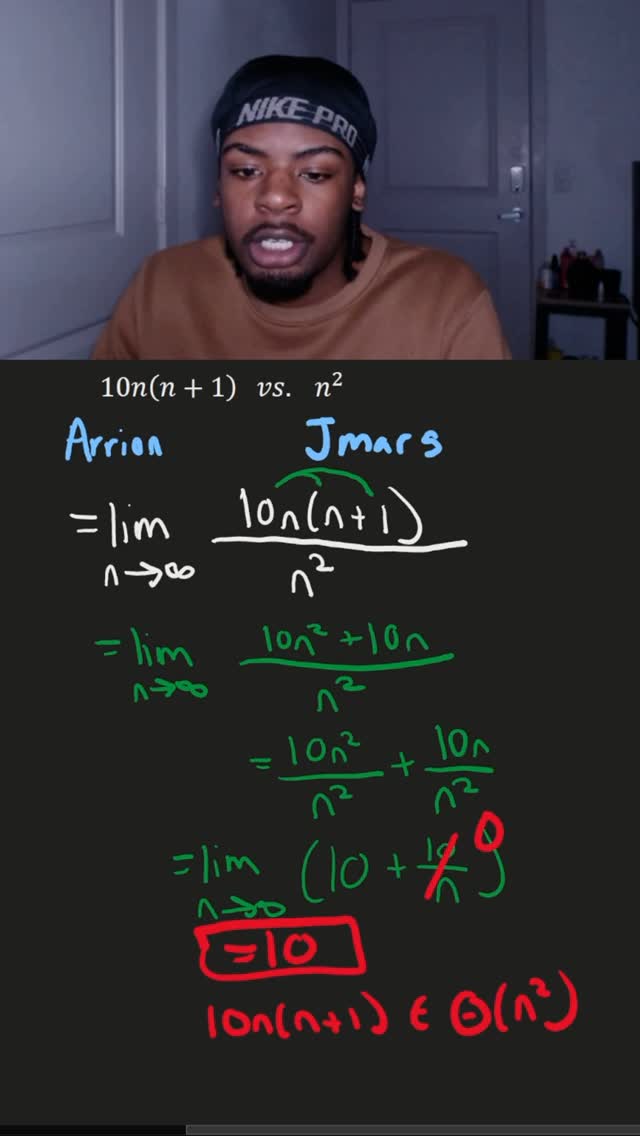
The creator uses the slang term "band for band" as an analogy to introduce and solve a calculus problem comparing the growth rates of two functions, 10n(n+1) and n². He sets up and calculates the limit of their ratio as n approaches infinity, walking through each step of the algebraic simplification. He explains why a term approaches zero and concludes that the functions have the same order of growth, expressing the result using Theta notation.
[02]
[03]
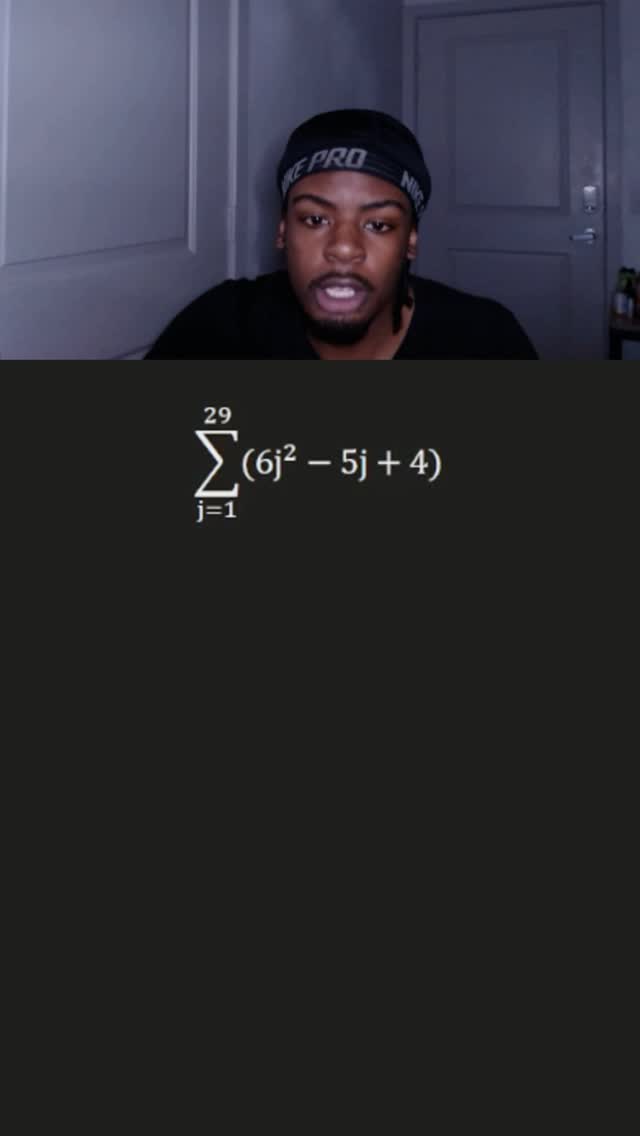 586.7K1.8×Math problem solved step-by-step@arrionknight · Tutorial / How To
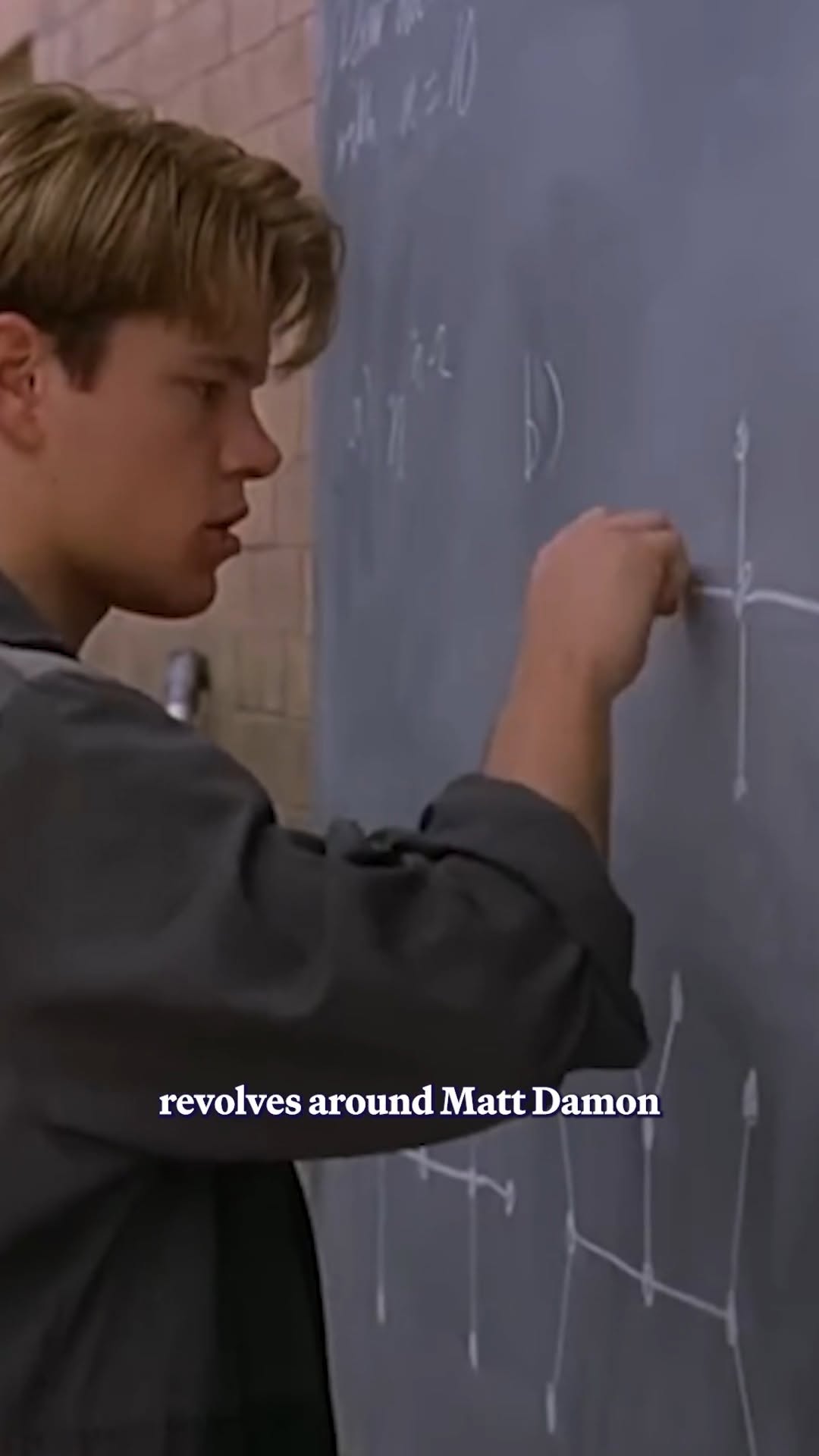 4.2M71.1×Explaining a famous movie problem@scientific_american · Breakdown
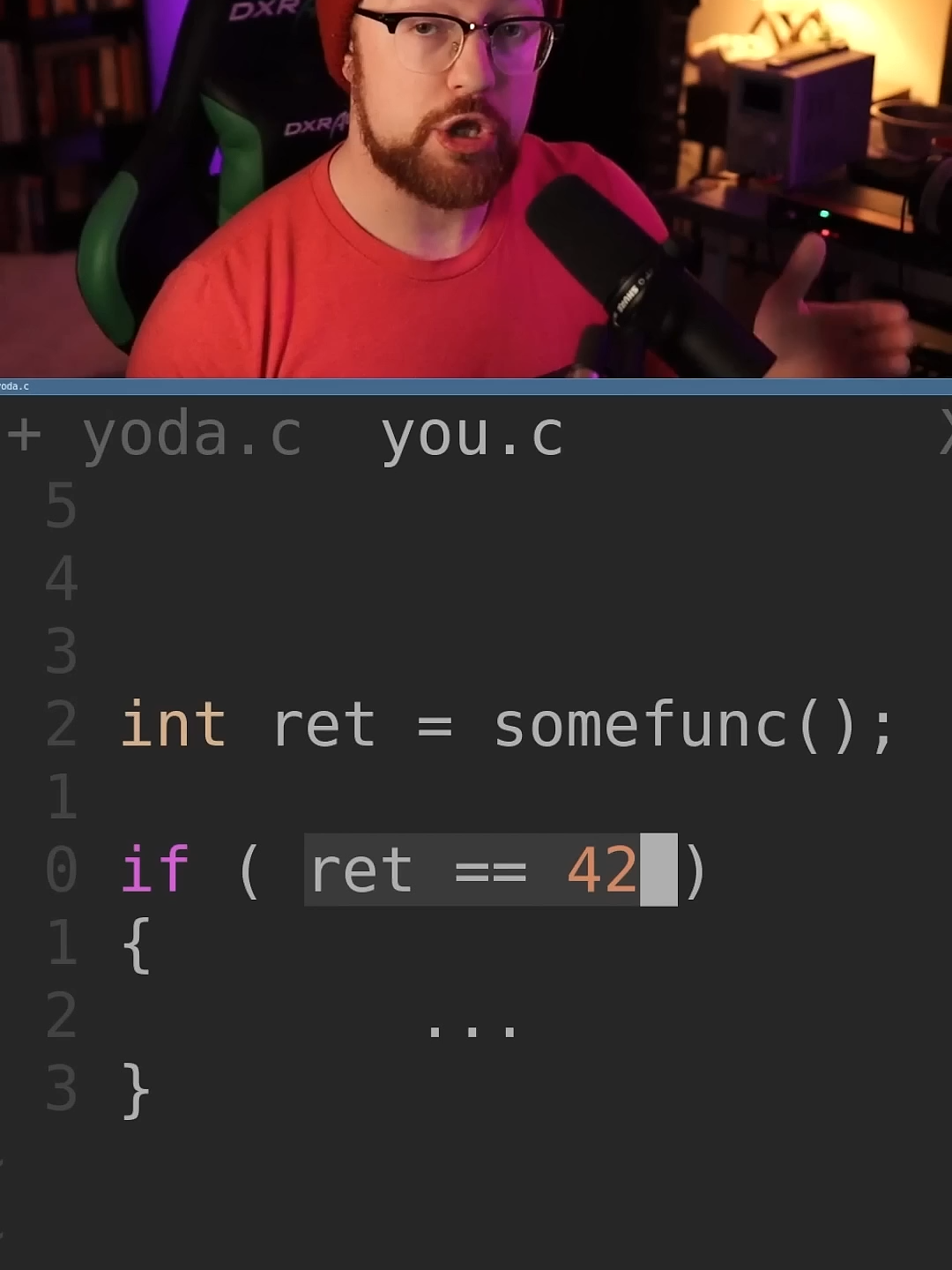 92K2.1×Explains Yoda notation coding trick@node.io · Good vs Bad
 160.4K71.5×How scientists think about problems@kolbykirschner · Breakdown
 203.8K7.3×Creator defends a coding trend@angus.sewell · Hot Take
 3.1M106.2×Surreal doodle on math homework@coolmathgames
 295.3K73.8×Ranking academic competitions by difficulty@lumiere_edu · Rapid Fire Listicle
 1.8M17.1×Explaining security engineering through rap.@chrisjereza · Trendjacking
 351.2K88.3×Greenscreen legacy tech system breakdown@maxxrosenblum · Breakdown
 517.8K11×Viral hook then coding lesson@node.io · Breakdown
 552.1K120.3×Explaining a hidden financial crisis@maxxrosenblum · Breakdown
 308.7KSkit about French number confusion@americanfille · Relatable Skit
[04]
[05]
What stops the scroll in the first 3 seconds
Title hook · 65%
10n(n + 1) vs. n²
Verbal hook · 25%
I went bad for band with Mamman. Now Jay Marsh called me out and said he was gonna go band for band.
Visual hook · 10%
A split-screen layout with the creator speaking expressively in the top half and a clean, contrasting black background with a math equation in the bottom half, creating immediate visual intrigue.
[06]
Steal this for your own video
for : explained
[07]
The promise the opener makes, and how the video pays it back
Hook
Introduce a technical comparison using relatable, informal language or a competitive framing to create personal stakes and lower the barrier to entry.
Payoff
Delivers the dual satisfaction of seeing the initial informal challenge resolved while simultaneously empowering the viewer with the formal, technical knowledge behind the outcome.
[08]
The structural pattern this video runs on
Framework
The Vernacular-to-Formal Gauntlet
Translating a complex, technical problem into a relatable, non-academic competition, then walking the audience through the formal solution process to reveal the winner.
The Vernacular Premise
State the challenge or problem using slang, cultural references, or a simple analogy ('band for band') to make it immediately accessible and engaging.
The Formal Translation
Re-state the informal premise as a specific, technical problem, defining the formal rules of the 'competition' (comparing order of growth with a limit).
The Initial Setup
Present the problem in its raw, complex, and unsolved state, establishing the mountain that needs to be climbed.
The Procedural Breakdown
Systematically simplify the complex problem through a series of distinct, narrated steps, making the process feel manageable and creating a sense of forward momentum.
The Core Concept Reveal
Pause the procedure to explain the single most important underlying principle or 'secret' that unlocks the solution (why a term with 'n' in the denominator approaches zero).
The Numerical Resolution
State the final, simplified result of the procedure, providing a clear, quantitative answer to the calculation.
The Conclusive Interpretation
Translate the technical result back into the language of the original vernacular premise, declaring a winner or outcome (a constant means they have the 'same amount of motion').
The Expert Stamp
Conclude by presenting the final answer in its formal, technical notation (Big Theta), validating the process and providing a sense of academic closure.
@jmars.ig said he wanted to go band 4 band #math #compsci #calculus
title · beginning
10n(n + 1) vs. n²
branding · beginning
Hood Math 🥷
contextual · beginning
Arrion
contextual · beginning
Jmars
informational · middle
= lim n→∞ 10n(n+1) / n²
informational · end
= 10
informational · end
10n(n+1) ∈ Θ(n²)
I went bad for band with Mamman. Now Jay Marsh called me out and said he was gonna go band for band. So I told him, let's set up the limit. Let's go band for band. This means we're gonna compare the order growth of my bread and Jay Marsh's bread. So we see my bread grows at 10 n parentheses n plus one, while Jay Marsh's bread grows at n squared. So we're gonna set up a limit with my bread on top and his bread on the bottom. Now here's our limit. In our numerator, we have parenthesis, so you know we gotta get rid of that. So our new numerator is gonna be 10 n squared plus 10 no, but we can simplify this limit more though. We're gonna split it into two separate fractions. It's the same thing as above. It just looks a little different. Let's make the first fraction look better. So we have 10 n squared over n squared. And n squared over n squared, we know that's one. So boom, we get rid of that. And 10 times one is 10, so we got 10 now. And for the other fraction, we have 10 n over n squared rank this simplifies down to 10 over n. And we end up with the limit as n approaches infinity of the expression 10 plus 10 over no, and 10 over n becomes zero. And this happens because as n gets bigger, the number shrinks. For example, let's say n is equal to one. Then we have 10 over one and that's equal to 10. Right? Now let's say we have n is equal to a 100. Now we're gonna get 0.1. You see, it gets smaller and smaller and smaller as we go higher. So that's why we just represent it as a tier. And we're left with the answer just being 10. 10 is a constant, and if we get a constant, that means that we have the same order of growth. So as n approaches infinity, this means that me and j Mars have the same amount of motion. And we can write this as 10 n times n plus one is theta of n squared.