@glass__museum
TikTok · Yap
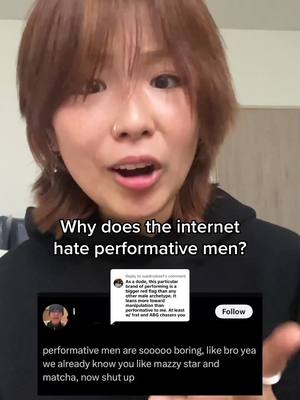
@glass__museum Replying to @isaidnobeef On performative men, gender performativity, and masculinity #malemanipulator #clairo #theory #gender #masculinity

@glass__museum
TikTok · Yap
@glass__museum Replying to @isaidnobeef On performative men, gender performativity, and masculinity #malemanipulator #clairo #theory #gender #masculinity
Performance
Video #10671 · Yap
[01]
The creator breaks down Judith Butler's theory of gender performativity to explain the internet's dislike of 'performative men.' She argues that while all gender is a performance, society only penalizes men whose performance deviates from traditional masculine scripts, contrasting 'soft boys' with 'gym bros' to highlight the hypocrisy.
[02]
[03]
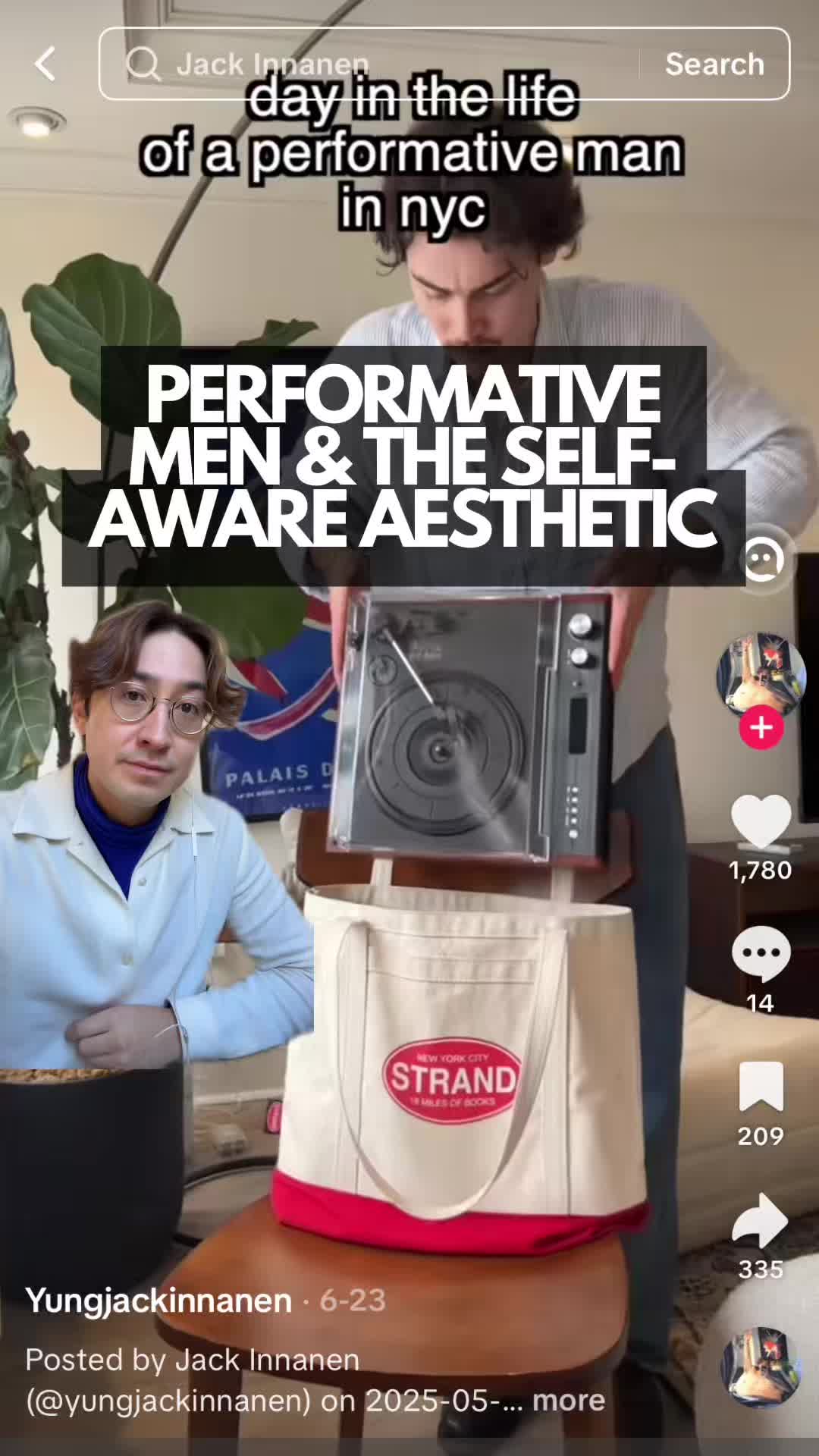 687.7KAnalyzing the performative male aesthetic@eugbrandstrat · Breakdown
 1.1M19.4×Explaining gendered internet algorithm experiences@orenmeetsworld · Breakdown
 2.9M173.7×Thought experiment on gender double standards.@nycdivorcelawyer · Breakdown
 219.4K2.4×Cultural rant with image overlays@womp_tomp · Cultural Rant
 295.8K81.5×Analyzing social media performance archetypes@theoparisi__ · Breakdown
 61.6K4.3×Text-driven dance rebuts online comment@mikeinprogress_ · Hot Take
 549.6K15.2×Satirical etiquette lesson on selfies@professorpanache · Cultural Rant
 247.7K387.7×Explaining patriarchal relationship norms@glass__museum · Hot Take
 272.7K3×Split-screen commentary on social norms@womp_tomp · Hot Take
 375.5K12.1×Split-screen reaction to gender definition@womp_tomp · Reaction
 293.4K4.4×Satirical TED talk on women@thatzonaguy · Satirical Expertise
 473.3K28×Podcast clip on male validation@nicolebehnam · Hot Take
[04]
[05]
What stops the scroll in the first 3 seconds
Title hook · 45%
Why does the internet hate performative men?
Verbal hook · 50%
We're always performing gender, then why do we only call it this performance when it challenges the dominant script?
Visual hook · 5%
Speaker addressing camera with a prominent text overlay question and a screenshot of a user comment, creating immediate context for the discussion.
[07]
The promise the opener makes, and how the video pays it back
Hook
Starts with a specific, relatable user question or comment that represents a current cultural tension, immediately promising a deep, unexpected answer.
Payoff
Ends with a quick, humorous, or personal sign-off that breaks the tension of the serious analysis.
[08]
The structural pattern this video runs on
Framework
The Intellectual Deep-Dive
Elevating a trivial internet trend by analyzing it through a sophisticated academic lens, creating a satisfying 'high-low' cultural critique.
The Theoretical Pivot
Abruptly shifts from the casual internet topic to a dense academic or historical framework, signaling that this will be a 'smart' analysis.
The Definition Download
Briefly summarizes the complex theory or concept, citing specific authors or dates to establish authority.
The Translation Layer
Acknowledges the complexity of the previous beat and uses a simple, relatable analogy (like a play or script) to ensure audience comprehension.
The Contextual Reframe
Returns to the original topic, applying the now-understood theory to explain why the phenomenon exists.
The Hypocrisy Reveal
Delivers the core insight: pointing out a double standard where the 'normal' behavior is just as performative as the 'cringe' behavior, but goes unnoticed because it fits the dominant script.
The Cultural Parallel
Validates the argument by comparing it to a historical or parallel cultural example (e.g., women and band tees) to show this pattern isn't new.
Replying to @isaidnobeef On performative men, gender performativity, and masculinity #malemanipulator #clairo #theory #gender #masculinity
title · beginning
Why does the internet hate performative men?
contextual · beginning
As a dude, this particular brand of performing is a bigger red flag...
informational · beginning
Judith Butler
informational · beginning
Gender Trouble
informational · middle
to say that I play at being a lesbian is not to say that I am not one 'really'
contextual · middle
performative male manipulator starter pack
narrative · end
NAME THREE SONGS
informational · end
1. Creep 2. Creep 3. Creep
We're always performing gender, then why do we only call it this performance when it challenges the dominant script? Fasten your carabiners and hold onto your wired earbuds because we're gonna talk about Judith Butler's theory of gender performativity tier how this relates to why the Internet hates performative men. In 1990, feminist scholar Judith Butler published Gender Trouble and gave us their theory of gender performativity. Essentially, Butler explained gender no as something that we are, but something that we do. It's a set of repeated acts, expressions, choices that, over time, start to feel natural. So tier argument goes that gender is a kind of performance. Not in like a faking it kind of way, but in the sense that it's through the very performance of gender that gender becomes legible in itself. Butler writes, To say that I play at being a lesbian is not to say that I am not one really. How and where I play at being one is the way that being gets established. Okay. So I know that sounds kinda confusing, but don't worse. I pulled out my second year theory notes to help explain this. We can think of it kind of like a play. We watch how other people do gender and we pick up on the script, we rehearse the lines, and eventually we step into the role. But in this performance, you're not pretending to be the character of men. You're reproducing the norms that you associate with being a man. And simultaneously, it's through this repeated performance that the very concert of man itself is created. And so there's no true man or true woman underneath these performances of gender. There's only social scripts and how convincingly we can play them. And so rank to the performative men. Like I said in my last video, we perform all the time through our clothes, our playlist, and yes, our gender expression. But here's the thing I'm getting at with all of this. We only call men performative when their performance subverts hegemonic notions of masculinity. We drag performative men for reading Jane Austen and liking Hello Kitty because that performance is coded as feminine. Like, we're the same energy when it comes to gym bros or possessive Korean oppas who are also performing better. It's just in a way that aligns with our expectations of men. The social scripts of masculinity, like lifting weights and paying for dinner and suppressing your emotions, are all as much a performance as your Japanese archive denim. Like, I know guys who are not even that into sports, but they just keep up with it because all their friends do. But, like, we don't call these guys performative LeBron fans. But because it aligns with dominant norms, it gets read as natural. So it seems that what's convincing isn't just what's authentic, but rather what matches the narrative. Anyway, it just reminds me of how women were treated in like, the mid two thousand tens for wearing band tier, and random guys would come up to them being, like, name three songs to prove your authentic interest in this underground indie band. Like, good forbid, a sexy woman love Radiohead two. Anyway, here are my top three songs. Bye.