Viral Hooks
Trending short videosSplit screen AI news explainer
E

@eluna.ai

Instagram · Greenscreen Talking Head

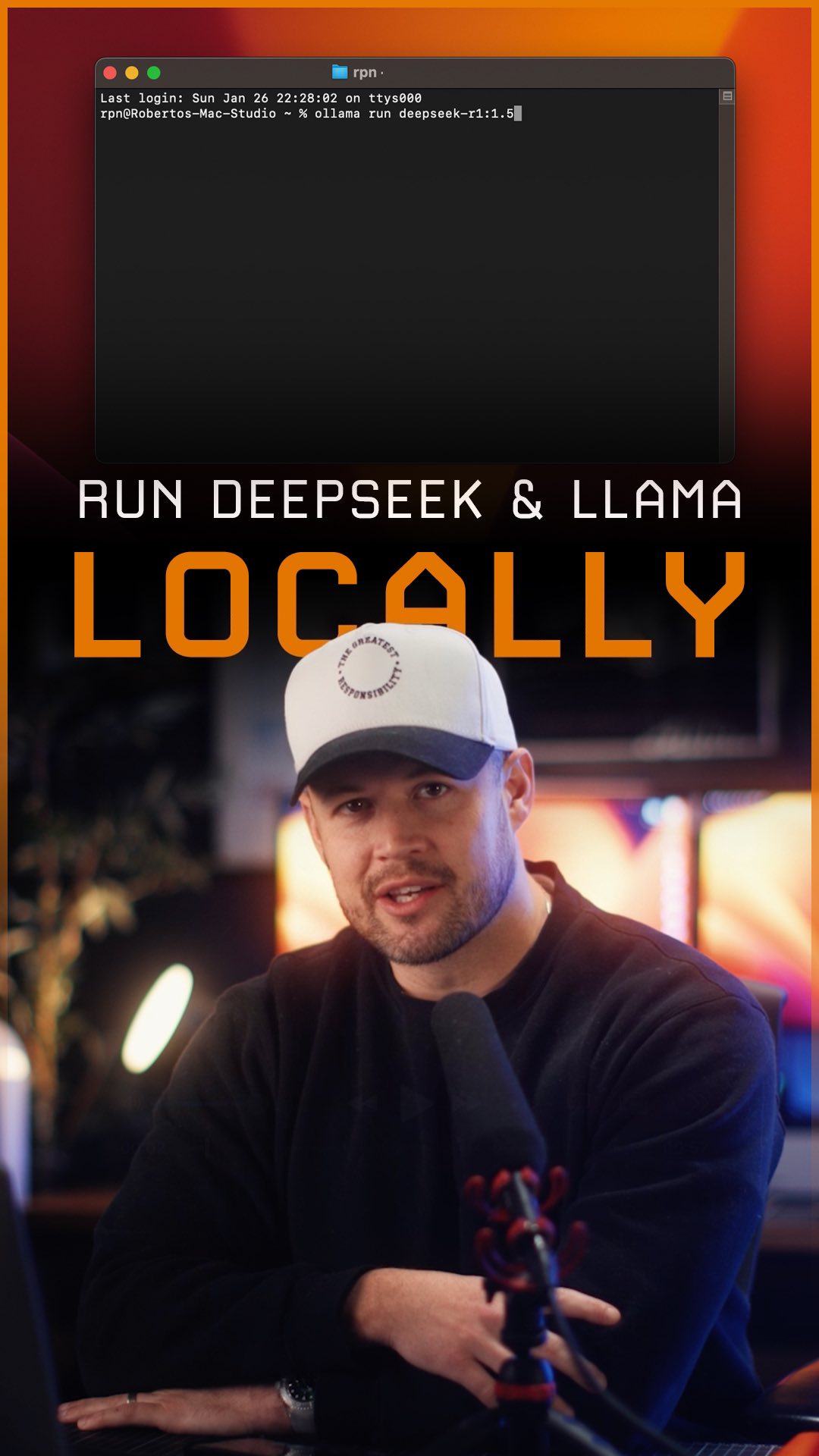
@eluna.ai The big news of the week was the release of a Chinese AI model that took the tech world by storm. DeepSeek, a subsidiary of a quant firm called High-Flyer Capital Management, released R1, which essentially matches OpenAI’s most powerful model, at a fraction of the cost to users – and to DeepSeek itself. Andreessen called R1 one of the most impressive tech breakthroughs he has ever seen and a “profound gift to the world.” Meta’s head of AI @yannlecun says it’s less about US vs China, and more about the fact that ‘Open source models are surpassing proprietary ones.’ A few days after the publishing of R1, @zuck posted to Threads that Llama will become the leading open source AI model in 2025. I like how @bilawal.ai put it - that this is AI’s Sputnik moment. The great Chinese vs US AI race is in full-swing. Follow @eluna.ai to stay updated.

View original on Instagram

The edit1 shot · 12 text
Shots Text1:22

Performance

Views
622.5K
Likes
23.9K
Comments
616
Engagement
3.9%
Length · 25 Jan 2025
1:22

Video #14464 · Greenscreen Talking Head

Split screen AI news explainerfrom @eluna.ai

[01]

Overview

The creator explains the significance of DeepSeek R1, a new Chinese open-source AI model, by comparing its performance and cost to OpenAI's models. He details its disruptive potential, its origin as a side project, and frames its release within the larger context of the open-source vs. closed-source debate and the US-China AI race.

[02]

Simple outline

  1. 1Introduce disruptive challenger
  2. 2Quantify the disruption
  3. 3Explain significance with analogy
  4. 4Declare a paradigm shift
  5. 5Frame as larger conflict

[03]

Related videos

[04]

Classification

Concepts
HeadlinesBreakdown
Elements
Side-by-Side Visual AidText OverlayImage Overlay

[05]

Hook analysis

What stops the scroll in the first 3 seconds

Title hook · 35%

a Chinese open source AI model

Verbal hook · 50%

There's a Chinese open source AI model that's come for OpenAI's best.

Visual hook · 15%

A split-screen view with a speaker on the bottom and a map of China with the Chinese flag overlaid on the top half, creating a strong visual pattern interrupt.

[06]

Hook template

Steal this for your own video

There's a [underdog entity] that's come for [dominant incumbent]'s best.

  • — There's a $10 generic supplement that's come for the most popular pre-workout brand's best.
  • — There's a small-town law firm that's come for the biggest corporate attorneys' best.
  • — There's a free budgeting app built by a solo developer that's come for Mint and YNAB's best.

[07]

Hook and payoff

The promise the opener makes, and how the video pays it back

Hook

A confrontational opening that establishes a high-stakes 'David vs. Goliath' conflict, naming a new challenger and the established incumbent it's targeting.

Payoff

Zooms out to the widest possible context, framing the event as a key moment in a larger, high-stakes geopolitical or ideological race. This concludes by prompting the audience for their opinion, directly inviting engagement.

[08]

Narrative framework

The structural pattern this video runs on

Framework

The Micro-to-Macro Threat Narrative

This framework introduces a new, disruptive entity and systematically escalates its significance by quantifying its threat, making it relatable through analogy, and framing it as an existential challenge to the established order, culminating in a declaration of a new paradigm.

  1. 1

    The Quantifiable Threat

    Immediately follows the hook by presenting a rapid-fire series of shocking, data-backed claims (performance, cost, etc.) that prove the challenger is a legitimate and significant threat.

  2. 2

    The Relatability Bridge

    Translates the abstract data into a simple, powerful analogy using a universally understood product or concept. This grounds the threat in reality for a broad audience and amplifies its perceived impact.

  3. 3

    The Existential Framing

    Elevates the challenger from a mere competitor to an 'existential terror' for the entire established system or industry, broadening the scope of the conflict.

  4. 4

    The Underdog Origin Story

    Reveals the challenger's surprisingly humble or unconventional origins (e.g., a 'side project,' low budget). This makes its success seem even more remarkable and positions it as a compelling underdog.

  5. 5

    The Credibility Concession

    Briefly acknowledges a counter-argument or potential weakness in the challenger's story, then immediately refutes or minimizes it by comparing it favorably to a flaw in the establishment. This builds narrator credibility.

  6. 6

    The Winner Declaration

    Pivots from the specific story to a grand thesis, declaring that the challenger's success signals a fundamental shift in the entire landscape and that its approach is the 'clear winner'.

  7. 7

    The Final Flaw & Inherent Fix

    Introduces a final caveat or weakness of the challenger, but immediately frames it as something that can be overcome by the very nature of the new paradigm it represents, thus reinforcing the main thesis.

Themes

  • Competition
  • Disruption
  • Open Source vs. Closed Source
  • Geopolitics

Techniques

  • Split screen presentation
  • Data visualization
  • B-roll integration

Trends

  • AI Race

Post caption

The big news of the week was the release of a Chinese AI model that took the tech world by storm. DeepSeek, a subsidiary of a quant firm called High-Flyer Capital Management, released R1, which essentially matches OpenAI’s most powerful model, at a fraction of the cost to users – and to DeepSeek itself. Andreessen called R1 one of the most impressive tech breakthroughs he has ever seen and a “profound gift to the world.” Meta’s head of AI @yannlecun says it’s less about US vs China, and more about the fact that ‘Open source models are surpassing proprietary ones.’ A few days after the publishing of R1, @zuck posted to Threads that Llama will become the leading open source AI model in 2025. I like how @bilawal.ai put it - that this is AI’s Sputnik moment. The great Chinese vs US AI race is in full-swing. Follow @eluna.ai to stay updated.

Text overlays

  • contextual · beginning

    a Chinese

  • contextual · beginning

    open source

  • contextual · beginning

    AI model

  • contextual · beginning

    for OpenAIs

  • title · beginning

    It's DeepSeek's R1

  • contextual · beginning

    panic in Valley.

  • contextual · beginning

    benchmarks

  • informational · middle

    API pricing is 96% cheaper.

  • contextual · middle

    existential

  • informational · middle

    Deep Seek was a side project

  • contextual · end

    open source is the clear winner

  • contextual · end

    great China vs America AI race is in full swing.

Transcript

There's a Chinese open source AI model that's come for OpenAI's best. It's DeepSeek's r one, and it's causing panic in Silicon Valley. I mean, it's free to yes, and some benchmarks have it beating OpenAI's flagship model no one, which requires a $200 a month subscription. Oh, and their API pricing is 96% cheaper. To understand how insane this is, imagine somebody comes out with a device just as good as the iPhone, but sells it for $50. Now that's not perfectly analogous, but it represents just how big of an existential terror this is to the closed source commercial models from OpenAI, Anthropic, etcetera. Now to make this crazier, DeepSeek was a side project born out of a quant firm, and r one reportedly required $5,000,000 to create. Now that's under dispute because they might have a black market in video pipeline they don't disclose. But, I mean, that's less than the total comp package of a single exec in big tech AI. It's looking like open source is the clear winner. The the closed models are gonna have to rely on brand, incredible consumer experiences or some sort of regulatory or political favoring. I mean, by the way, DeepSeek does have government imposed censorship. I mean, try asking about Tiananmen Square or Xi Jinping. But therein lies the magic of open source. I mean, r one, llama, you can fine tune these yourself and build on top of them. And there's an incredibly vibrant community of developers doing just that, which is why I think open source is the future of AI. And the great China versus America AI race is in full swing. Let me know what you think about DeepSeek's R1. See you soon.


Split screen AI news explainer | Viral Hooks