@zephzoid A May 2008 investigative report exposed that Whole Foods’ 365-brand frozen organic vegetables including spinach, sugar snap peas ironically named “California Blend” were labeled “Product of China” in small print on the back of packages.
The organic integrity of these Chinese imports immediately drew scrutiny: The USDA doesn’t directly inspect imported organic foods, instead relying on private third-party certifiers authorized to approve use of the USDA organic label.
Not to mention, buying produce from China is completely illogical compared to supporting your small local farmers.
Whole Foods mostly stopped Chinese organic sourcing in 2010 after consumer backlash.
It’s now been almost 10 years since Amazon announced its acquisition of Whole Foods.
If you’re into health, you probably still view Whole Foods as a darling of this space.
But it’s been a long-time trend now in the wrong direction.
We need to get back to shopping local at farmers markets.
Comment “Localize” for the app
The creator exposes Whole Foods for sourcing produce from China by presenting evidence from an old news report and a product package that contradicts its 'locally grown' marketing. He then discusses the brand's acquisition by Amazon and concludes by promoting an app that helps consumers buy from small, local farmers as a better alternative.
Why am I just now finding out Whole Foods got completely exposed for sourcing produce from China?
Visual hook · 20%
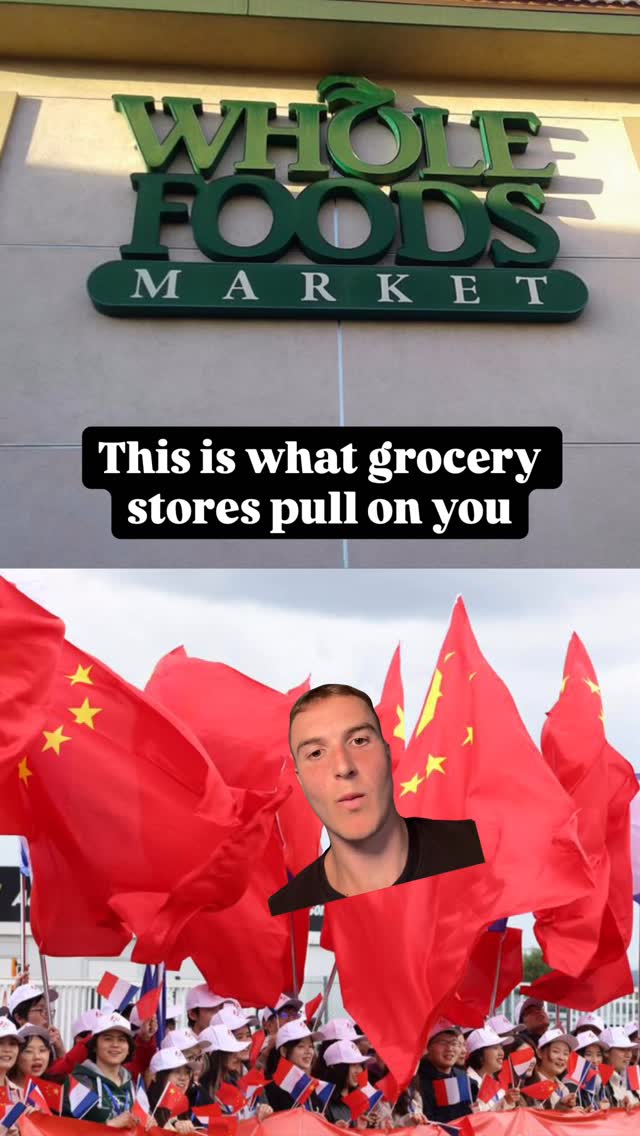
A shot of the recognizable Whole Foods logo is immediately juxtaposed with the creator's face overlaid on a crowd of people waving Chinese flags, creating a visually jarring and intriguing contrast.
[07]
Hook and payoff
The promise the opener makes, and how the video pays it back
Hook
A direct, personal question that frames the topic as a shocking, newly discovered secret, creating immediate intrigue and a sense of shared revelation with the audience.
Payoff
To frame the proposed solution as a return to a more authentic or morally correct ideal, providing a philosophical justification that elevates the call to action beyond a mere practical choice.
[08]
Narrative framework
The structural pattern this video runs on
Framework
The Exposé & Empower
To generate outrage against a trusted entity by revealing a 'hidden truth' and then channeling that outrage into a specific, actionable alternative, positioning the alternative as the morally superior choice.
1
The Legacy Exposé
To establish the claim's credibility and historical context by presenting third-party evidence (like a news report), proving the issue is not new or unfounded.
2
The 'Smoking Gun' Exhibit
To make the abstract problem tangible and personal by showcasing a specific, undeniable piece of evidence (like a product label) that demonstrates the entity's deception.
3
The Present-Day Escalation
To connect the past issue to the present by introducing a recent development that suggests the problem is unresolved or potentially worsening, maintaining urgency.
4
The Empowering Alternative
To pivot from problem to solution by presenting a clear, simple, and actionable alternative that allows the viewer to bypass the exposed entity entirely.
Themes
Corporate transparency
Consumer awareness
Support for local businesses
Deceptive marketing
Techniques
Use of archival news footage
Product label analysis
Juxtaposition
Trends
Brand takedown
Consumer advocacy
Post caption
A May 2008 investigative report exposed that Whole Foods’ 365-brand frozen organic vegetables including spinach, sugar snap peas ironically named “California Blend” were labeled “Product of China” in small print on the back of packages.
The organic integrity of these Chinese imports immediately drew scrutiny: The USDA doesn’t directly inspect imported organic foods, instead relying on private third-party certifiers authorized to approve use of the USDA organic label.
Not to mention, buying produce from China is completely illogical compared to supporting your small local farmers.
Whole Foods mostly stopped Chinese organic sourcing in 2010 after consumer backlash.
It’s now been almost 10 years since Amazon announced its acquisition of Whole Foods.
If you’re into health, you probably still view Whole Foods as a darling of this space.
But it’s been a long-time trend now in the wrong direction.
We need to get back to shopping local at farmers markets.
Comment “Localize” for the app
Text overlays
title · beginning
This is what grocery stores pull on you
contextual · beginning
Why am I just now finding out
contextual · middle
With 175 stores, Whole Foods is the undisputed leader in organic foods and promotes locally grown
contextual · middle
But the I Team has found that much of Whole Foods' organics are imported from China
informational · end
The message is really simple
call-to-action · end
Buy your produce from small local farmers
informational · end
This is really how it's meant to be and what Whole Foods' original ethos was
Transcript
Why am I just now finding out Whole Foods got completely exposed for sourcing produce from China? With a 175 stores, Whole Foods is the undisputed leader in organic foods and promotes locally grown. But the I team has found that much of Whole Foods organics are imported from China. Honestly, I would have never flipped it over to see that it was a product of China. So after all the backlash, they have drastically cut down on this, but come on. California blend on the front and product of China on the bad. It's absolutely ridiculous. Since then, we've seen Amazon acquire them, so can we really expect things to get better for Whole Foods going forward? The message is really simple. Buy your produce from small local farmers. This is really how it's meant to be and what Whole Foods' original ethos was.