Video #19405 · Talking Head Edit
Designer explains headphone stand shape originfrom @craighillcompany
A product designer demonstrates the flaw in traditional headphone stands using a visual hook, then uses modeling clay and a Pringle chip to explain the geometric solution (hyperbolic paraboloid) they implemented. He showcases the final product, validates it with a customer review, and concludes with a philosophy about caring for quality objects.
- 1Show damaging problem
- 2Reveal hidden geometry
- 3Compare to relatable object
- 4Demonstrate product solution
- 5Connect to emotional value
ConceptsOrigin StoryProduct ShowcaseBreakdown
ElementsB-Roll CutawayAnnotation Overlay
[05]
Hook analysis
What stops the scroll in the first 3 seconds
Title hook · 55%
Most stands leave a crease
Verbal hook · 30%
Most stands leave a crease in the headband, and we wanted to fix that with our design.
Visual hook · 15%
Close-up shot of a headphone band resting on a stand with a blue graphical line highlighting the pressure point and indentation.
[07]
Hook and payoff
The promise the opener makes, and how the video pays it back
Hook
The Evidence of Harm: Visually demonstrating the specific damage or annoyance caused by the status quo (the crease).
Payoff
The Philosophy of Care: Elevating the product from a simple utility to a symbol of respect for the user's belongings.
[08]
Narrative framework
The structural pattern this video runs on
Framework
The Tangible Proof Design Narrative
Validating a specific design choice by physically visualizing an invisible constraint and anchoring complex engineering to a relatable, everyday object.
- 1
The Physical Impression
Using a malleable medium (clay) to physically capture and reveal the 'invisible' shape required for the solution.
- 2
The Relatable Anchor
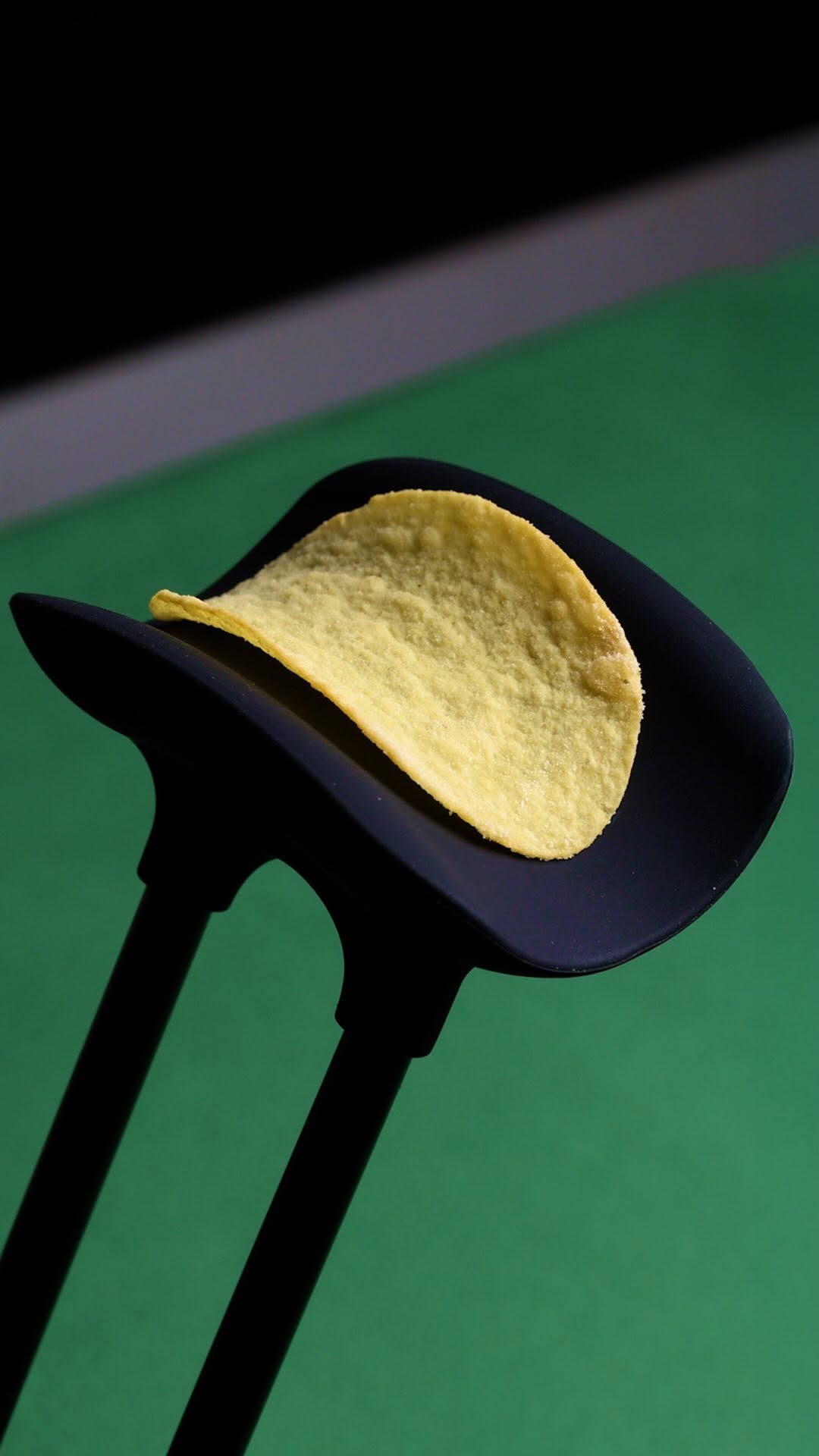
Translating the complex technical geometry (hyperbolic paraboloid) into a universally understood object (a Pringle) to demystify the engineering.
- 3
The Design Bridge
Visually transitioning from the relatable object directly to the product component, proving the design intent.
- 4
The Validation Loop
Citing specific user feedback that confirms the design solves the initial problem.
Themes
- Design philosophy
- Problem solving
- Quality care
- Attention to detail
Techniques
- Physical analogy
- Demonstration
- Social proof integration
Trends
- Design process reveal
- Oddly satisfying shapes
Post caption
To prevent creasing: hyperbolic paraboloid.
Many headphone stands with a simple bar or hook design can slowly crease and damage your headphone band over time.
We found that the Pringle shape was the perfect form to match a headphone band's curve and ensure no creasing occurs.
We love this form and are curious to know: what other objects share this saddle geometry?
Text overlays
title · beginning
Most stands leave a crease
contextual · beginning
in the headband
contextual · beginning
and we wanted to fix that
contextual · beginning
with our design.
informational · middle
Simple Elegance
informational · middle
I love this headphone stand not only for its sleek minimal design but also because the curved silicon cradle avoids leaving indentations in the headband padding—an appreciated and thoughtful detail.
Transcript
Most stands leave a crease in the headband, and we wanted to fix that with our design. If I press this clay onto the underside of the headband, the resulting shape is a hyperbolic paraboloid. The maybe most visually striking similarity is our favorite sour cream and onion Pringles. It curves upward in this yes, and it curves downward in this axis. You can see a very simple jump from this shape to the shape of the top of our headphone stand. We designed this form to as softly and nicely as possible cradle the underside of the headband of headphones. We have people who write in and tell us how much they like our headphone stand because it does not crease the headband. If you have a pair of headphones that you care about, you should have a home for them that reflects that care. And that's why we put so much thought into this shape of this cradle, the contact point for how the headphones are supported. It was trying to show care towards this object that many people care about.