@gsnwilliams
Instagram · Talking Head Edit
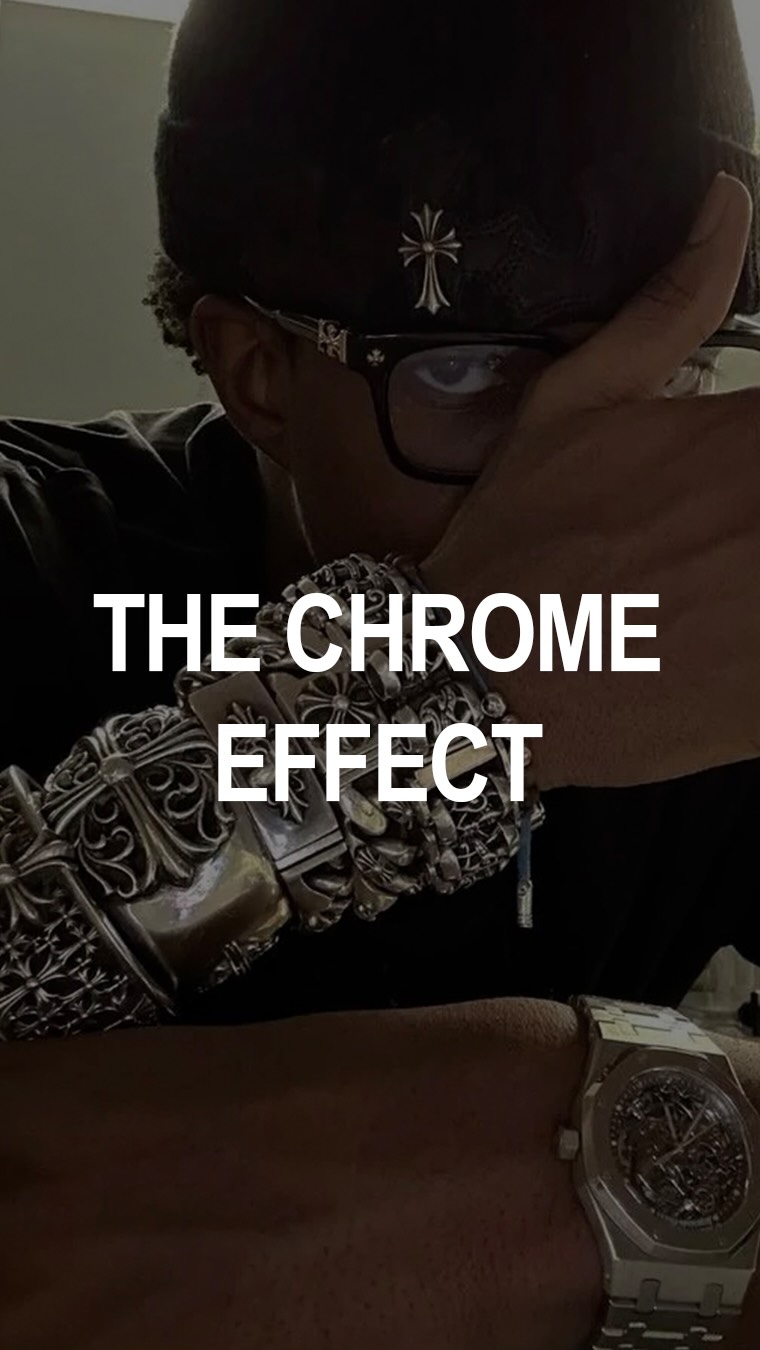
@gsnwilliams Why does every biker jewellery brand look like Chrome Hearts? #ChromeHearts #BikerJewellery #AGRockCouture #Gaboratory

@gsnwilliams
Instagram · Talking Head Edit
@gsnwilliams Why does every biker jewellery brand look like Chrome Hearts? #ChromeHearts #BikerJewellery #AGRockCouture #Gaboratory
Performance
Video #38687 · Talking Head Edit
[01]
The creator presents a historical deep dive into gothic biker jewelry, starting by challenging the common assumption that Chrome Hearts invented the style. He traces its origins from post-revolution Mexico, through its adoption by rock musicians in Britain via The Great Frog, to its development in LA by Gabor Nagy. The creator then explains how Chrome Hearts built a luxury brand around this existing aesthetic and achieved global recognition, concluding that their dominance has overshadowed the style's true, more diverse history.
[02]
[03]
 499.1K145.7×Historical breakdown of streetwear origins@henrythekid · Culture Profile
 60.1K2×Showcasing creators of heritage style@ethan.lorin · Culture Profile
 459.8K87.6×History of rebel fashion explainer@henrythekidd_ · Breakdown
 9.7M2×Showcasing diverse men's fashion styles@wisdm · Evolution Showcase
 411.2K2.3×Cultural trend analysis with visuals@mirandadoesbrands · Breakdown
 552.7K20.6×Explaining an obscure aesthetic's origin@fakeplasticbrands · Breakdown
 600.6K24.4×Speedrunning dark historical aesthetics@fakeplasticbrands · Rapid Fire Listicle
 381.2K111.4×Cultural breakdown of Gen Z Catholicism@mirandadoesbrands · Breakdown
 770.1K1.7×Comparing three designers' jacket interpretations@frontoffice.co · Case Study Breakdown
 316K53.5×Explaining why rich people dress poor@peter_reitano · Breakdown
 485.7KCultural analysis of brand remixing@eugbrandstrat · Breakdown
 2.1MExplaining the evolution of status symbols@eugbrandstrat · Breakdown
[04]
[05]
What stops the scroll in the first 3 seconds
Verbal hook · 25%
Take a look at this ring.
Visual hook · 75%
An extreme close-up shot of an ornate, gothic-style silver ring on a person's finger, immediately focusing the viewer on the video's subject.
[06]
Steal this for your own video
An extreme close-up of that most people think they understand — but don't.
[07]
The promise the opener makes, and how the video pays it back
Hook
Presents a familiar object or idea to trigger a common assumption in the viewer, then immediately subverts that assumption to create a knowledge gap and a compelling mystery.
Payoff
Returns to the object or idea from the hook, revealing its true identity and context. This full-circle moment provides a satisfying resolution and delivers the final thesis, which redefines the viewer's entire understanding of the subject's history.
[08]
The structural pattern this video runs on
Framework
The Hidden Lineage
To deconstruct a popular assumption about an iconic subject by revealing its forgotten historical context and influences, ultimately reframing the subject's true innovation and legacy.
The Core Question
Explicitly states the central question or paradox that the narrative will solve, giving the viewer a clear reason to keep watching.
The Deep Origin
Traces the subject's aesthetic or conceptual roots to an unexpected and earlier point in history, establishing that the subject was not created in a vacuum.
The Evolutionary Path
Shows how the core concept evolved and was adopted by different cultures or subcultures, adding layers of historical context and demonstrating its journey.
The Key Precursor
Introduces a pivotal but lesser-known figure or entity that directly influenced the main subject, serving as the 'missing link' in the popular story.
The Reframing of Genius
Clarifies the main subject's true contribution, shifting the narrative from 'invention' to a more nuanced form of innovation like branding, synthesis, or popularization.
The Catalyst for Dominance
Explains the specific strategic events or partnerships that propelled the subject from a niche player to a globally recognized icon, answering 'how' it became so dominant.
Why does every biker jewellery brand look like Chrome Hearts? #ChromeHearts #BikerJewellery #AGRockCouture #Gaboratory
contextual · middle
Mexican Revolution
contextual · middle
Slash
contextual · middle
Ozzy Osbourne
contextual · middle
Gabor Nagy
contextual · end
Leonard Kamhout
contextual · end
Rei Kawakubo
branding · end
Dover Street Market
A look at this ring. Odds are you can guess the brand who made it without me telling you. Chrome Hearts, right? Except it isn't. Chrome Hearts might have popularized this style of gothic biker jewelry, but this aesthetic has existed long before the brand even started. So why does everything now get called a Chrome Hearts dupe? The origins of biker jewelry can be traced all the way back to Mexico following the Mexican revolution. As the peso lost its value, best people began melting down coins and transforming them into chunky rings decorated with skulls and indigenous motifs. This style was later popularized in Europe in places like Britain where this style of jewelry moved beyond motorcycle clubs and into music. When the great frog opened up on London's Carnaby Street in 1972, it began creating heavy silver skull rings for musicians and people surrounding the area. These have been worn by artists like Lemmy, Slash, Ozzy Osbourne, and members of Iron Maiden alongside many others. But in LA, the tier began developing into what we now recognize as gothic biker jewelry. And one of the most influential people in that scene was Gabor Nage. His brand Gaboratory became known for heavy silver crosses and skulls carved with these unsettling smiles. Gabor was also connected According to tier story repeated among collectors, best even helped install machinery inside tier early workshop. While the full extent of his involvement is hard to actually verify, his influence shows that Chrome Hearts wasn't creating this style of jewelry within isolation. What Chrome Hearts did best was build the luxury world round. Richard Stark best was build the luxury world around. Bruce Tier and John Bowman initially began by creating the leather clothing they couldn't find anywhere else. They brought in silversmith Leonard come out to create custom silver hardware, combining the premium leather with these gothic crosses. Chrome Hearts then expanded that identity beyond jewelry into clothing, eyewear, and furniture. While Chrome Hearts' celebrity following helped build the profile of the brand, Raekao Kubo gave the brand an important entry into Japanese fashion. In the early nineties, she showcased Chrome Hearts inside Comme des Garcons' Iyama flagship. This relationship later continued through Dover Street Market, helping Chrome Hearts go from a niche American biker label to a globally recognized luxury brand. And that brings us back to the ring I showed you in the beginning. It was made by a brand called A and G Rock Couture. This was founded by Amalgasous, and they emerged during the same era and created their own interpretation of luxury rock and roll jewelry. But its similarities to chrome hearts eventually led to multiple legal disputes between the brands over certain designs rank trademarks. But A and G wasn't just some brand that decided to wake up and start copying chrome. Chrome didn't invent every skull, cross, or heavy silver rank, but it became so much bigger than the movement surrounding it that we now remember the entire history through chrome hearts. So when a ring looks like this, it probably isn't a fake chrome piece. It might just be another bit of history that we forgot.