@npr
Instagram · Skit
@npr Update: The U.S. Federal debt is now over $40 trillion If the debt gets too high, what EXACTLY is the bad thing that happens? From the @planetmoney archives Producer: @jackcorbe • Jack Corbett / NPR.

@npr
Instagram · Skit
@npr Update: The U.S. Federal debt is now over $40 trillion If the debt gets too high, what EXACTLY is the bad thing that happens? From the @planetmoney archives Producer: @jackcorbe • Jack Corbett / NPR.
Performance
Video #40587 · Skit
[01]
The creator uses a metaphor of walking on thin ice to explain the risks of high government debt. He breaks down three potential negative outcomes (default, hyperinflation, and crowding out), explains the concept of snowballing interest, and concludes by discussing why simply paying off the debt can also be harmful, emphasizing the need for economic growth to outpace debt growth.
[02]
[03]
 2.1M2.6×Car rant debunking who actually drives the national debt@bradley.thor · Hot Take
 648.6K38.1×Skit explains complex economic topic@npr · Breakdown
 532.4KPassionate car rant against selling public lands to corporations@bradley.thor · Breakdown
 923.9K1.1×Satirical car rant on bad economic and tax policy@bradley.thor · Hot Take
 699.3KCar rant on how recessions benefit the wealthy at everyone else's expense@bradley.thor · Hot Take
 920.8K23.7×Expert explains impending supply crisis@bfmradio · Opportunity Explainer
 961.8K23.9×Satirical explainer on economic inequality@npr · Opportunity Explainer
 174.8K47.2×Creator explains ski town crisis@realkylepetitt · Headlines
 581.4K9×Explaining a personal economic theory@fmsmith319 · Opportunity Explainer
 926KMonologue on savings milestone temptations@devantefields · Motivational Mantra
 1.3MSubway debate on saving vs spending@subwaytakes · Debate
 1.9M11.7×Evidence-based generational economic critique@fmsmith319 · Breakdown
[04]
[05]
What stops the scroll in the first 3 seconds
Title hook · 55%
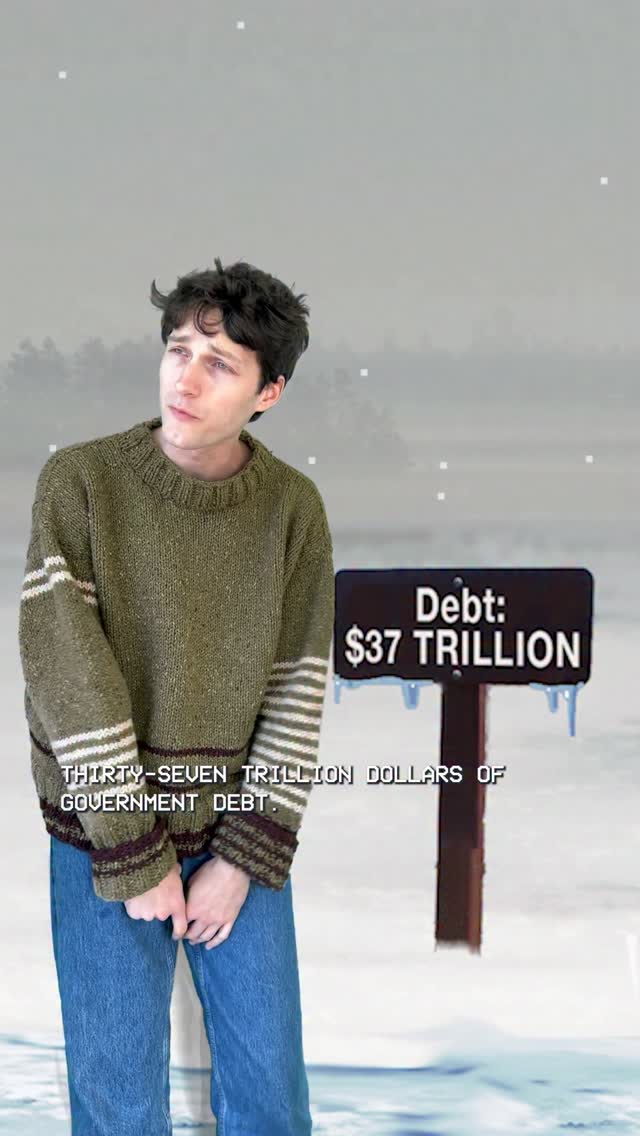
Debt: $37 TRILLION
Verbal hook · 40%
$37,000,000,000,000 of government debt.
Visual hook · 5%
A speaker is composited onto a stylized, snowy, pixel-art landscape next to a sign, creating a surreal and visually distinct setting.
[06]
Steal this for your own video
of .
[07]
The promise the opener makes, and how the video pays it back
Hook
Frame a complex problem as an unprecedented, high-stakes journey into uncharted territory, using a powerful metaphor to establish the danger (e.g., 'walking on thin ice').
Payoff
Conclude not with a comforting resolution, but by re-emphasizing the inherent complexity and uncertainty of the situation, ending on a note of dark humor or intellectual provocation that leaves a lasting impression.
[08]
The structural pattern this video runs on
Framework
The Unsettling Explainer
To deconstruct a complex, anxiety-inducing topic by presenting a list of potential negative outcomes, debunking the obvious simple solution, and concluding with the unsettling reality that the true path forward is a delicate, uncertain balancing act.
The Explicit Problem Statement
A proxy character voices the central question the audience is thinking, directly stating the video's purpose and promising a clear answer.
The Consequence Gauntlet
Systematically present a numbered list of potential negative outcomes, explaining each with a simple mechanism and a clear, visualized result, moving from simple to more complex concepts.
The Vicious Cycle Reveal
Escalate the threat by introducing a self-perpetuating negative feedback loop that makes the problem seem intractable and self-accelerating.
The Obvious Solution & Twist
A proxy character voices the audience's intuitive solution, which is then immediately and surprisingly debunked with a counter-intuitive historical precedent, creating cognitive dissonance.
The Paradox Explained
Detail the underlying logic for why the simple, intuitive solution is actually counter-productive, resolving the cognitive dissonance created in the previous beat.
The Core Balancing Act
Reveal the true, complex principle for managing the issue, shifting the viewer's understanding from a simple fix to a continuous, delicate process of managing competing forces.
Update: The U.S. Federal debt is now over $40 trillion If the debt gets too high, what EXACTLY is the bad thing that happens? From the @planetmoney archives Producer: @jackcorbe • Jack Corbett / NPR.
title · beginning
Debt: $37 TRILLION
contextual · beginning
DANGER THIN ICE
contextual · beginning
SERIOUSLY.
informational · beginning
Debt: $38 TRILLION
title · middle
Default
contextual · middle
not payin' it!
contextual · middle
GAME OVER
title · middle
CROWDING OUT
informational · middle
Debt interest
informational · middle
MORE Debt MORE interest
informational · end
A LOT MORE Debt A LOT MORE interest
informational · end
DEBT -> Investment -> GROWTH
$37,000,000,000,000 of government debt. No one's ever made it this far. How much further can we go before the ice cracks? No one knows. We could be really close to it cracking, or maybe we're not even halfway. If the debt gets too high, what exactly is the bad thing that's supposed to happen? Well, it might look like, one, we default on our debt. We miss our interest payments. People hesitate to lend us more cash. When countries do this, it usually doesn't go great, global financial crisis type thing. But two, since we're in control of the currency we owe, we good just print a ton of money and pay the debt off. This would result in, like, super mega inflation. Three, a thing called crowding out could happen. To take on debt, the government issues bonds, basically Yes, and pays interest on them. This could divert money away from productive investments like building factories or research, and this diversion drags the economy down. Also, now that we're way out here, there are new rank. Like this. Snowballing of best. We're making interest payments on our best, but to make those interest payments, we get into more debt, which leads to bigger interest payments. And then we need to get into more debt, and then even better, and then more debt. And then That sounds bad. Shouldn't we just pay it off? Yeah. We did that once. Right after that, we had the longest depression in American history. Why? To pay off debt, you're taxing, taking money out of the economy. Money that could be bouncing around inside of it as investment, causing it to grow. But if it grows the economy, the debt can be sturdy. Yeah. And some debt is weaker, like those interest payment snowballs. Those are relatively unproductive. In general, you just want your economy to grow faster than your debt. It's a balancing act no no one really knows how it works. Isn't that exciting?