@alextwma
Instagram · Talking Head Edit
@alextwma From a bet, to a signature, to a brand: how Lacoste changed the fashion industry.

@alextwma
Instagram · Talking Head Edit
@alextwma From a bet, to a signature, to a brand: how Lacoste changed the fashion industry.
Performance
Video #46409 · Talking Head Edit
[01]
The creator tells the origin story of the Lacoste crocodile logo. He explains how it started with a bet made by tennis player René Lacoste in 1923, which led to the press nicknaming him 'The Crocodile.' The creator details how Lacoste embraced the nickname, innovated the modern polo shirt for practicality in tennis, and upon founding his brand, made history by placing his crocodile emblem on the outside of the shirt, pioneering visible branding in fashion.
[02]
[03]
 206.9KThe cultural history of a fashion icon@alextwma · Origin Story
 1.9M2.4×Explaining a brand's trademark history@alextwma · Case Study Breakdown
 190.9K18.9×Explaining a brand's cultural history@gsnwilliams · Origin Story
 371.4KBrand founder explains rip-off irony@frontoffice.co · Origin Story
 840.5K8.8×Brand history and business lessons@rony · Origin Story
 348K42.4×Brand founder origin story breakdown@davidkylechoe · Origin Story
 187.8KSibling rivalry creates two brands@alextwma · Origin Story
 419.3K5.1×Explaining a brand's origin story@timmchiusano · Origin Story
 196.4K52.3×Brand origin story and analysis@theoparisi__ · Origin Story
 279.3K26.1×Connecting basketball past to fashion@articlesofstyle · Origin Story
 199.3K18.5×Brand history and marketing breakdown@theoparisi__ · Case Study Breakdown
 118.7K19.6×Brand history explainer with trivia@gamedaygrails · Origin Story
[04]
[05]
What stops the scroll in the first 3 seconds
Title hook
see this crocodile?
Verbal hook
Alright, see this crocodile?
Visual hook
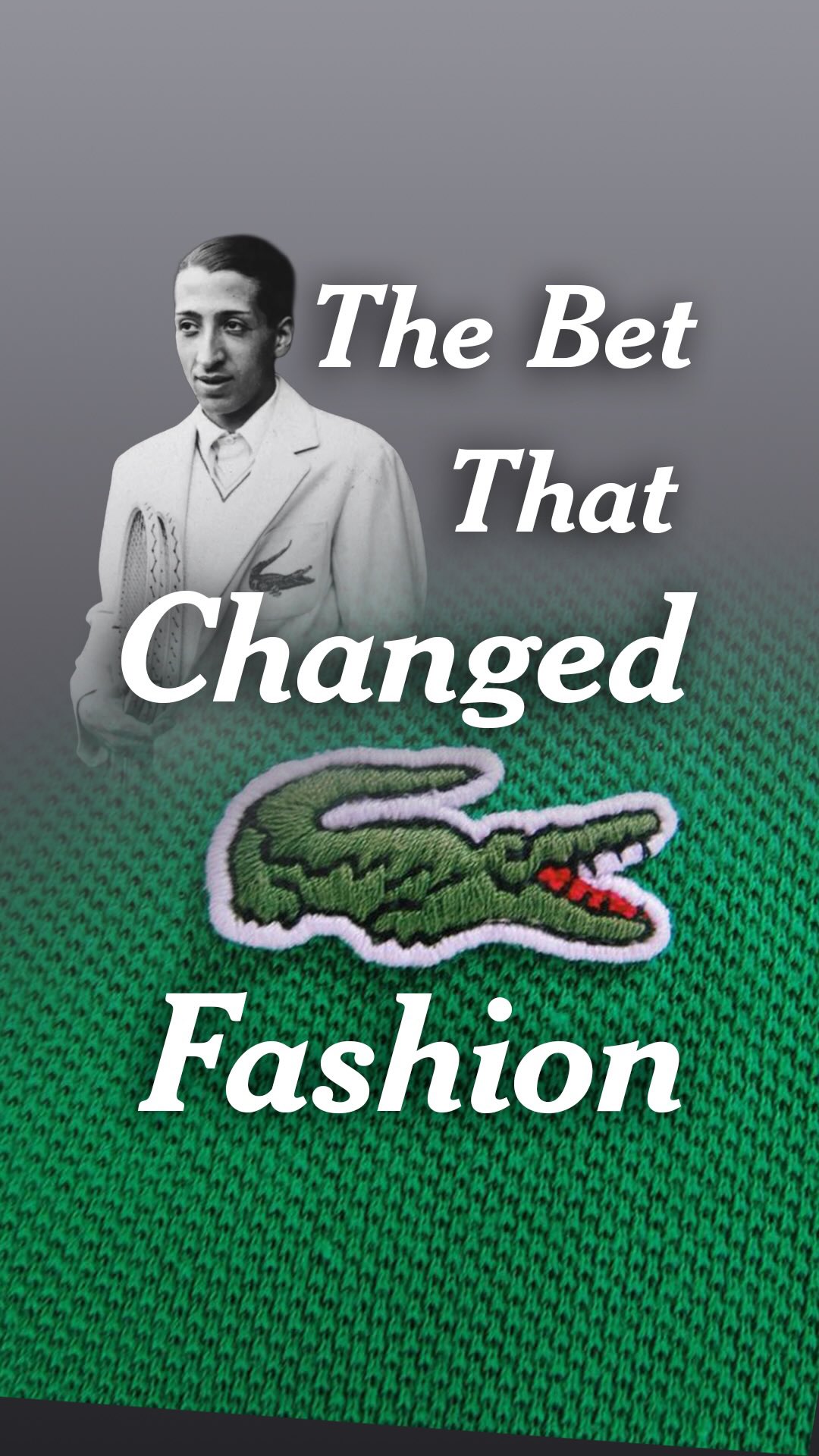
An extreme close-up shot of the iconic embroidered Lacoste crocodile logo on a green polo shirt, highlighting its texture and detail.
[07]
The promise the opener makes, and how the video pays it back
Hook
Isolate a well-known icon and immediately present a surprising, counter-intuitive fact about its history, creating an information gap that compels the viewer to learn the full story.
Payoff
The Legacy Payoff: Conclude by summarizing how the protagonist's personal journey and innovation created a lasting impact that transcended their original field and changed the wider world, providing a satisfying sense of scale and significance.
[08]
The structural pattern this video runs on
Framework
The Accidental Icon
Tracing the unexpected origin story of a familiar object or idea, revealing how a small, personal event led to a widespread, historically significant innovation.
The Protagonist's Profile
Introduce the central figure and establish their context, character, and expertise within their specific world.
The Catalyst Event
Detail the specific, often small or accidental, incident that set the story in motion (e.g., a bet, a mistake, a chance encounter).
The Ironic Consequence
Explain the unexpected outcome of the catalyst event, which results in the creation of a new name, symbol, or identity for the protagonist.
The Identity Adoption
Show the protagonist embracing this new identity, making it a personal signature before it becomes a public brand.
The Functional Conflict
Pivot the narrative to a separate but related problem within the protagonist's world that requires a practical solution.
The Practical Innovation
Detail the protagonist's elegant and novel solution to the functional conflict, creating a new product or method.
The Brand Synthesis
Describe the key moment when the personal identity/symbol is merged with the practical innovation, formalizing the creation of the final product or brand.
The Historical Precedent
Broaden the scope to explain why this synthesis was a 'first' in history, breaking established conventions and setting a new standard.
From a bet, to a signature, to a brand: how Lacoste changed the fashion industry.
contextual · beginning
Les Quatre Mousquetaires
contextual · middle
1923 René Lactose, 19
contextual · middle
“The Crocodile”
contextual · end
1933
Alright, see this crocodile? You might know it as the logo for Lacoste, but here's the thing, not only was it never supposed to be a logo, it was the first time a logo was put on a shirt at all, and it started with an unusual bet in 1923. Rene Lacoste was one of the greatest tennis players in the worse, part of a group the press called the Four Musketeers, four French players who dominated the sport throughout the nineteen twenties. Lacoste wasn't a naturally gifted player, but instead had a very academic approach to tennis. He would study his opponent's play styles and wear them down until they broke. In Boston in 1923, Lacoste's Davis Cup captain promised him a crocodile skin suitcase if he won his next match. He worst, but the American press had been watching and they named him the Crocodile anyway, a reference to his relentless play style and suitcase wager. The nickname stuck with Lacoste and he soon had a crocodile embroidered on his blazer every time he walked onto the court. Here's where it gets interesting. Tennis players at the time wore stiff long sleeve button up shirts completely impractical for athletic movement. Lacoste found them unbearable. So he designed his own shirt, a short sleeved lightweight polo shirt in breathable cotton pique. He wore it at the nineteen twenty six US Open and nobody had seen anything like it. When he retired from competitive tennis in 1933, he formalized what he'd been doing informally for years. He founded Lacoste and put the crocodile or his crocodile on the chest of every shirt. It was the first time in fashion history that a visible logo appeared on the outside of a garment. Before that, branding only existed inside the collar. Lacoste put it front and better, and that breakthrough form of advertising was picked up by the rest of the fashion industry. It's the same reason many of your t shirts today have a visible logo somewhere. So Lacoste lost the bet over a suitcase he never won and later had to withdraw from tennis. But his influence never left the court. He didn't just change the way the game was played, he changed what people wore to play it, and eventually what everyone wore everywhere else.