@fineasjackson
Instagram · Talking Head Edit
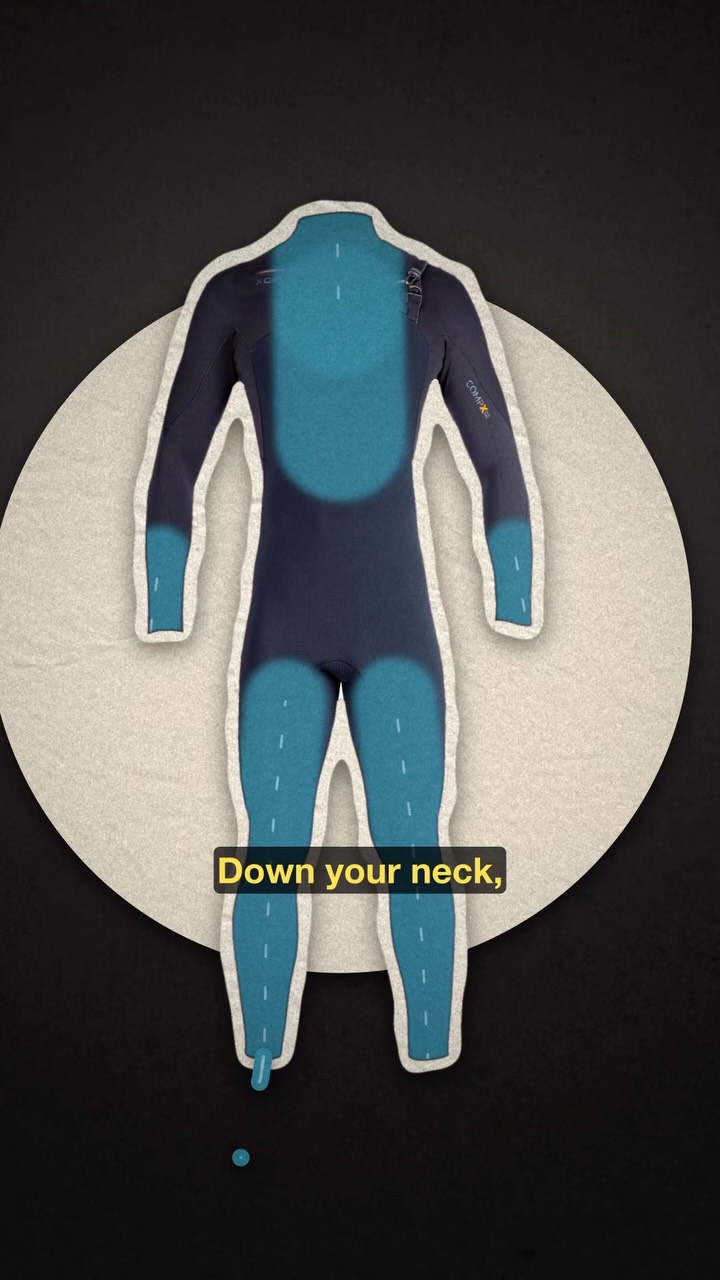
@fineasjackson A wetsuit isn’t waterproof. On purpose. But why?

@fineasjackson
Instagram · Talking Head Edit
@fineasjackson A wetsuit isn’t waterproof. On purpose. But why?
Performance
Video #48149 · Talking Head Edit
[01]
The creator explains the paradoxical science of how wetsuits work by first establishing that they are not waterproof. He then delves into the history of cold-water diving suits, detailing the failures of the 'stay dry' method with rubber and wool, and introduces the nuclear physicist who eventually invented the modern wetsuit.
[02]
[03]
 548.2K1.6×Explaining waterproofing beyond the coating@sakata.ken · Breakdown
 380.4K2.2×Explaining waterproof clothing design principles@frontoffice.co · Explainer
 276.2K17.6×Explaining Japan's fan-cooled work jackets@fineasjackson · Opportunity Explainer
 2.8M2.4×Testing a vintage self-cooling bag@theironsnail · Strange but True
 634.6K34×Explaining hidden suit quality differences@fineasjackson · Breakdown
 9.8M564×Explaining wool jacket tech benefits@thisisantwon · Product Demo
 269KBurberry's techwear origin story@frontoffice.co · Origin Story
 1.6M1438.9×Documenting a DIY product invention@paulasojoro · Journey Documentation
 3.7M5×Explains historical sweater knitting technique@theironsnail · Breakdown
 464.6K6.4×Explaining a creative design solution@yitaigeng · Origin Story
 349KWhy durable clothes still create waste.@frontoffice.co · Breakdown
 209.9KMyth-busting the Aran sweater story@theironsnail · Breakdown
[04]
[05]
What stops the scroll in the first 3 seconds
Verbal hook · 100%
Look at this suit, it isn't waterproof.
Visual hook
A medium close-up of an expressive speaker talking directly to the camera, creating an immediate personal connection.
[06]
Steal this for your own video
Look at this , it isn't .
[07]
The promise the opener makes, and how the video pays it back
Hook
Present a common object or idea and immediately state a paradoxical or counter-intuitive fact about it, creating an instant knowledge gap.
Payoff
End on a cliffhanger by fully introducing the 'hero' and their credentials but withholding the actual solution, thus creating anticipation for a subsequent part.
[08]
The structural pattern this video runs on
Framework
The Paradoxical Origin Story
To explain the 'why' behind a common object or concept by first presenting a counter-intuitive paradox about it, then tracing the history of failed attempts to solve the underlying problem, and finally introducing the unlikely hero or breakthrough that led to the current solution.
The Counter-Intuitive Hook
State a surprising, counter-intuitive fact about the subject that defies common sense.
The Confounding Evidence
Provide evidence that deepens the paradox, showing two conflicting realities co-existing.
The Core Mystery
Explicitly state the central question that the paradox raises, framing the rest of the video as the answer.
The Historical Context (The Old Way)
Introduce the previously accepted solution or paradigm that the subject replaced.
The Flaw in the Old Way
Explain the critical weakness or failure point of the old paradigm, demonstrating why a new solution was necessary.
The Montage of Failure
Showcase a rapid succession of other failed attempts to solve the problem, emphasizing the difficulty and desperation of the search.
Raising the Stakes
Escalate the importance of the problem by connecting it to a high-stakes group or situation (e.g., military, survival).
The Unexpected Savior
Introduce the inventor or source of the solution, highlighting their unexpected or unrelated background to create intrigue.
The Savior's Origin Story
Provide a brief, compelling backstory that establishes the credibility and authority of the 'savior,' setting the stage for the reveal of the solution.
A wetsuit isn’t waterproof. On purpose. But why?
branding · beginning
"Chasing Beauty" Episode 93
contextual · middle
WOOL
contextual · middle
RUBBER
contextual · end
Hugh Bradner
contextual · end
1943
contextual · end
1945
contextual · end
1951
Good at this suit. It isn't waterproof. The second you jump in, cold water pours inside. Down your neck, up your sleeves, right against your skin. And yes, in this, surfers can sit in near freezing water for hours. So how does a suit that lets the water in keep you warm? This is Chasing Best episode 93 rank today we're looking at the wetsuit. Before the wetsuit, the whole idea was to stay dry. In the early nineteen fifties, a diver in cold water wore a rubberized suit with thick wool underwear underneath. The wool kept them warm and the rubber kept the water out until it didn't. If water got in, it flooded the wool and the wool stopped working. So divers tried everything else. Long johns, surplus air force survival suits. Some just greased up their skin and the navy had it worse. Its frogmen had to stay in cold water for long stretches And staying dry wasn't working. The answer came from a nuclear physicist. Hugh Bradner had helped build the atomic bomb. In 1943, he was recruited to Los Alamos for the Manhattan Project.