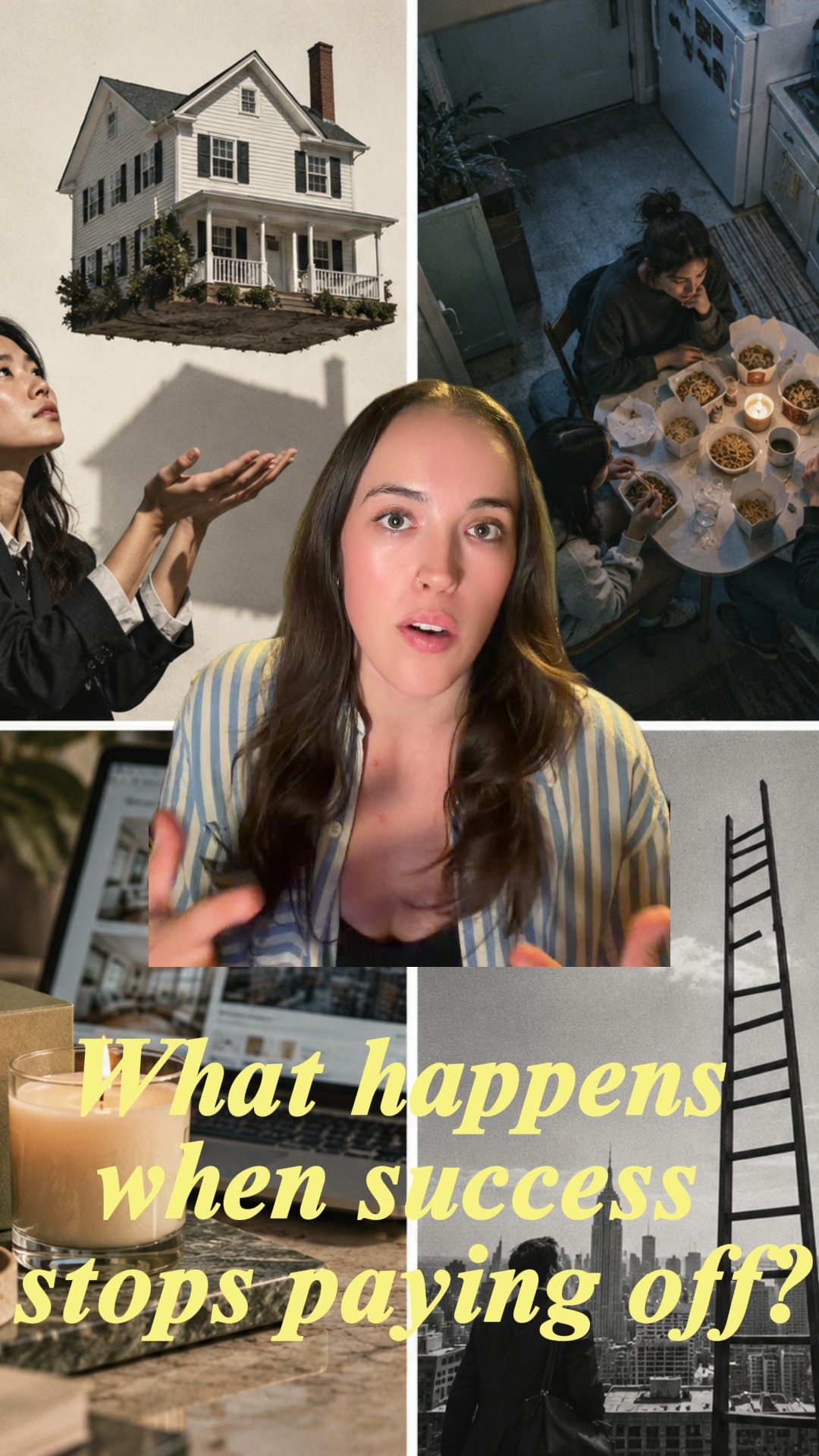
The creator defines and explains the concept of the 'duppie' (downwardly mobile professional), contrasting this new social class with the 'yuppie' of the 1980s. She uses a variety of visual aids, including charts, memes, and archival footage, to illustrate how economic stagnation has created a generation with high cultural capital but low financial capital. The creator analyzes the characteristics, struggles, and psychological effects on this demographic, arguing that traditional markers of success like a college degree no longer guarantee upward mobility.
Post caption
In the ’80s we had the yuppie. Today we have the duppie (originally “depressed urban professional,” which also tracks, but I think “downwardly mobile” is more accurate now). We have many of the same aspirations and tastes, but are struggling to achieve ownership (and thus, build wealth).
The degree used to be the ticket in, but now everyone has one, and the things that helped ensure a middle-class life (housing, healthcare, childcare, education) have gotten so expensive that a “good” salary just doesn’t buy the life it used to.
Transcript
Tier currently witnessing the rise of the downwardly mobile professional, which is a generation that has inherited all of the cultural best of the upper middle class, but absolutely none of it's well. So there's a tier that's going around called dubby, which stands in contrast to the yuppie, which is a well educated, affluent young adult who thrived in major cities during the economic boom of the nineteen eighties, having a very clear runway into the middle and even upper middle class. Yuppie bad in the eighties was able to successfully convert their income into wealth. The Yuppie is following this exact same playbook, but getting met with economic stagnation. Better the cultural class language that yuppies and now ws have are actually quite similar. They know what books to read. They know what everyone's rank about... Talking about. They know what the new hot restaurant is, and yet tier are struggling economically. They are splitting a two bedroom with three people. They're ordering dinner on an app they can't really afford. And in some cases, they might be getting help from their parents to avoid fully backsliding. They're priced out of a lot of the milestones of American life, and they're over... Often overqualified and underemployed. A lot of the core mentalities of yuppies worse greed is good, being hypercompetitive, materialistic, and very deeply invested in traditional corporate structures. While w's, on the other hand, are much more disillusioned. You know, they're stripped of a lot of faith in traditional institutions. This is really a story about people who did everything right. You know, they collect the degrees. They sign the student loan paperwork and play by the rules of a twentieth century meritocracy. And the degree specifically used to be the ticket in, but now everyone has one. So the edge it gives you keeps shrinking. Right now, recent grads are actually more likely to be unemployed than the average worker, which basically never used to happen. At the same time, the things that actually made you middle or upper middle class, like housing and health care and childcare and education, have gotten so good that even a good salary doesn't buy the life it used to. And that does something really specific about how you think about money. There's a term for it called status incongruity, and it basically means that you're rich in cultural capital as in to the taste, the education, the references, and poor rank actual capital. And that gap feels terrible. So people try to close it in the only way they can, which is by spending. Maybe you can't afford the house, but you can buy that $8 candle, so to speak. Or we see people go in the opposite direction where they stop saving because the down payment feels mathematically impossible, and your debt just becomes another bill that you assume you'll pay forever. And the whole theme of the w is really just proof that the better, for a lot of people, is starting to move backwards. And so for a lot of us, that cultural taste is the only inheritance we're gonna