Post caption
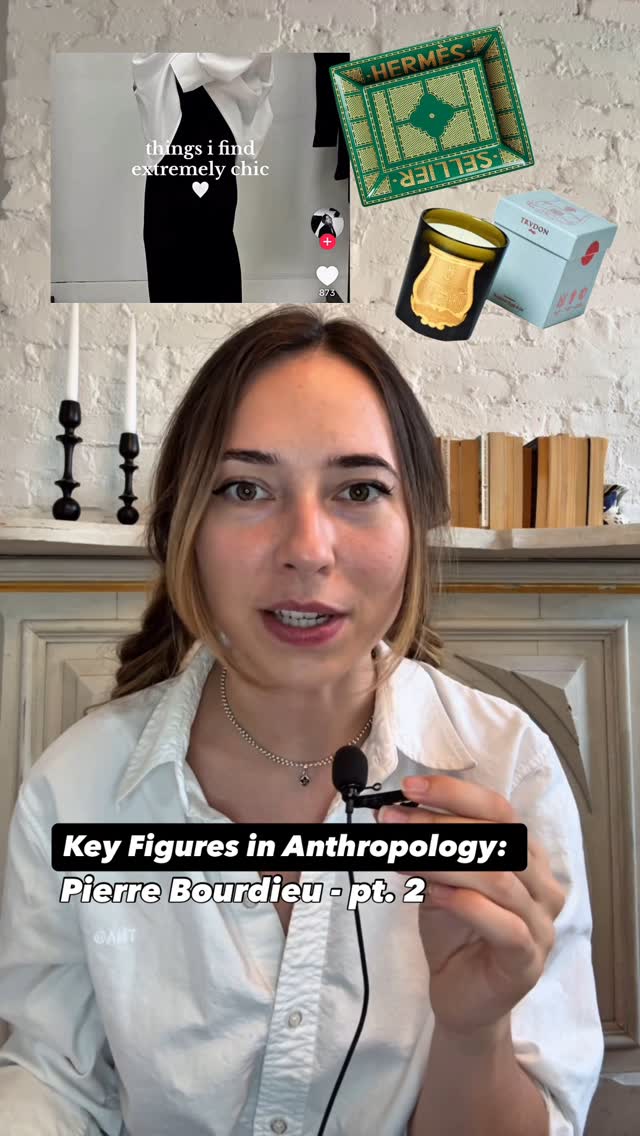
Today, we go over why social media isn’t going to be the great equalizer everyone thinks it’s going to be when it comes to the taste of the elite. What do you think? This is part 3 of my series breaking down the work of Pierre Bourdieu.
Transcript
The elite will never accept you, no matter what you do. And here's proof. In a previous video, I talked about French sociologist Pierre Bourdieu's concept of taste being a weapon used in social and class warfare. And on that video, I got a few comments saying something along the lines that social media is gonna be an equalizer when it comes to the taste of the elite. And while I see this happening currently as well, I wouldn't go as far to say that social media has the power to close that gap. For two reasons. First, the codes will always be shifting. One example of this is with luxury logos. In the eighties and nineties, conspicuous logos were the height of luxury signaling. But then mass accessibility happened. Counterfeits flooded the market, middle class people started buying entry level logo pieces, and suddenly logos became declasse. So what did the elite do? They pivoted to quiet luxury, like your lower piano, the robe, Brunello Cuccinelli. The code became, if you know, you know. And if you don't know, if you're still wearing logo belts, you've revealed yourself. Where the trap lies is by the time you've learned the new code, it's already begun shifting again. Bourdieu called this the cultural arbitrary, which is a topic that deserves its own video. So if you wanna see that, be sure to like and follow. But broken down simply, it's the notion that there's nothing inherent about the hierarchies that exist in our society. Classical music is not objectively better than pop music. French cuisine is not objectively more sophisticated than soul food. And while these hierarchies are real and have real consequences, tier are socially constructed in order to exert power. That's why when suddenly the middle class begin to adopt markers of the elite, the pendulum shifts because it benefits those in power to distance themselves from the middle class. The second reason kind of touches on Bourdieu's theory of habanist, which is the idea that your taste is internalized through your upbringing. Someone born into privilege learns taste without effort. They go to museums as a child and not as a school field trip, but as a casual weekend outing. They travel to Europe no to see the sites, but to visit family friends in the countryside. And Bourdieu's devastating insight is that cultural capital has very little to do with knowing things. But to perform them with ease, that's where the magic lies. If you were to compare with someone who acquired the knowledge later on in life through effort, you'd see they've read the books, taken the wine courses. They know the same things, probably more things, but it shows. Boruju would say you can acquire the knowledge, but can you acquire the disposition? The ability to care and not care in the exact right measure. Can you perform indifference convincingly? For most people, no. Because the ease itself is a product of privilege. It requires never having to try. In a future video, I plan on answering the question, if all of this even better. So if you want to see that, be sure to like and follow and leave a comment below with your thoughts.