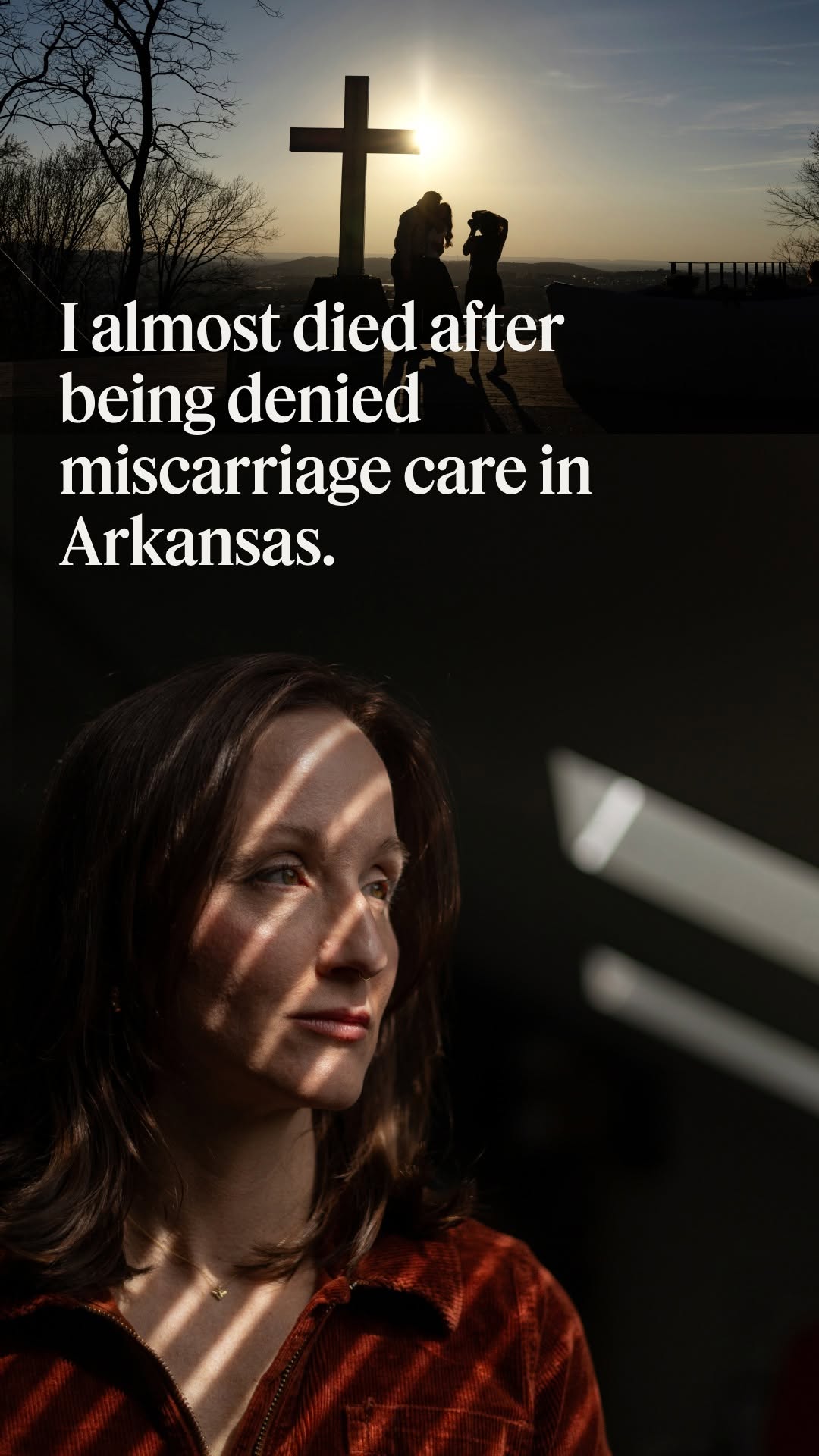
@propublica On Sept. 16, 2024, Emily Waldorf’s daughter found her curled up on the bathroom floor, bleeding during a dangerous miscarriage at 17 weeks pregnant.
Waldorf and her husband rushed to an Arkansas hospital, expecting emergency care. Instead, doctors told her they could not intervene under the state’s abortion ban because a fetal heartbeat was still present.
Doctors told her she could remain at the hospital until she got sick, or drive nearly four hours to a hospital in Kansas, which has no abortion ban.
She had worked at the Arkansas hospital for the past six years. She was a highly educated 38-year-old woman with connections to the governor. Even after she met the hospital’s CEO, called the governor and hired a lawyer, she still could not get care.
As she lay in a hospital bed, worried that infection could enter her uterus at any moment, she finally understood that the ban now applied to anyone losing a baby.
Watch her tell her story.
Denied miscarriage care personal storyfrom @propublica
[01]
Overview
A woman, Emily Waldorf, recounts her life-threatening experience of having a miscarriage at 17 weeks and being denied medical intervention at a hospital in Arkansas due to the state's abortion ban. She details the three conditions under which doctors could act—her becoming sick, the fetus's heart stopping, or natural delivery—and her decision to travel to Kansas for care after her water broke. Waldorf, a former employee of the hospital, explains how the trauma led her to quit her job and now advocate for change, arguing that healthcare access shouldn't be determined by one's zip code.
They're gonna let me die before they'll deliver this baby.
Visual hook · 35%
An emotionally charged, tight close-up shot of a woman speaking directly to the camera with a serious and pained expression, creating immediate human interest and emotional weight.
[06]
Hook template
Steal this for your own video
They're going to let me [devastating outcome] before they'll [basic action anyone would expect].
— They're going to let me lose my house before they'll process my insurance claim.
— They're going to let me fail out before they'll give me access to disability accommodations.
— They're going to let me go bankrupt before they'll approve my medical coverage.
[07]
Hook and payoff
The promise the opener makes, and how the video pays it back
Hook
An emotionally extreme statement that immediately establishes a life-or-death conflict and frames the central problem before any context is given.
Payoff
The transformation of personal suffering into a clear, actionable, and morally resonant message for the audience, giving the story a greater purpose.
[08]
Narrative framework
The structural pattern this video runs on
Framework
The Personal Crisis to Systemic Indictment
To transform a personal, emotionally charged story of institutional failure into a universal call to action by systematically escalating the stakes and revealing the systemic flaws that caused the crisis.
1
The Shocking Premise
A direct, high-stakes statement that summarizes the core injustice of the story, hooking the viewer with the emotional peak of the conflict.
2
The Factual Grounding
A brief, clear explanation of the initial situation and the technical/factual context needed to understand the conflict that follows.
3
The Institutional Barrier
The moment the protagonist's expectation of a normal resolution is denied by a system, rule, or institution, presenting an impossible set of conditions and creating the central conflict.
4
The False Hope Escalation
A new development that should logically resolve the crisis but instead makes it worse, demonstrating the system's fundamental flaw and the protagonist's powerlessness.
5
The Emotional Core
A beat dedicated to the protagonist's internal feeling of despair, abandonment, or betrayal, solidifying the emotional connection with the audience.
6
The Layer of Irony
A revelation that adds a layer of personal betrayal or cruel irony to the situation, such as the protagonist being a part of the very system that failed them.
7
The Universal Bridge
The moment the narrative explicitly transitions from the personal story to a broader critique, questioning how the systemic failure affects others and turning a personal anecdote into a societal warning.
8
The Statement of Purpose
The final beat that reframes the traumatic experience as a motivation for a larger cause or a clear moral lesson, providing a powerful and shareable payoff.
Themes
Healthcare access
Bodily autonomy
Legislative impact
Medical ethics
Personal trauma
Techniques
Personal storytelling
Documentary filmmaking
Emotional appeal
Post caption
On Sept. 16, 2024, Emily Waldorf’s daughter found her curled up on the bathroom floor, bleeding during a dangerous miscarriage at 17 weeks pregnant.
Waldorf and her husband rushed to an Arkansas hospital, expecting emergency care. Instead, doctors told her they could not intervene under the state’s abortion ban because a fetal heartbeat was still present.
Doctors told her she could remain at the hospital until she got sick, or drive nearly four hours to a hospital in Kansas, which has no abortion ban.
She had worked at the Arkansas hospital for the past six years. She was a highly educated 38-year-old woman with connections to the governor. Even after she met the hospital’s CEO, called the governor and hired a lawyer, she still could not get care.
As she lay in a hospital bed, worried that infection could enter her uterus at any moment, she finally understood that the ban now applied to anyone losing a baby.
Watch her tell her story.
Text overlays
contextual · beginning
Emily Waldorf
Physical Therapist
contextual · beginning
Washington Regional Hospital
Fayetteville, Arkansas
informational · beginning
1.) Become sick
informational · middle
2.) Fetus' heart stops beating
informational · middle
3.) Deliver naturally
contextual · middle
ARKANSAS
strict state abortion ban
contextual · middle
The University of Kansas Hospital
Kansas City
contextual · middle
Emily during her ride
from Arkansas to Kansas
call-to-action · end
PROPUBLICA
Life of the Mother
She Faced a Life-Threatening Miscarriage. Under Arkansas' Abortion Ban, Even Calls to the Governor's Office Didn't Help.
Head to the link in our bio to read more.
informational · end
Washington Regional Medical Center and the doctors involved in Emily Waldorf's care did not respond to questions.
informational · end
ProPublica asked the Arkansas State Medical Board, the governor's office and Republican lawmakers who sponsored the abortion ban whether they planned to issue guidance clarifying that doctors do not need to wait for signs of infection to treat miscarrying patients like Waldorf. Texas recently provided guidance that says doctors don't need to wait for miscarrying patients to get sicker before intervening. Arkansas and other states have not.
informational · end
The Arkansas Medical Board told ProPublica that the law is already clear enough. Medical boards in 18 other states with abortion bans either said they had no plans to issue new guidance or did not respond to ProPublica's questions. The governor's office also declined to respond.
informational · end
In response to ProPublica's questions, Mary Bentley, a Republican state representative and lead sponsor of the original ban, said she believes the law already allows doctors to provide abortions to women with preterm premature rupture of membranes (PPROM) and that physicians do not need to wait for signs of infection before acting. She said she is contacting the medical board about issuing guidance similar to Texas' and would support additional legislation if necessary.
Transcript
They're gonna let me die before they'll deliver this baby. When I was seventeen weeks pregnant, I had an onset of bleeding and I was diagnosed with cervical insufficiency, which is where your cervix shortens and dilates early. The OB told me that I would be miscarrying this baby. I thought that they were going to induce me to save my life, but instead I was told that either I needed to become sick, the heart needed to stop beating, or I needed to deliver naturally before anyone would intervene. After I'd been there for four days and my water broke, I thought, okay, this is when they're going to induce me, but instead, they told me that I had two options. I could either stay there and continue to be observed, or I could go to Kansas. That made me feel like nobody was going to care for me and they were going to let me die. I was an employee at the hospital that I was a patient at, so I ended up taking off three months from work and then going back and trying to be a good steward financially for my family and realizing that better day that I walked into that hospital I was re traumatized. So I quit my job. I wish that someone would have told me on Monday whenever I walked in those doors, hey, we can't help you. You need to go to Kansas now. But instead, I waited for five days and put my own life at rank, and it makes me think about other people that may not have the knowledge or may not ask the questions and how many more people are going to die because of these laws. Your zip code should not determine your health care. To be honest, I'm doing this for my own daughter and for her future, and she deserves a better future than what I got whenever I was pregnant.
Denied miscarriage care personal story | Viral Hooks