@fineasjackson
Instagram · Talking Head Edit
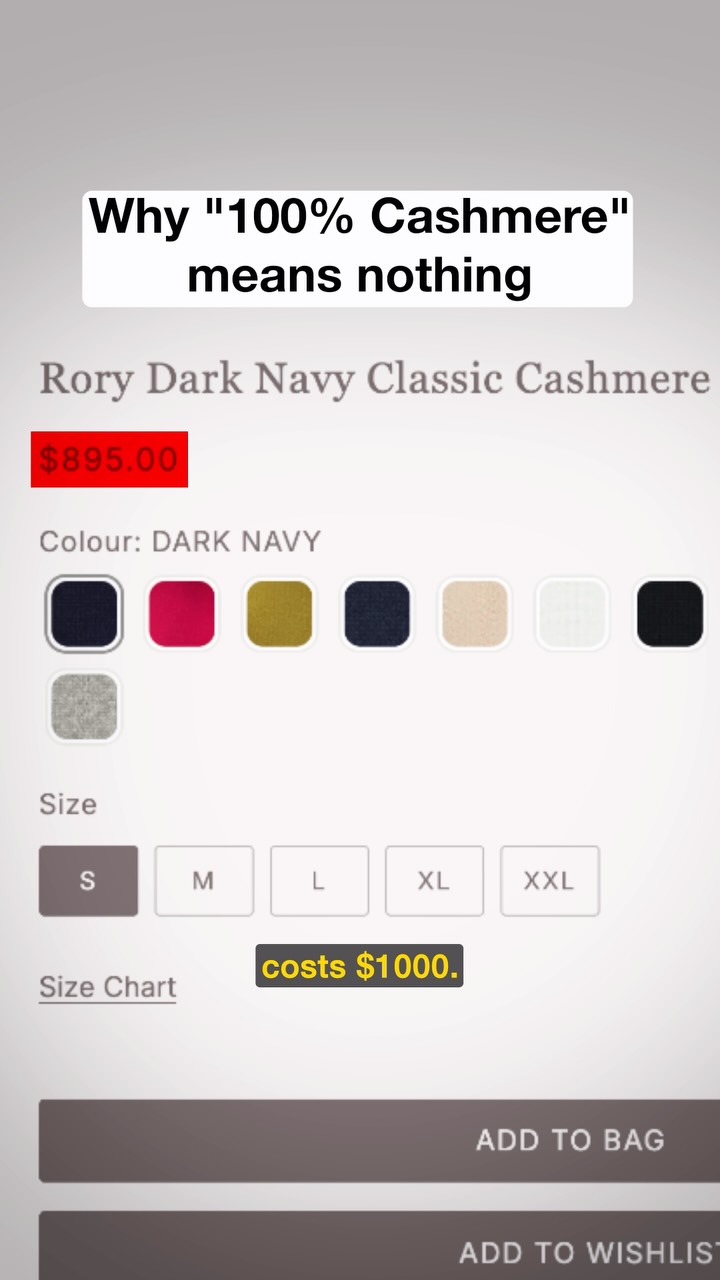
@fineasjackson If two sweaters are both 100% cashmere, then how can they be so different in price…?

@fineasjackson
Instagram · Talking Head Edit
@fineasjackson If two sweaters are both 100% cashmere, then how can they be so different in price…?
Performance
Video #38409 · Talking Head Edit
[01]
The creator poses a question about the vast price difference between two sweaters both labeled '100% Cashmere.' He then breaks down the legal definition of cashmere in the US, explaining that it's a broad term based on fiber diameter and origin from a 'cashmere goat,' which is not a specific breed. The video uses maps and B-roll to show where these goats live, explains how their dual-layer coat works, and illustrates the process of harvesting the fine undercoat, which is the actual cashmere fiber.
[02]
[03]
 454.6KCashmere history and quality breakdown@maisonrickie · Breakdown
 564.7K10.1×Ranking the world's softest wools@fineasjackson · Explainer
 278.1K19.4×Explain hoodie quality and pricing@fineasjackson · Breakdown
 466.3K2.4×Outfit story reveals material lesson@itsjrue · Anecdotal Philosophy
 4.5M241×Explains why linen prices vary@fineasjackson · Breakdown
 1.2M16×Clothing quality check explainer@wangjenniferr · Tutorial / How To
 593K41.9×Explaining the satin marketing loophole@fineasjackson · Breakdown
 266.1K28×Historical breakdown of wool types@gents.studios · Hot Take
 655.4K3.5×Wool science and fabric choices@frontoffice.co · Breakdown
 1.7M25.8×Cheap vs expensive cotton explained@fineasjackson · Breakdown
 229.8KExplains sweater controversy with history@theironsnail · Origin Story
 634.6K34×Explaining hidden suit quality differences@fineasjackson · Breakdown
[04]
[05]
What stops the scroll in the first 3 seconds
Title hook · 55%
Why "100% Cashmere" means nothing
Verbal hook · 40%
This cashmere sweater costs $50, and this one costs $1000.
Visual hook · 5%
The video opens with the creator pointing directly at the camera, followed by rapid cuts to screenshots of two product listings, with the vastly different prices ($59.90 vs $895.00) highlighted to create immediate visual contrast and intrigue.
[06]
Steal this for your own video
Why "" means
[07]
The promise the opener makes, and how the video pays it back
Hook
Juxtapose two seemingly identical items with the same label but a vast difference in price, posing a direct question about the discrepancy to create an immediate knowledge gap.
Payoff
The viewer gains 'insider knowledge,' understanding that the simple label they encounter in the marketplace hides a complex reality. This resolves the initial tension from the hook, leaving the viewer feeling empowered and informed.
[08]
The structural pattern this video runs on
Framework
The Deceptive Simplicity Blueprint
To expose the hidden complexity behind a seemingly simple label or term by systematically deconstructing its official definition, origin, and production process, thereby explaining a paradox in its value.
The Series Frame
Establishes authority and context by branding the content as an episode in an ongoing series, making the information feel more credible.
The Deceptive Standard
Presents the official, legal, or technical definition of the term. This acts as a red herring, as the definition itself is insufficient to solve the initial paradox, thus deepening the mystery.
The Semantic Twist
Reveals that a key component of the definition is a broad, non-specific category, not a single entity. This debunks a common misconception and delivers the first major 'aha' moment.
The Environmental Origin
Explains the specific geographical and climatic conditions required to produce the raw material, grounding the explanation in a real-world context and justifying its inherent qualities.
The Two-Layer System
Visually and verbally differentiates between the coarse, low-value outer component and the fine, high-value inner component of the source material.
The Harvest Ritual
Shows the labor-intensive process of extracting the valuable material from its source, connecting the natural origin to the human effort involved.
The Core Identity Reveal
Conclusively states that only the refined, high-value component is the 'true' subject, resolving the initial ambiguity of the label and providing a clear takeaway.
If two sweaters are both 100% cashmere, then how can they be so different in price…?
title · beginning
Why "100% Cashmere" means nothing
contextual · beginning
$50
contextual · beginning
costs $1000.
branding · middle
"Chasing Beauty" Episode 69
title · middle
CHAPTER I WHAT “100% CASHMERE” ACTUALLY MEANS
contextual · middle
Dairy cow
This cashmere sweater costs $50 and this one costs 1,000. They both say the same thing on the label, a 100% cashmere. So if they're made of the exact same material, how can they be that different in price? This is Chasing Beauty episode 69 and today we're pulling apart cashmere. In The US, a fiber can be called cashmere as long as it comes from the undercoat of a cashmere goat and averages at most 19 microns in diameter. So what does that mean? Well, the funny thing is a cashmere goat isn't actually one specific breed. It's a broad term like dairy cow. Cashmere goats are mainly raised across Mongolia, Northern China, and Central Asia where the winters are brutal. They grow a worse outer coat called guard hairs that holds up to the winter wind. Underneath is an incredibly fine crimped down that traps warm air against their body. In spring, that undercoat loosens and sheds. It gets combed or sheared off and separated from the worse hair. The down undercoat is cashmere, but that's basically as far as the a 100% cash