@fineasjackson
Instagram · Talking Head Edit

@fineasjackson Satin…of what? How can two satin products be priced so differently? #satin #fabric #education

@fineasjackson
Instagram · Talking Head Edit
@fineasjackson Satin…of what? How can two satin products be priced so differently? #satin #fabric #education
Performance
Video #17827 · Talking Head Edit
[01]
The creator begins by questioning the vast price difference between products labeled 'satin.' He explains that satin is a type of weave, not a material, and uses diagrams and footage to show how its structure creates a shine. He then reveals that brands exploit this by weaving cheap plastic materials like polyester into satin, and contrasts the poor moisture-wicking properties of polyester with the breathability of genuine silk. The video concludes by providing actionable advice for consumers, explaining the 'momme' weight standard for identifying quality silk and suggesting cotton sateen as a more affordable, breathable alternative.
[02]
[03]
 4.5M241×Explains why linen prices vary@fineasjackson · Breakdown
 278.1K19.4×Explain hoodie quality and pricing@fineasjackson · Breakdown
 1.2M16×Clothing quality check explainer@wangjenniferr · Tutorial / How To
 1.7M25.8×Cheap vs expensive cotton explained@fineasjackson · Breakdown
 1.6M2×Explaining luxury t-shirt manufacturing process@alextwma · Opportunity Explainer
 210.4K27.3×Five hidden clothing quality signs@gents.studios · Breakdown
 103.9K1.9×Explaining true T-shirt quality history@gents.studios · Breakdown
 266.1K28×Historical breakdown of wool types@gents.studios · Hot Take
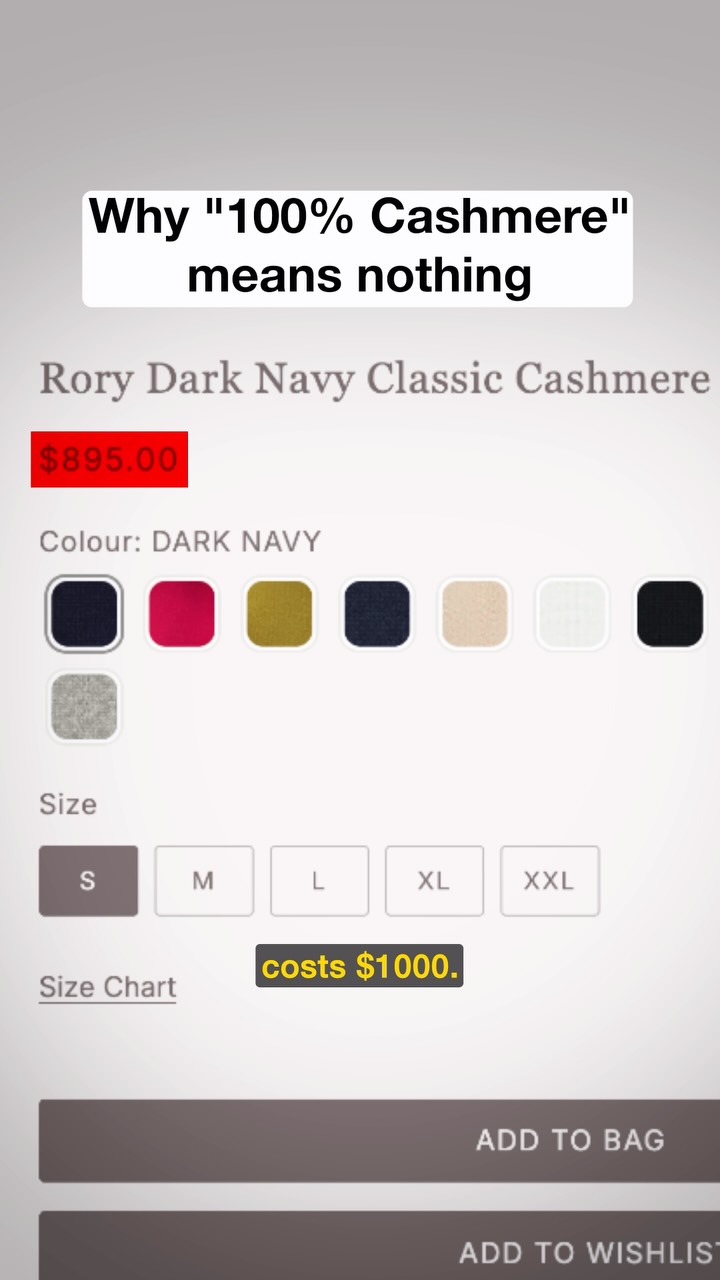 1.5M72.1×Explaining why cashmere prices vary@fineasjackson · Breakdown
 655.4K3.5×Wool science and fabric choices@frontoffice.co · Breakdown
 634.6K34×Explaining hidden suit quality differences@fineasjackson · Breakdown
 247.7K5×Clothing quality check: understanding seams@gents.studios · Explainer
[04]
[05]
What stops the scroll in the first 3 seconds
Verbal hook · 55%
Have you ever seen the word satin on a box and wondered how the exact same word can be used on two different products?
Visual hook · 45%
A direct-to-camera shot of the speaker, followed by a quick cut to a product shot of a 'Luxury Satin' sheet set box, creating a pattern interrupt and visual context for the verbal hook.
[07]
The promise the opener makes, and how the video pays it back
Hook
Present a relatable paradox where two products with the same name have vastly different prices, framing it as a 'marketing loophole' to create an immediate curiosity gap.
Payoff
Arm the viewer with a single, powerful question that encapsulates the video's core lesson. This transforms them from a passive consumer into an empowered decision-maker, providing a clear and memorable takeaway.
[08]
The structural pattern this video runs on
Framework
The Expert Loophole
To establish authority and provide high utility by identifying a common consumer paradox, revealing it's caused by a widespread misconception exploited by marketers, and then empowering the viewer with expert knowledge and a simple, actionable question to overcome it.
The Foundational Misconception
Reframe the viewer's understanding by revealing that the key term is not a 'thing' but a 'process'. This is the central 'aha' moment that unlocks the rest of the explanation.
The Technical Breakdown
Explain the mechanics of the 'process' using simplified technical details and visuals. This builds credibility and provides the scientific reasoning for the term's properties.
The Deceptive Application
Expose how the 'process' definition is exploited by brands, revealing that low-quality inputs can be used to mimic high-quality outputs. This introduces the central conflict.
The Empirical Proof
Provide a clear, data-driven comparison between the high-quality and low-quality inputs using a single, powerful metric. This validates the value judgment with objective evidence.
The Tangible Consequence
Translate the abstract data into a relatable, negative sensory experience that the viewer has likely felt, cementing the superiority of the high-quality option.
The Pro-Level Metric
Introduce a piece of insider terminology or a specific metric that allows viewers to identify true quality, elevating them from amateur to informed consumer.
The Accessible Alternative
Offer a practical, middle-ground solution that balances quality and cost, ensuring the advice is useful even for viewers not ready for the premium option.
Satin…of what? How can two satin products be priced so differently? #satin #fabric #education
branding · beginning
"Chasing Beauty" Episode 12
contextual · middle
Polyester satin
contextual · middle
Nylon satin
contextual · middle
Acetate satin
informational · middle
POLYESTER
informational · middle
SILK
title · middle
MOISTURE REGAIN
Have you ever seen the word satin on a box and wondered how the exact same word can be used on two different products? One priced at $30 and the other well over $500 It's the ultimate marketing loophole. This is episode 12 of Chasing Beauty and today, we're looking at the engineering behind the label. Satin is a weave, not a material. Most fabrics are held together by a ton of intersections. Threads crossing over and under each other constantly. Satin is built on floats. Long stretches where one thread glides over several others before finally dipping under. Fewer intersections means a smoother surface where light reflects more cleanly. That's the good, the luxury look. But here's where brands fool you. You can weave almost anything into satin. Polyester, nylon, rayon, acetate, even cotton. When a brand puts satin on the box without saying silk, they are selling you a shiny version of plastic. It has the same shine better a completely different biology from silk. But what even makes silk a better choice than polyester? Moisture regain. Silk is a protein that can absorb about 11% of its weight in moisture. It helps manage the microclimate between your skin and the sheet. Polyester is plastic. It can only absorb about 0.4%. That clammy stuck to the sheet feeling is sweat, literally trapped against your skin because plastic can't breathe. But it doesn't end there. Those long floats that create the shine can also snag more easily. This means that cheap silk will tear with only light use. This is where the luxury industry tries to trick you again. In silk, look for momethe, the weight standard for silk fabric. Higher momethe means more silk per area and more durability. For bedding, 19 to 22 momethe is the sweet spot. Durable, drapey, and smooth. If what you're actually looking for is the sheen and smoothness, but you're not interested in sleeping in plastic or paying silk prices, there's another option. Cotton sateen. Basically a satin weave, but typically done with cotton. It gives you that soft good, but the underlying fiber is still breathable. Next time you see that word, ask the only question that matters. Satin of what?