@maisonrickie
TikTok · Talking Head Edit
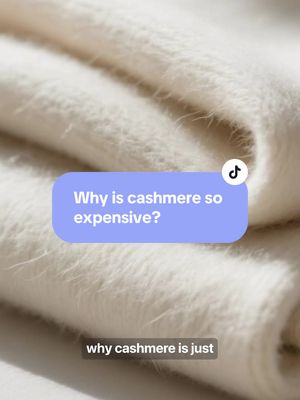
@maisonrickie Why is cashmere so expensive? Today we look into why that’s the case 🐐 Do you guys love your cashmere?

@maisonrickie
TikTok · Talking Head Edit
@maisonrickie Why is cashmere so expensive? Today we look into why that’s the case 🐐 Do you guys love your cashmere?
Performance
Video #10370 · Talking Head Edit
[01]
The creator explains the high cost of cashmere by detailing its geographic origins and production scarcity, recounts its historical rise in popularity due to Napoleon, and concludes with a practical guide on cashmere quality grades and pricing.
[02]
[03]
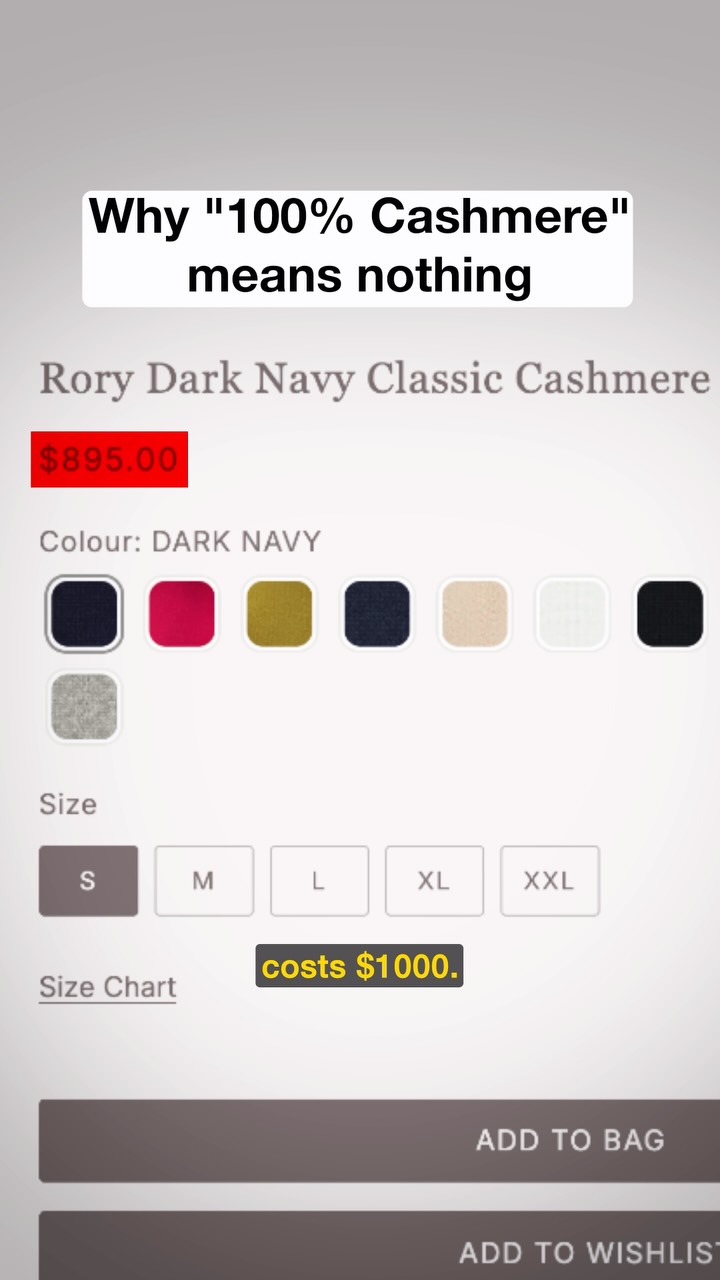 1.5M72.1×Explaining why cashmere prices vary@fineasjackson · Breakdown
 466.3K2.4×Outfit story reveals material lesson@itsjrue · Anecdotal Philosophy
 278.1K19.4×Explain hoodie quality and pricing@fineasjackson · Breakdown
 564.7K10.1×Ranking the world's softest wools@fineasjackson · Explainer
 266.1K28×Historical breakdown of wool types@gents.studios · Hot Take
 655.4K3.5×Wool science and fabric choices@frontoffice.co · Breakdown
 210.4K27.3×Five hidden clothing quality signs@gents.studios · Breakdown
 593K41.9×Explaining the satin marketing loophole@fineasjackson · Breakdown
 1.7M25.8×Cheap vs expensive cotton explained@fineasjackson · Breakdown
 1.3M1.6×Explaining why one fabric improves@alextwma · Breakdown
 1.6M2×Explaining luxury t-shirt manufacturing process@alextwma · Opportunity Explainer
 4.5M241×Explains why linen prices vary@fineasjackson · Breakdown
[04]
[05]
What stops the scroll in the first 3 seconds
Title hook · 55%
ever wondered why cashmere is just so damn expensive?
Verbal hook · 40%
Have you ever wondered why Kashmir is just so damn expensive?
Visual hook · 5%
Speaker sitting on a couch gesturing directly at the camera, followed immediately by a close-up texture shot of stacked cashmere sweaters.
[06]
Steal this for your own video
Ever wondered why is just so damn ?
[07]
The promise the opener makes, and how the video pays it back
Hook
The Price Paradox: Acknowledges the consumer's skepticism about the high cost of a common luxury item to establish immediate relatability.
Payoff
The Value Verdict: Identifies the 'sweet spot' tier where the average consumer gets the best return on investment.
[08]
The structural pattern this video runs on
Framework
The Luxury Deconstruction
Demystifying a high-status object by validating its cost through scientific scarcity and history, then empowering the viewer with a practical tiered buying guide.
The Biological Origin
Establishes the extreme geographic and environmental conditions required to produce the raw material.
The Scarcity Equation
Quantifies the difficulty of production using specific yield numbers (e.g., '3 to 6 goats per sweater') to logically justify the cost.
The Historical Validation
Connects the item to a specific historical figure or event to cement its cultural status and prestige.
The Market Segmentation
Breaks down the product category into three distinct tiers (A, B, C) based on price and quality.
Why is cashmere so expensive? Today we look into why that’s the case 🐐 Do you guys love your cashmere?
title · beginning
ever wondered why cashmere is just so damn expensive?
contextual · beginning
Club Monaco
contextual · beginning
Banana Republic
informational · beginning
The Kashmir Valley, Tibet, Ladakh
informational · beginning
Capra Hircus
informational · beginning
-40°C (-40°F)
informational · middle
3 to 6 goats
contextual · middle
Napoleon
contextual · middle
Josephine
informational · end
Grade A
informational · end
$1,000+
informational · end
Grade B
informational · end
$200 and $500
informational · end
Grade C
Have you ever wondered why Kashmir is just so damn expensive? Walk into a Club Monaco or a Banana Republic and they're selling for a couple $100. But are you actually getting what you're paying for? The answer might not be what you think. No, Kashmir originates from the Himalayas. Specifically the Kashmir Valley, Tibet, Ladakh, and Mongolia. Called cashmere because it was Kashmiri artisans who first mastered the processing and weaving technique to make quality garments. The fiber itself comes from a particular good, the capra herpes, also known as the pashmina good, which evolved is remarkably fine undercoat as protection against brutal winters where temperatures can plunge to negative 40 degrees Celsius. And as these particular conditions that make for the best quality catamaran. So much so that attempts to relocate cashmere goats to other parts of the world have failed, But that's a topic for another video. And each of these goats only produces around 200 grams of raw undercoat annual, roughly enough for one scarf. But after processing, only a 100 grams of that raw undercoat is usable. Meaning to make one cashmere sweater, it requires the annual yield of three to six coats. A full coat would demand 30 to 40 coats. But how did this fiber from seemingly so far become such a symbol within Better culture? Many date the moment back to Napoleon Bonaparte's Egyptian campaign in 1799, where French officers purchased cashmere shawls from trade routes passing through. Napoleon sent several of these shawls to his wife Josephine in Paris and her initial reaction was largely ambivalent, writing to her son ugly and very expensive better light and warm. I have serious doubts that this fashion will last. But within a few years, she ended up becoming cashmere's biggest influencer, wearing cashmere shawls in almost every private portrait and even commissioning custom designs to be sent to Constantinople. French fashion magazines then picked up on these styling choices and cashmere spread throughout European high society. Okay. So now you want your own cashmere. Where do you go and what are you paying for? Quality is graded from a to b to c, depending on the thickness of the fibers. With grade a, you'll be spending north of $1,000 for a sweater. But what you get is a sweater that will last you decades with the right care and will actually get softer with age. Often rank heirloom piece, you'll see minimal pilling and better shape retention over time. Then we have grade b, which is where I think you get the most value. Ranging between $200 and $500 this is what you'll find at your Banana Republic, your Club Monaco. Still soft, still warm, and it's durable enough for worst. The sweet spot for most people. And then with grade c, you'll normally see this blended with another tier to technically say that it's cashmere. But you get what you pay for. With pieces you can often find in the below $50 range. On my page I talk about my journey building and expanding my taste having not grown up with a ton of exposure. So if that sounds interesting to you, like and follow for more.