@frontoffice.co
TikTok · Talking Head Edit

@frontoffice.co Hakama and autobiographical design #fashiondesigner #hakama #samurai #fashiontiktok #fashion #japanese

@frontoffice.co
TikTok · Talking Head Edit
@frontoffice.co Hakama and autobiographical design #fashiondesigner #hakama #samurai #fashiontiktok #fashion #japanese
Performance
Video #8178 · Talking Head Edit
[01]
The creator provides a detailed analysis of traditional Japanese Hakama pants, explaining their functional design for combat, the symbolic meaning of their pleats tied to Bushido virtues, and their philosophical representation of balanced asymmetry. He then connects these historical principles to his own work as a fashion designer, showcasing how he incorporates these ideas into his modern trousers to create autobiographical and culturally rich garments.
[02]
[03]
 942.4K1.5×Tracing the surprising history of pants@frontoffice.co · Origin Story
 412KExplaining why military pants are stronger@theironsnail · Breakdown
 2.5MExplaining a niche fashion term@stylebidder · Breakdown
 361K1×Designer deconstructs the perfect dad jean@frontoffice.co · Breakdown
 287.3K3.6×Explaining design mistake and solution@yitaigeng · Breakdown
 296.2K4.3×Creator reacts to men's pants collection@the.second.button · Reaction
 642.7K5.1×Demonstrating a pant cuff hack@aelfaco · Tutorial / How To
 219.5K20.3×Talking head fashion styling advice@sjparv · Explainer
 661.6K2×Explaining functional clothing design details@sakata.ken · Case Study Breakdown
 480.1K1.1×Comparing three brands' design philosophies@frontoffice.co · Case Study Breakdown
 565.7K1.7×Explaining Japanese denim's origin story@sakata.ken · Origin Story
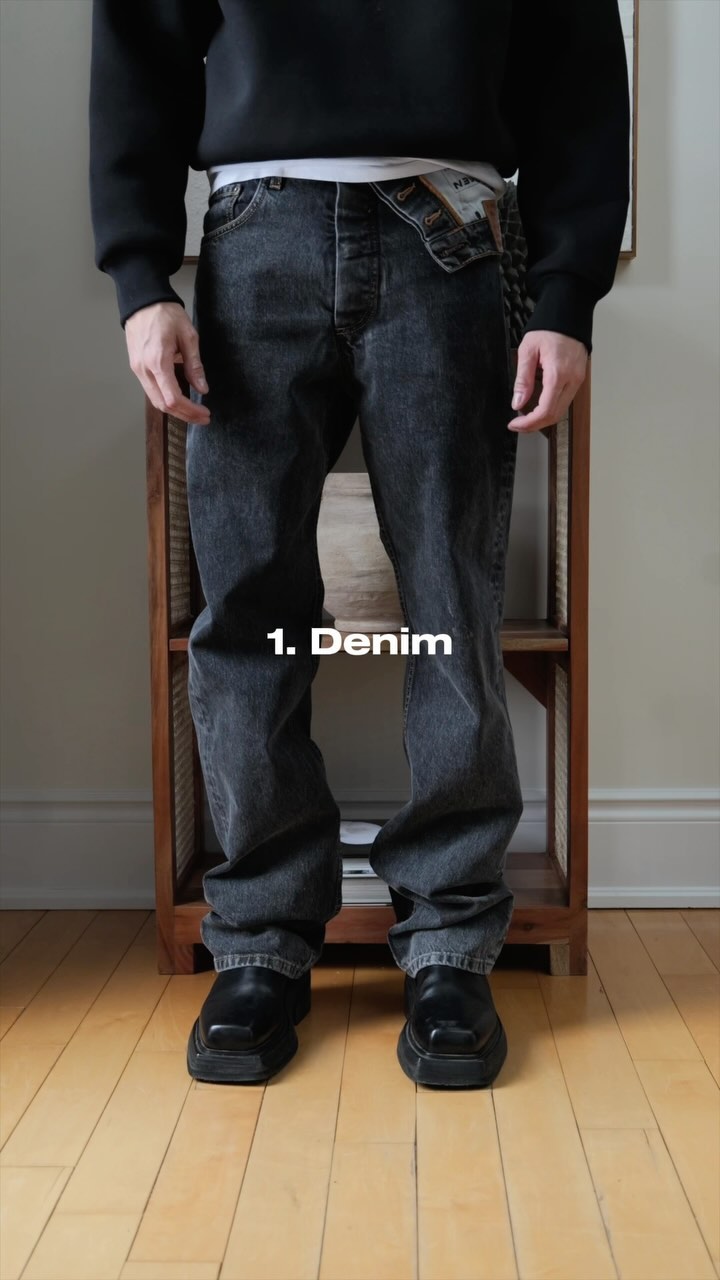 2.4MQuick list of essential pants@emmanuel.uddenberg · Buying List
[04]
[05]
What stops the scroll in the first 3 seconds
Title hook · 55%
samurai pants
Verbal hook · 30%
Let's talk about samurai pants, Hakama.
Visual hook · 15%
A quick cut from a modern speaker in a studio setting to a vintage, sepia-toned photograph of a samurai.
[07]
The promise the opener makes, and how the video pays it back
Hook
Immediately name a specific, intriguing object and promise to reveal its hidden meanings, 'Easter eggs,' or cultural insights.
Payoff
The Manifesto: Conclude with a concise, powerful statement of purpose that defines the creator's values and intended audience, positioning their work as a document of a specific ethos.
[08]
The structural pattern this video runs on
Framework
The Artifact Autopsy
Deconstructing a familiar object to reveal its hidden functional, symbolic, and philosophical layers, then using that analysis as a bridge to showcase the creator's own work and establish a personal manifesto.
The Anatomical Breakdown
Detail the physical construction and observable features of the object, establishing the 'what' before the 'why'.
The Functional Revelation
Explain the practical, often surprising, purpose behind the object's design, providing the first layer of deeper understanding.
The Symbolic Revelation
Uncover the deeper, cultural or moral code embedded within the object's features, creating a powerful 'aha' moment for the viewer.
The Philosophical Abstraction
Elevate the analysis by explaining how the object's design represents a broader worldview, philosophy, or abstract concept.
The Personal Pivot
Transition from the historical/analytical to the personal by asking, 'What is the lesson here?' and reframing the object's core principles as a personal philosophy or creative approach ('autobiography').
The Modern Application
Demonstrate how this philosophy is applied in the creator's own work, product, or process, explicitly linking their choices back to the principles derived from the original object.
Hakama and autobiographical design #fashiondesigner #hakama #samurai #fashiontiktok #fashion #japanese
contextual · beginning
samurai pants
contextual · beginning
hidden meaning
informational · beginning
hide your footwork
informational · middle
the seven moral virtues of Bushido
contextual · middle
balance but asymmetry
contextual · middle
acceptance of imperfection
contextual · middle
I tell my own story
contextual · end
these clothes are biographical
Let's talk about samurai pants, Hakama. Something that is by construction of pleated skirts, pleated trousers, but has so much Easter eggs, hidden meaning, like a real insight into Japanese culture. With five pleats in front, two at the bad. That's a construction that keeps the circumference around the waist tight, and that flows into a larger shape in the leg. And the purpose of this wider circumference around your feet is to disguise or to hide your footwork during fights, during sword fights, so that your actions in battle are unpredictable. So they come in two variants, a skirt and a pair of pants. They're called Andon and Umanori. The pants, Umanori, literally translates to horse rider. And these pants are a physical symbol of Bushido, the samurai moral code. There's five pleats in front, two at the bad, and they represent the seven moral virtues of Bushido. Honesty, honor, loyalty, courage, compassion, respect, justice. And in the front, it presents you with two seemingly conflicting ideas. They look balanced, but they are asymmetrical. Tier are three pleats on the right and two pleats on the left. So balance, but asymmetry. And that is a metaphor for a very Japanese worldview, and acceptance of imperfection rank clothes are just clothes. But as a garment, everything physical is simultaneously functional, cultural, historical. This is a document of who the samurai are as a piece of art, as a piece of communication, perfection. So to a designer, what's the lesson here? How do you make your own hakama, but how do you iterate on perfection? I suppose the lesson to learn isn't how do I produce perfection, it is how do I tell my own tier? Lesson is autobiography. So I try and play rank experiment with ideas of asymmetry, sometimes unsuccessfully. But my pleated trousers are by modern standards unusual, uncommon. Instead of an Italian style reverse pleat, which is more common nowadays, they use forward pleats, which are simultaneously classically English and formally Japanese to present trousers that can be read by two cultures. Seasons track pants from the front look conventional. But if you turn to the side, once again, we have pleats that face each other like hakama and then fall away to a wider circumference. And I don't present those details front on because I feel appreciation shouldn't be advertised. It's not for everyone in the room. It's for the wearer. These clothes are for someone who looks at small details, that sees big ideas about design, culture, history. These clothes are biographical of us. This is a document of who I design for.