@mirandadoesbrands
TikTok · Talking Head Edit
@mirandadoesbrands An exploration of how we went from the Mad Men era to the marketing girlie trope and what occupational femminisation is #marketing #sociology #branding

@mirandadoesbrands
TikTok · Talking Head Edit
@mirandadoesbrands An exploration of how we went from the Mad Men era to the marketing girlie trope and what occupational femminisation is #marketing #sociology #branding
Performance
Video #25948 · Talking Head Edit
[01]
The creator presents a historical analysis of the marketing industry, tracing its evolution from a male-dominated, prestigious field in the 'Mad Men' era to a female-dominated profession often perceived as a 'support function.' She uses archival photos, pop culture references, and data visualizations to illustrate this shift, ultimately defining it as 'occupational feminization' and suggesting a new recoding is happening due to AI.
[02]
[03]
 1.6M354.4×Historical breakdown of marketing's gender shift@mirandadoesbrands · Breakdown
 699.5K209.8×Greenscreen marketing industry trend breakdown@mirandadoesbrands · Breakdown
 1.2M4.8×Historical parallel for marketing jobs@mirandadoesbrands · Breakdown
 208.5K1.7×Explaining why marketing jobs are rebranded@mirandadoesbrands · Hot Take
 170.6K33.8×Marketing trend analysis with receipts@mirandadoesbrands · Breakdown
 92.7KHistorical context for marketing trend@mirandadoesbrands · Breakdown
 445.5K114.2×Explaining marketing trend with examples@var.aunevik · Case Study Breakdown
 424.8K23.4×Marketing trend breakdown with visuals@mirandadoesbrands · Breakdown
 66.7KMarketing framework case study breakdown@gigi.yaps · Breakdown
 2.2M164.2×Marketing trend breakdown with examples@var.aunevik · Breakdown
 157.9K32×Explaining the human-touch marketing trend@mirandadoesbrands · Breakdown
 321.2K111.1×Greenscreen marketing case study pitch@mirandadoesbrands · Case Study Breakdown
[04]
[05]
What stops the scroll in the first 3 seconds
Title hook · 55%
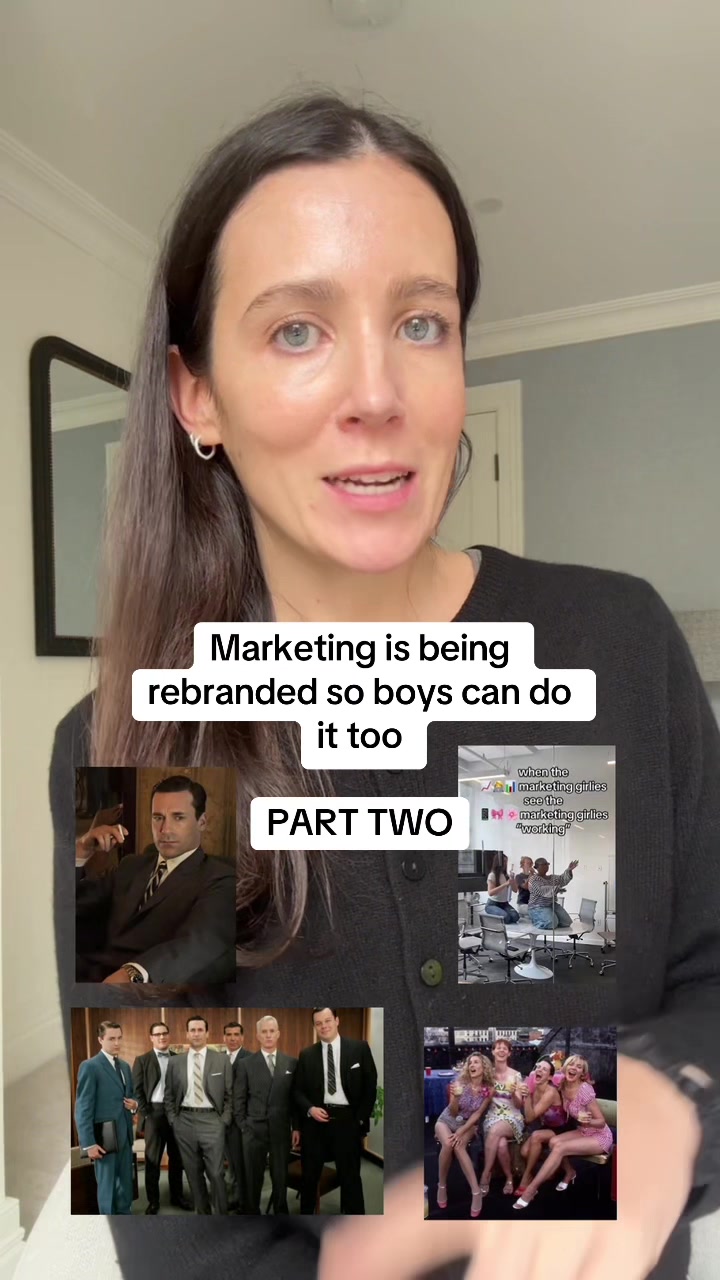
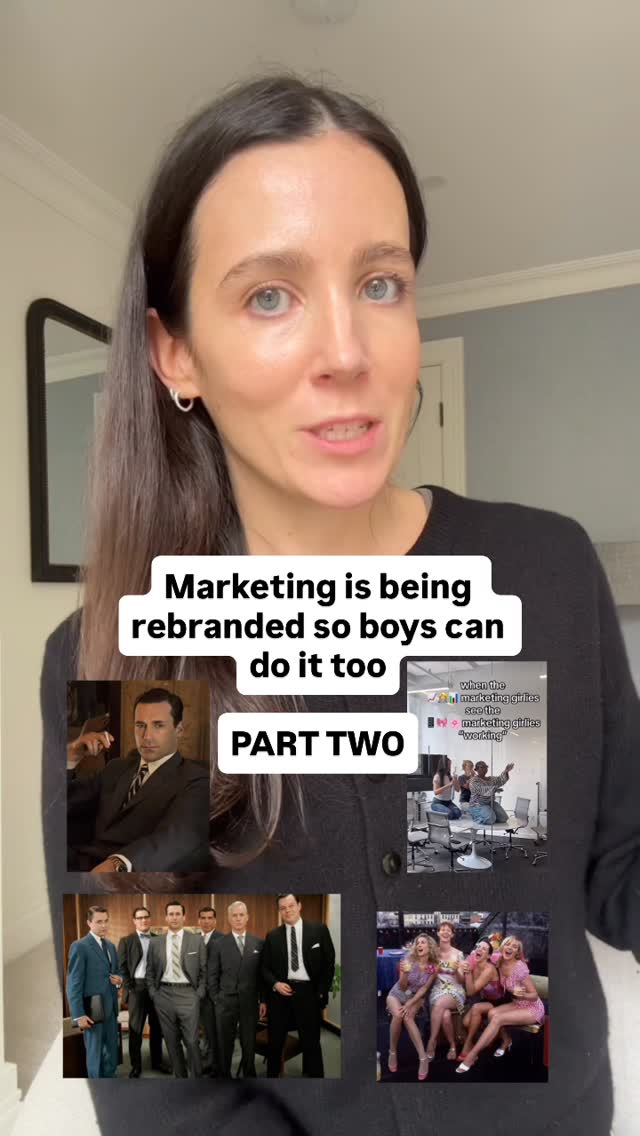
Marketing is being rebranded so boys can do it too PART TWO
Verbal hook · 15%
Marketing is being rebranded so that boys can do it too, part two.
Visual hook · 30%
A collage of four distinct images appears alongside the speaker, visually contrasting the 'Mad Men' era of marketing (men in suits) with the modern 'marketing girlie' trope (women in office and social settings).
[07]
The promise the opener makes, and how the video pays it back
Hook
A bold, contrarian thesis statement that challenges a common perception about a field, hinting at a current or future reversal of a long-term trend.
Payoff
The Future Re-Coding. Connects the entire historical narrative to a new, emerging catalyst (e.g., technology), predicting that it is causing another fundamental shift in the field's value and perception, thus fulfilling the promise of the initial hook.
[08]
The structural pattern this video runs on
Framework
The Historical Reversal
Tracing the historical evolution and perceived devaluation of a profession or concept due to a specific cultural/demographic shift, and then predicting its future revaluation or reversal driven by a new catalyst.
The Masculine Golden Age
Establishes the subject's prestigious, high-status origin story, associating it with a specific demographic and a set of valued, 'serious' attributes.
The Tipping Point
Introduces the key demographic or cultural shift that acted as the catalyst for change, altering the composition and perception of the field.
The Pop-Culture Devaluation
Demonstrates how cultural narratives and media began to re-code the subject, associating it with new, often stereotyped and implicitly less-valued, traits.
The Tangible Downgrade
Presents concrete evidence (data, charts, common knowledge) of the negative consequences of this perceptual shift, such as loss of pay, prestige, or influence.
The Scholarly Stamp
Introduces a formal academic term or concept to name the phenomenon, lending intellectual authority and credibility to the entire preceding argument.
An exploration of how we went from the Mad Men era to the marketing girlie trope and what occupational femminisation is #marketing #sociology #branding
title · beginning
Marketing is being rebranded so boys can do it too PART TWO
contextual · beginning
Mad Men era
contextual · beginning
marketing girly trope
contextual · beginning
50s and 60s
contextual · middle
"PR-ification of marketing"
informational · end
occupational feminization
informational · end
Occupational feminization refers to the process where the proportion of women in a specific occupation, industry, or the workforce as a whole increases, often exceeding that of men. While women have entered higher-level professions, this trend frequently leads to "devaluation," where feminized jobs experience lower relative wage growth and reduced status.
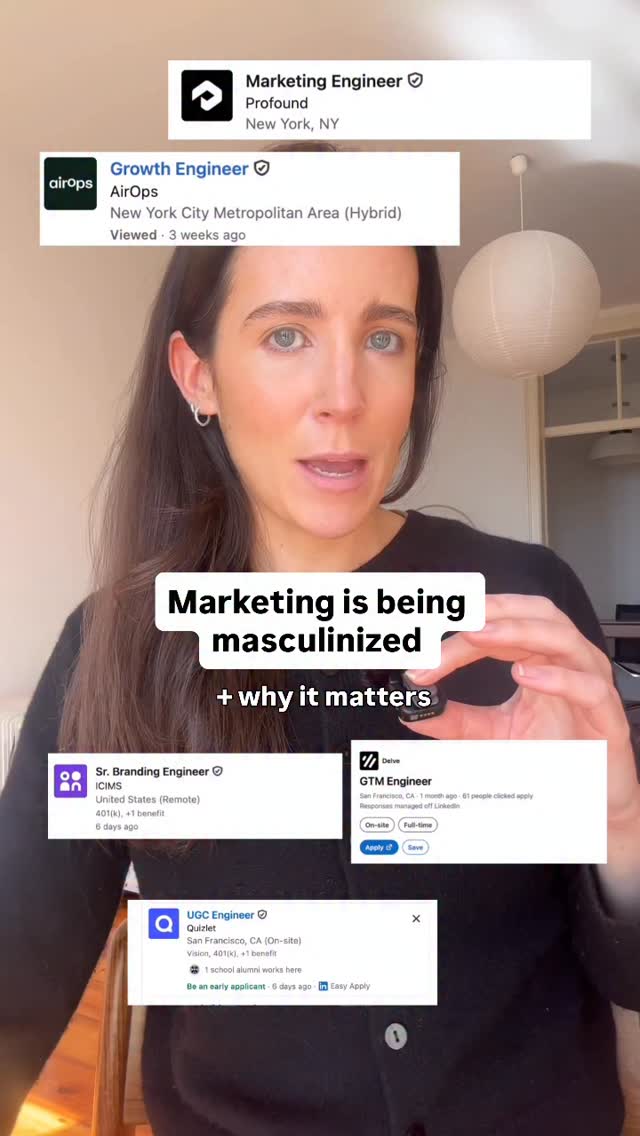
Marketing is being rebranded so that boys can do it too, part two. Let's talk about how we went from the bad men era to the marketing girly trope. In the fifties and sixties, marketing was a man's world. It was a prestigious role that was framed as the science of persuasion, and they used the language of warfare, conquering the market, dominating the consumer. And it wasn't until the seventies and eighties that more women entered the field. The industry realized that women controlled household spending, and there was this narrative that women were more naturally suited to understanding consumers. Then in the nineties and early two thousands, we saw the PRification of marketing. Shows like Sex and the City and Bridget Jones started pushing this idea that marketing was throwing parties and making things look pretty. And it was around this time that marketing pay began to lag compared to other business functions. And by 2010, marketing was 60 to 70% female, and in many organizations perceived as a support function rather than a growth engine. And this is what sociologists call occupational feminization. Once a job gets coded a certain way through language and cultural narratives, that framing shapes who does that job and how much it's valued. Marketing has been recoded multiple times over the years. And whilst there is not a tech pro psyops, we are seeing signs that it's being recoded again as a result of AI.