@fineasjackson
Instagram · Talking Head Edit
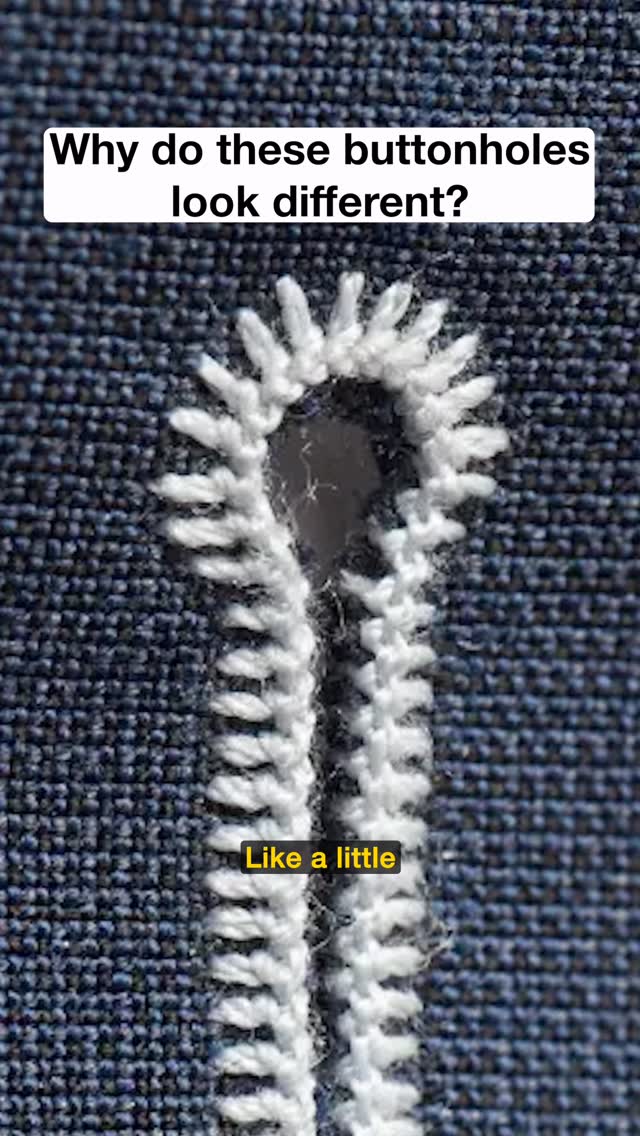
@fineasjackson Why do some buttonholes look different than others?

@fineasjackson
Instagram · Talking Head Edit
@fineasjackson Why do some buttonholes look different than others?
Performance
Video #33278 · Talking Head Edit
[01]
The creator explains the functional difference between keyhole buttonholes found on heavy fabrics like denim and straight-slit buttonholes on lighter garments like dress shirts. He debunks the idea that the design is purely decorative, providing historical context on the evolution of buttons from ornaments to fasteners. Using visual aids and animated sketches, he demonstrates how the tension from thick, shanked buttons on outerwear would rip a straight-slit hole, and how the circular end of a keyhole buttonhole distributes stress to prevent tearing.
[02]
[03]
 210.4K27.3×Five hidden clothing quality signs@gents.studios · Breakdown
 320.2KDesigner breaks down overshirt fabrics@frontoffice.co · Breakdown
 1.2M4.9×Step-by-step shirt styling hack@derschutze · Tutorial / How To
 247.7K5×Clothing quality check: understanding seams@gents.studios · Explainer
 1.1M14.4×Designer shows mistake and fix@yitaigeng · Origin Story
 103.9K1.9×Explaining true T-shirt quality history@gents.studios · Breakdown
 115.7K1.9×Handmade shirt product feature showcase@yitaigeng · Product Showcase
 590K2×Jacket design process breakdown@sakata.ken · Breakdown
 1.2M39.3×Design sample to final product@oddmuselondon · Before/After Transformation
 278.1K19.4×Explain hoodie quality and pricing@fineasjackson · Breakdown
 349KWhy durable clothes still create waste.@frontoffice.co · Breakdown
 257.5K11.1×Explaining sewing machine tension simply@oliviasews_ · Tutorial / How To
[04]
[05]
What stops the scroll in the first 3 seconds
Title hook · 45%
Why do these buttonholes look different?
Verbal hook · 30%
Look at the buttonhole on your heavy denim.
Visual hook · 25%
An immediate cut to an extreme close-up, high-quality shot of a keyhole-style buttonhole on a piece of dark denim fabric.
[06]
Steal this for your own video
Why does look ?
[07]
The promise the opener makes, and how the video pays it back
Hook
Poses a direct question about a visual discrepancy in a familiar object, creating an immediate curiosity gap by making the viewer question something they've always taken for granted.
Payoff
The viewer experiences an intellectual 'aha!' moment, feeling they've gained secret knowledge about the hidden genius in the world around them, which satisfies the initial curiosity and rewards their attention.
[08]
The structural pattern this video runs on
Framework
The Hidden Physics Blueprint
To reveal the unseen, high-stakes engineering principle behind a common, everyday object by first meticulously defining a problem and visualizing its failure state before presenting the elegant, built-in solution.
The Unseen Difference
Juxtaposes two common but different versions of an object (e.g., a keyhole vs. a straight buttonhole) to establish the central mystery.
The False Assumption Rejection
Proposes and immediately debunks the most obvious, superficial explanation (e.g., 'it's just for decoration'), signaling that a deeper, functional answer is coming.
The High-Stakes Claim
Makes a dramatic assertion about the critical function of the feature, elevating its importance from trivial to essential (e.g., 'it's the only reason it doesn't rip apart').
The Contextual Frame
Provides historical or background information that sets the stage for why the core problem exists in the first place (e.g., the evolution of buttons from decorative to functional).
The Problem Defined
Isolates and names the central scientific or mechanical challenge (e.g., 'Tension'). Contrasts a simple case where the problem is minimal with a complex case where it's critical.
The Critical Complication
Introduces a secondary element or variable that exacerbates the core problem, making a simple solution impossible (e.g., the button 'shank').
The Failure State Visualized
Uses animation or demonstration to show the catastrophic result of applying a simple solution to the complex problem, creating maximum tension and clarity.
The Elegant Solution Reveal
Presents the feature from the hook as the specific, ingenious solution to the visualized failure. Explains the mechanical principle that makes it work (e.g., the circle distributes force).
The Historical Coda
Concludes with a brief history of the solution's origin, framing it as a piece of practical, often anonymous, ingenuity that emerged from necessity.
Why do some buttonholes look different than others?
title · beginning
Why do these buttonholes look different?
branding · middle
"Chasing Beauty" Episode 53
informational · middle
Standard buttonhole
informational · middle
Keyhole buttonhole
informational · middle
Keyhole
Look at the buttonhole on your heavy denim. See how it's a straight slit that ends in a tiny punched circle? Like a little keyhole. Now good at a dress shirt. Just a straight slit. No circle. No keyhole. You'd think this is decoration. A tailor's flourish. It isn't. That little hole is the only reason outerwear doesn't rip itself apart. This is Chasing Beauty episode tier, and today we're looking at the hidden physics holding your wardrobe together. For most of human history, clothing was held together with ties, pins, or brooches. Buttons existed, but they were decorative. Status symbols. Not actual fasteners. When tailors finally started using them to close garments, they ran into a big problem. Tension. A dress shirt is light. Made from cotton, silk, or linen. When you button it, the fabric moves with you. There's very little mechanical stress pulling the two sides apart. So a simple straight slit reinforced with thread is all you need. But a heavy wool overcoat? Stiff denim? That's a completely different problem. Heavy fabrics don't trape. They resist. And the buttons on a coat aren't thin and flat. They're thick, heavy, and raised off the fabric on what's called a shank. A shank is that little pillar of thread, sometimes metal, that lifts a button up no it can reach over the thick overlap of the coat or denim. Without it, you couldn't get the two sides to close at all. If you push a thick shanked button through a straight slit in heavy wool, the shank jams itself at the end of the cut. Every time you move, breathe, sit down, the shank pulls directly against that sharp corner. It stretches the fabric. And eventually, the stress just rips the hole wide open. The keyhole fixes this. That punch circle at the end of the slit gives the shank somewhere to sit. And because the circle has no corners, the pulling force gets distributed evenly across the threads instead of concentrating at one point. The earliest known keyhole buttonholes show up in European tailoring around the seventeenth century. Nobody wrote it down as an invention. It was one of those solutions that just appeared. Tailor by tailor, shop by shop, because the coats kept failing without it.