@fineasjackson
Instagram · Talking Head Edit
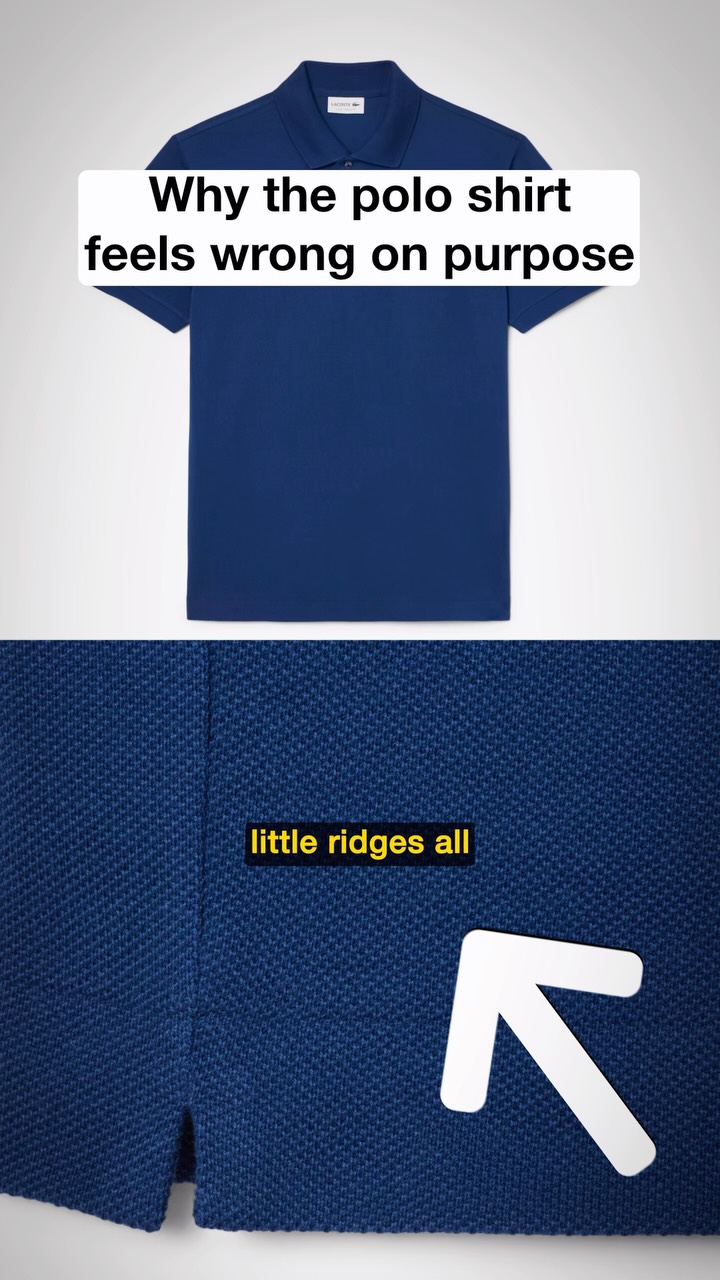
@fineasjackson The polo shirt looks wrong on purpose. Why is the fabric bumpy and the back much longer than the front…?

@fineasjackson
Instagram · Talking Head Edit
@fineasjackson The polo shirt looks wrong on purpose. Why is the fabric bumpy and the back much longer than the front…?
Performance
Video #39783 · Talking Head Edit
[01]
The creator explains the history and innovative design of the polo shirt, breaking down why its two most distinctive features—the piqué fabric and the longer 'tennis tail' hem—were engineered by tennis player René Lacoste to solve specific performance problems with traditional 1920s sportswear.
[02]
[03]
 1.1M14.4×Designer shows mistake and fix@yitaigeng · Origin Story
 511.7K19.1×Explaining shirt design through history@fineasjackson · What Is X?
 3.2M7.3×Explaining hidden rugby jersey features@theironsnail · What Is X?
 823.1K1×Explaining a famous clothing innovation@alextwma · Origin Story
 320.2KDesigner breaks down overshirt fabrics@frontoffice.co · Breakdown
 1.1M2.5×Explaining design philosophy through examples@frontoffice.co · Origin Story
 889.9K2×Explaining the history of a word@frontoffice.co · Origin Story
 124.6K2.4×Explaining handmade shirt's unique features@yitaigeng · Product Showcase
 655.4K3.5×Wool science and fabric choices@frontoffice.co · Breakdown
 2.8M2.9×Explaining a product design origin@theironsnail · Origin Story
 1.6M2×Explaining luxury t-shirt manufacturing process@alextwma · Opportunity Explainer
 4.2M13.9×How three cultures designed for heat@frontoffice.co · Breakdown
[04]
[05]
What stops the scroll in the first 3 seconds
Title hook · 55%
Why the polo shirt feels wrong on purpose
Verbal hook · 40%
Look at this shirt. This fabric, those little ridges all over it, that isn't normal.
Visual hook · 5%
A stylized shot of the speaker in a leather jacket and sunglasses, followed by quick cuts to product shots and close-ups of fabric texture, creating visual intrigue and pattern interruption.
[06]
Steal this for your own video
Why feels on purpose
[07]
The promise the opener makes, and how the video pays it back
Hook
Create a curiosity gap by identifying two counter-intuitive or 'wrong' features of a common, everyday object, framing them as a mystery to be solved.
Payoff
The Revolutionary Debut: Describe the climactic moment the fully-realized innovation was introduced to the world, summarizing its collection of features and contrasting it against the inferior status quo to deliver the final 'aha' moment.
[08]
The structural pattern this video runs on
Framework
The Hidden Genius Blueprint
Deconstructing a familiar object to reveal the hidden functional intelligence behind its seemingly strange or 'wrong' features, told through a historical problem/solution narrative.
The Masterpiece Thesis
Reframe the initial anomalies as evidence of intentional, masterful design. This establishes the video's core argument and promises a satisfying explanation.
The Protagonist & The Problem
Establish the historical context, introduce the innovator as the protagonist, and clearly define the inadequate 'old way' of doing things, presenting it as the central conflict to be overcome.
The First Innovation: Material
Isolate the first major flaw of the old way, explain its technical failure, and then reveal the protagonist's first innovation that solved it, including a simple, visual breakdown of *how* it works.
The Second Innovation: Form
Introduce a second, distinct problem with the old way, and repeat the pattern: reveal the second innovation and provide a clear, functional explanation for its design.
The polo shirt looks wrong on purpose. Why is the fabric bumpy and the back much longer than the front…?
title · beginning
Why the polo shirt feels wrong on purpose
branding · beginning
"Chasing Beauty" Episode 73
contextual · middle
CHAPTER I LACOSTE'S OBSESSION
contextual · middle
CHAPTER II PIQUÉ FABRIC
contextual · middle
CHAPTER III THE TENNIS TAIL
contextual · end
CHAPTER IV THE 1926 DEBUT
informational · middle
Tennis Tail Hem Made to stay tucked in
Look at this shirt. This fabric, those little ridges all over it, that isn't normal. No, look at the bad. It hangs much longer than the front. Two things that look wrong but make this shirt a technical masterpiece. This is episode 73 of Chasing Best and today, we're looking at the engineering behind the polo shirt. In the nineteen twenties, tennis was one of the biggest sports in the world and Rene Lacoste was one of its best players. He wasn't naturally the most talented better he was obsessive. He'd study his opponent's weaknesses, map their patterns and then grind them down through sheer preparation. He was meticulous about everything including what he wore and what he worse, like every other player at the tier, was a disaster. Stiff, starched collar, long sleeve, button up dress shirts on clay courts in the summer. But the problem wasn't just the cut. It was the fabric of the shirt itself. Standard cotton shirts are a single flat weave. One layer and smooth. The moment you sweat through it, it collapses onto your skin. Sealed against your chest like a wet second layer. Lacoste couldn't stand it. So he started building something else. He landed on a fabric that had never been used in sportswear, cotton pique. The name comes from the French piquel meaning to quilt. Textile makers named it that because the surface looked like the hand stitched quilts of Marseille. Tiny geometric bridges pressed into the cloth and it feels nothing like a simple cotton knit. Pique is knit to create tiny raised ridges across the entire surface almost like a honeycomb. Those ridges hold the fabric off your skin best barely. And in the gaps between them, air moves allowing heat to escape. So where a flat cotton shirt seals against your chest when you sweat, PK keeps a layer of air between you and the fabric. Even when it's soaked through, it doesn't stick to you in the exact same way. But Lacoste had a second problem. Every time he served, arm overhead, whipping around to hit the ball, the back of his shirt yanked out from his waistband. Between points, he was reaching behind him, stuffing the hem back in. For a player who won matches through rhythm and focus, that was a distraction he hated. So he cut the back panel longer. Two to three extra inches of fabric that just hangs there. But when it's tucked into your pants and you extend for a serve, the slack absorbs the motion. The shirt can actually move with your body instead of pulling free. It's called a tennis tail. In 1926, Lacoste walked onto the court at the US National Championships wearing his creation. Short sleeves, a flat collar with just enough ribbing to flip up against the sun, a strange bumpy fabric nobody recognized and a hem that wasn't even. And every other player was still buttoned into a dress shirt.