Viral Hooks
Trending short videosLinkedIn post writing framework tutorial
D

@dibratto

Instagram · Prop Yap

@dibratto Comment “LINKEDIN” for my 23-page LinkedIn mini-course (100% free). This video breaks down exactly how to write the perfect LinkedIn post, as someone who does this all day every day. I hope it’s helpful. #founder #linkedin #b2bsaas #ycombinator #startup

View original on Instagram

The edit1 shot · 18 text
Shots Text2:21

Performance

Views
148.3K
Likes
4.6K
Comments
5.3K
Engagement
6.7%
Length · 2 Sept 2026
2:21

Video #44402 · Prop Yap

LinkedIn post writing framework tutorialfrom @dibratto

[01]

Overview

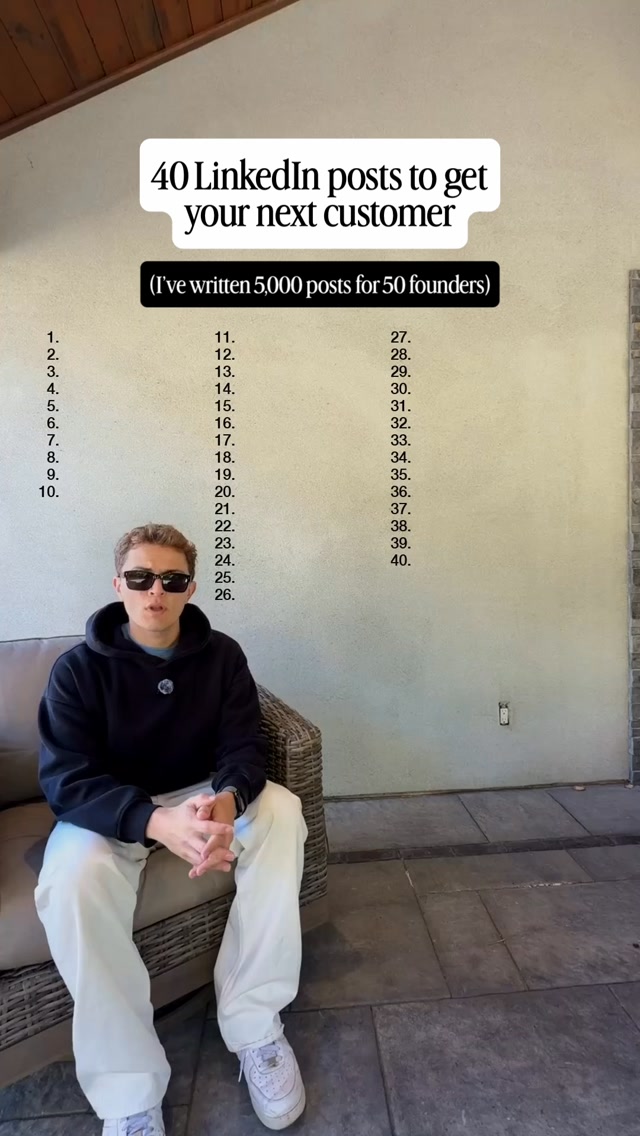
The creator delivers a tutorial on writing effective LinkedIn posts by presenting his 'THBM' (Topic, Hook, Body, Media) framework. He uses his laptop to display a series of slides, explaining each component in detail with rules, examples, and specific mechanisms, such as how to create a 'curiosity gap' for the hook. He concludes with a call-to-action, offering a free, in-depth playbook to viewers who comment on the video.

[02]

Simple outline

  1. 1Claim expertise with proof
  2. 2Introduce proprietary framework
  3. 3Deconstruct each framework part
  4. 4Provide actionable sub-tactics
  5. 5Offer deeper value for engagement

[03]

Related videos

[04]

Classification

Format
Concepts
Tutorial / How ToPlaybook
Elements
In-Scene Media PlaybackGraphic OverlayDM / Comment-for-Info CTAImage OverlayTitle Text Hook

[05]

Hook analysis

What stops the scroll in the first 3 seconds

Title hook · 50%

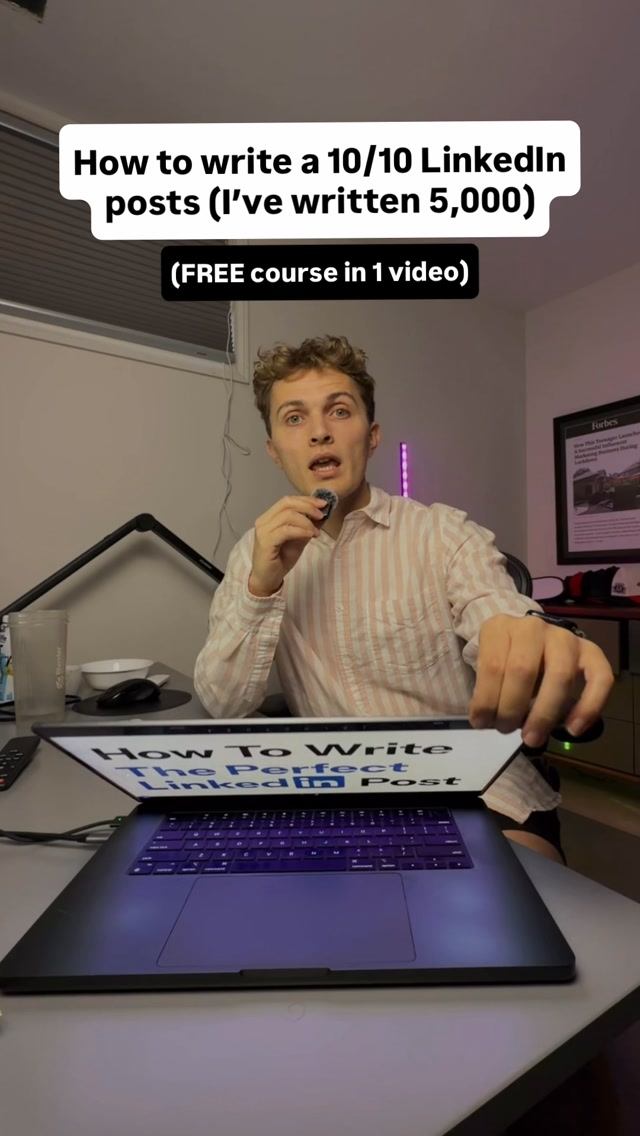
How to write a 10/10 LinkedIn posts (I've written 5,000)

Verbal hook · 40%

Here's how to write the perfect LinkedIn post even if you've never written one.

Visual hook · 10%

The creator holds up a laptop with a large, bold, and clear title slide that reads 'How To Write The Perfect LinkedIn Post', immediately establishing the video's topic and value.

[06]

Hook template

Steal this for your own video

How to [achieve desired result] (I've [done this thing] [specific number] times)

  • — How to write a 10/10 cold email (I've sent 8,000)
  • — How to nail a first-time deadlift (I've coached 1,200 beginners)
  • — How to cook restaurant-quality steak at home (I've seared 3,000)

[07]

Hook and payoff

The promise the opener makes, and how the video pays it back

Hook

Make a high-value promise and immediately validate it with overwhelming quantitative and social proof to establish undeniable authority.

Payoff

Conclude the lesson by summarizing the framework's effectiveness and then present a clear Call to Action that offers a more comprehensive resource in exchange for a specific engagement action, reinforcing the creator's role as an expert guide.

[08]

Narrative framework

The structural pattern this video runs on

Framework

The Proprietary Framework Breakdown

To establish authority on a complex topic by introducing and deconstructing a simple, memorable, proprietary framework, providing actionable tactics for each component.

  1. 1

    The Authority Claim

    Hook the viewer with a bold promise of mastery over a desirable skill, then immediately establish credibility with large numbers, prestigious associations, and visual proof of results.

  2. 2

    The Secret Formula Reveal

    Introduce a simple, proprietary acronym or mnemonic device that codifies the complex skill into a digestible, memorable system, creating an intellectual curiosity gap.

  3. 3

    Component 1 Deconstruction: The Strategic Goal

    Explain the first element of the framework, focusing on its high-level purpose and the core principles that guide its application. Provide a binary choice for implementation (e.g., do X for this outcome, do Y for that outcome).

  4. 4

    Component 2 Deconstruction: The Critical Mechanism

    Explain the second, most crucial element of the framework. Define its primary function and introduce the key psychological principle required to make it work effectively.

  5. 5

    The Tactical Toolbox

    Provide a numbered list of specific, replicable examples or techniques for executing the psychological principle introduced in the previous beat. This grounds the theory in practical application.

  6. 6

    Component 3 Deconstruction: The Rules of Execution

    Explain the third element of the framework by presenting a concise list of prescriptive rules or best practices for its construction and formatting.

  7. 7

    Component 4 Deconstruction: The Contextual Pairing

    Explain the final element of the framework by focusing on its interaction with the platform's environment. Provide a simple 'if-then' guide for matching different types of content to the appropriate format.

Themes

  • Expertise
  • Education
  • Content Creation
  • Professional Development

Techniques

  • Framework-based teaching
  • Credibility building
  • Curiosity gap
  • Call-to-action

Trends

  • Creator Education
  • Short-form course

Post caption

Comment “LINKEDIN” for my 23-page LinkedIn mini-course (100% free). This video breaks down exactly how to write the perfect LinkedIn post, as someone who does this all day every day. I hope it’s helpful. #founder #linkedin #b2bsaas #ycombinator #startup

Text overlays

  • title · beginning

    How to write a 10/10 LinkedIn posts (I've written 5,000)

  • contextual · beginning

    (FREE course in 1 video)

  • title · beginning

    How To Write The Perfect LinkedIn Post

  • informational · beginning

    50+ founders, backed by these VCs and more

  • informational · throughout

    THBM

  • informational · beginning

    TOPIC: Does the topic of the post make the reader know, like, or trust you better?

  • informational · middle

    IMPORTANT: Choose one (1) thing to write about.

  • informational · middle

    Every line should support one clear point. If it doesn't strengthen the point, cut it.

  • informational · middle

    HOOK: Does the hook give the reader no choice but to press “see more” on LinkedIn?

  • informational · middle

    Curiosity Gap Mechansim 1: Pair two things that shouldn't go together.

  • informational · middle

    Curiosity Gap Mechansim 2: Reveal the decision but hold back the reason.

  • informational · middle

    Curiosity Gap Mechansim 3: Start At The Moment Something Changed

  • informational · middle

    1. Write only as long as it needs to be.

  • informational · middle

    2. Don't over or under-do line breaks.

  • informational · middle

    3. Write in most logical order possible.

  • informational · end

    Think about media in the context of how it will be digested in the feed.

  • informational · end

    Which Media Goes With Which Post Founder / Team story -> Founder / team picture Deep Listicle: Carousel Dense Process: Cheatsheet/infographic. Industry Commentary: News headline / Tweet screenshot

  • call-to-action · end

    If you want my ENTIRE LinkedIn playbook for founders, comment “LINKEDIN” and I'll send it to you.

Transcript

Here's how to write the perfect LinkedIn post even if you've never written one. This is coming from someone who's written 5,000 plus for founders bad by these VCs and more. Those have driven these results. So you know I'm not lying. The perfect LinkedIn post has four levers. I call it tier h b m. Let me tell you how to make each one perfect. T is for topic. The topic of your post must make the reader know, like, or trust you better. For knowing and liking, you're gonna share stories and opinions. Also for liking better mostly for trusting, you're gonna share frameworks, processes, and case studies. No, very importantly, your post should aim to convey one thing, a story, a lesson, a framework, whatever. Every line in the post should support that point. If it does not support the point, cut it. Now, h is for hook. This is the most important sentence you will write in the post. You must give the reader no choice better to press see more on LinkedIn. To do that, you have to create a curiosity gap. This is the gap between what the reader already knows and what they need to keep reading to learn. Here are a few curiosity gap mechanisms that we can use. Number one, pair two things that shouldn't go together. For example, I run a 100 person marketing agency, but I've never had a marketing job. You see? Number two is revealing the decision, but holding back the reason. For example, last month, I turned down the biggest client or agency had ever been offered. And finally, number three, start at the moment something changed. For example, ten minutes into my first board meeting, the CEO closed his laptop and asked everyone to leave. There is so much more to this that you have to worst. Follow me or research it yourself. Here are a few rule here are a few rules to write the body of your post. Number one. Write only as long as the post needs to be. Like I said, you must make every line fight worst life. Number two. Don't overdo or underdo line breaks. The way I think about it, use them to separate ideas and arguments, not individual lines. Thirdly, this is very important. Write the points and arguments in the order that makes the most logical sense to a cold reader. That is a mouthful. All it means is you must assume the reader doesn't know who you are or what you do, and you have to hook them in, give them context, give them the value of the worst, and then end it off. M is for media and this is very important. You must think about media in the context of how it will be digested in the feed. What I mean by that is when a reader scrolls LinkedIn, they will only see your hook and the media itself, and you need to optimize for that. Here's how to do that. For a founder or team story, use a founder or team picture. For a deep listicle, use a carousel. For a dense process, use a cheat sheet or an infographic. For industry commentary, use a headline screenshot or a tweet screenshot. You will be fine if you optimize for all of these factors. If you want a full guide on how to build your LinkedIn presence as a founder, comment LinkedIn and I will send it to you.