@fineasjackson
Instagram · Talking Head Edit
@fineasjackson Kings wore a stranger’s hair. Covered in flour. Why?

@fineasjackson
Instagram · Talking Head Edit
@fineasjackson Kings wore a stranger’s hair. Covered in flour. Why?
Performance
Video #49662 · Talking Head Edit
[01]
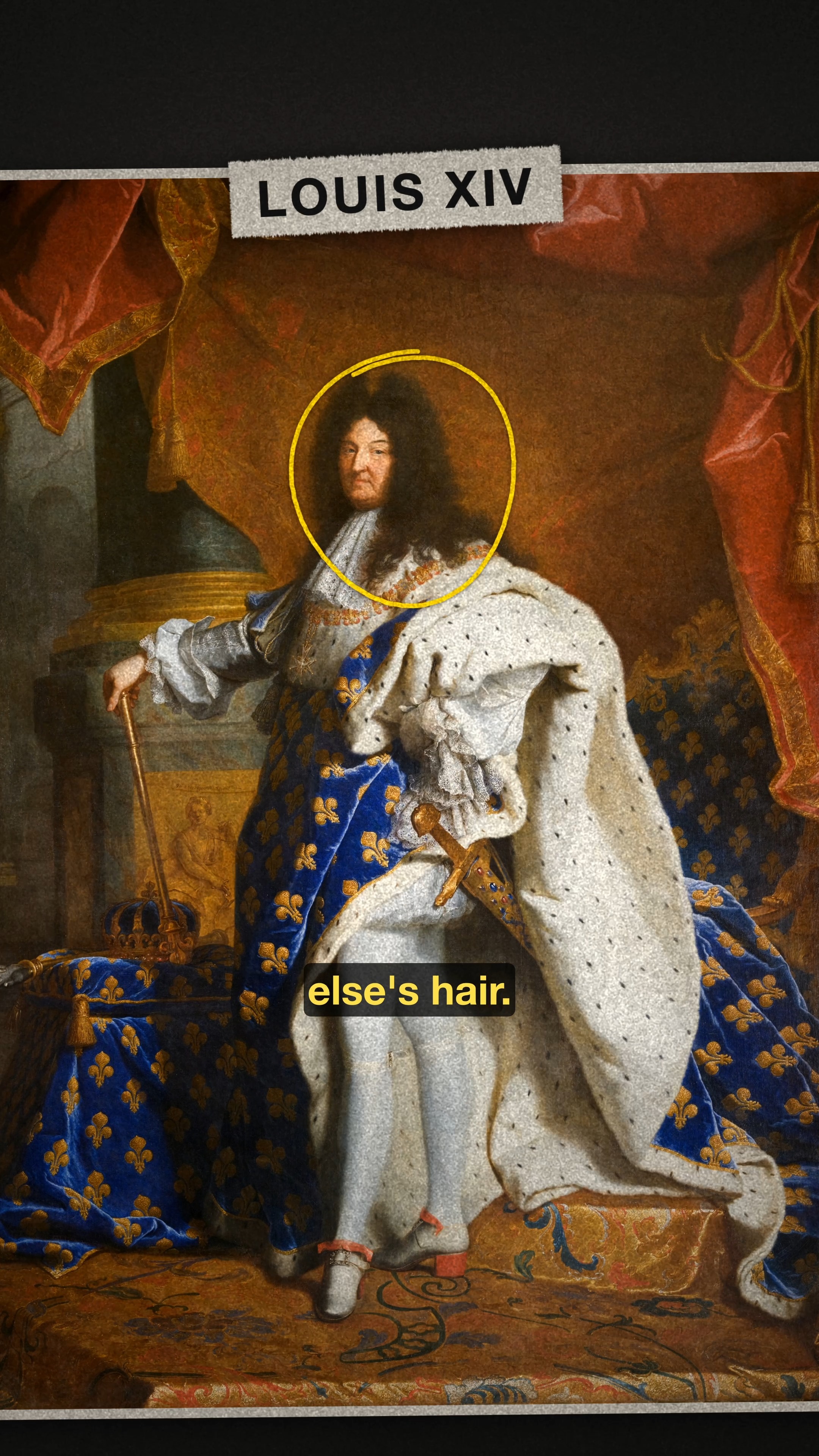
The creator explains the historical trend of powerful European men wearing wigs. He first presents the extravagant hair of Louis XIV, reveals it's a wig, and debunks the common myth that syphilis was the sole reason. He then traces the trend's origin to King Louis XIII of France, who started wearing a wig to hide his baldness, leading his court to copy him, and how his son, Louis XIV, later adopted and exaggerated the style to turn an insecurity into a symbol of power and fashion.
[02]
[03]
 177.8K5.3×Explaining the history of ties@brockvignery · Origin Story
 2.6M143.6×Explaining suit button fashion history@fineasjackson · Strange but True
 599.1KExplaining workwear's historical fashion origin.@frontoffice.co · Breakdown
 3.6M14.8×Explaining why a fashion trend died@alextwma · Case Study Breakdown
 1.1M55.7×Explaining the origin of collars@fineasjackson · Origin Story
 2.4M7.8×Explaining the history of collars@alextwma · What Is X?
 115.5K2.5×Explaining the history of a style@ella.bellaaa___ · Breakdown
 156.9K4.3×Fashion commentator reviews celebrity outfits@johnmvilla2 · Rapid Fire Listicle
 344.4K9.6×Explaining old money fashion signals@thejaunt_ · Breakdown
 1.5M13.9×Explaining the history of neckties@alextwma · What Is X?
 1.3M115.8×Monologue on confidence and style@thejaunt_ · Anecdotal Philosophy
 17M3×Rapid-fire men's fashion style guide@wisdm · Rapid Fire Listicle
[04]
[05]
What stops the scroll in the first 3 seconds
Verbal hook · 85%
Look at this hair.
Visual hook · 15%
A direct-to-camera shot of an energetic speaker, followed by a quick cut to a classical painting, creating visual contrast and pattern interruption.
[06]
Steal this for your own video
Look at this .
[07]
The promise the opener makes, and how the video pays it back
Hook
Isolate a visually strange or counter-intuitive detail from a well-known subject and immediately reveal it's not what it appears to be, creating an instant mystery.
Payoff
Conclude by connecting the transformed trend back to the opening visual, providing a satisfying and complete explanation that resolves the initial mystery.
[08]
The structural pattern this video runs on
Framework
The Historical Debunk
To answer a common 'why' question by first presenting and debunking a popular misconception, then revealing the true, often more human, origin story and tracing its evolution.
The Widespread Anomaly
Broaden the scope of the initial mystery, showing it wasn't an isolated incident but a widespread phenomenon among a specific, high-status group.
The Central Question
Explicitly state the core 'why' question that the narrative will now answer for the viewer.
The Common Misconception
Introduce the most popular, surface-level explanation for the phenomenon, validating what a portion of the audience might already believe.
The 'Yes, But...' Pivot
Partially validate the common misconception to build trust, but immediately pivot by highlighting a logical flaw or gap that it fails to explain, thereby creating intellectual suspense for the 'real' answer.
The Origin Point
Reveal the true origin of the phenomenon, grounding it in a specific, often relatable human story or insecurity involving a key historical figure.
The Social Cascade
Explain the mechanism by which the behavior spread from the originator to a wider group, establishing it as a trend.
The Status Transformation
Show how a subsequent influential figure or generation co-opted and amplified the trend, transforming its original purpose (e.g., hiding a flaw) into a public symbol of power, wealth, or status.
Kings wore a stranger’s hair. Covered in flour. Why?
contextual · beginning
LOUIS XIV
branding · middle
"Chasing Beauty" Episode 95
contextual · middle
1624, LOUIS XIII
contextual · end
LOUIS XIV
Good at this hair. Long, curled, piling up high and falling past the shoulders. It isn't his. This is Louis the fourteenth, King of Rank, and he's wearing someone else's hair. For more than a hundred years, the most powerful men in Europe did the same. Men with perfectly good hair cut it off to make a wig fit. So why did men want fake hair so badly? This is Chasing Best episode 95 and today tier looking at the wig. Ask why men wore wigs and you'll usually hear one worse, syphilis. Syphilis can make your hair fall out in patches and some men did hide it under a wig. But a disease doesn't explain why healthy men wanted one. For that, you have to start with a bald spot, a royal one. In 1624, Louis the thirteenth of France started going bald. He was tier. So he covered it with a wig and his courtiers copied him. At first, that's what the wig was, a way to hide rank insecurity. His son, Louis the fourteenth bad famously thick hair until it started falling out too. So the Sun King went the other way. He made his wigs enormous. That's the wig in this portrait.