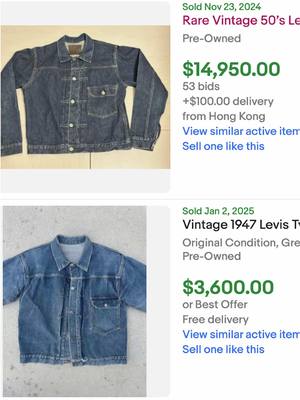
@crust_young This jacket was made terribly! …on purpose? In my hands is the Bronson MFG 1943 War Simplified Model 1st selvedge denim jacket. It’s a reproduction that pays homage to a very specific era in US history. Going back to the 1940’s, US consumer goods were hit with a variety of shortages in skilled labor and materials, due to WWII. This Bronson jacket demonstrates what that lack of skilled labor might have looked like, with poorly finished stitches and loose thread all over the jacket. The jacket also has nods to different wartime decrees made by the War Production Board in order to limit and preserve materials and supplies. Iron buttons were painted silver, bronze was used instead of copper, jackets were limited to four buttons, one pocket (without a flap), and hems and fabric belts could be no wider than two inches. The imperfection of this Bronson jacket tells that story - and personally, I love it! #mensfashion #selvedgedenim #wwii #vintagefashion #denimjacket #levis
Explaining why a jacket was poorly madefrom @crust_young
[01]
Overview
The creator explains why a 1940s-style denim jacket was intentionally made with poor quality and simplified features. He details two main reasons rooted in WWII: a shortage of skilled labor and a series of decrees from the War Production Board to conserve materials like fabric and metal, which affected the number of buttons, pockets, and hardware used. He concludes by noting that the jacket shown is a reproduction and that an original from that era is highly valuable.
This jacket was made terribly, but it was made terribly on purpose.
Visual hook · 5%
The creator holds up a dark, textured denim jacket, presenting it directly to the camera as the central focus of the shot.
[06]
Hook template
Steal this for your own video
This [product or object] was made terribly—but it was made terribly on purpose.
— This cookbook was made terribly—but it was made terribly on purpose.
— This apartment building was made terribly—but it was made terribly on purpose.
— This video game controller was made terribly—but it was made terribly on purpose.
[07]
Hook and payoff
The promise the opener makes, and how the video pays it back
Hook
An immediate, counter-intuitive statement that creates a strong curiosity gap by presenting a paradox (e.g., 'This was made badly, but for a good reason').
Payoff
The Value Reversal. This final beat connects the object's 'flaws' to a surprising and desirable outcome (e.g., high monetary value, cultural significance, rarity), providing a satisfying resolution to the initial paradox and proving the object's worth.
[08]
Narrative framework
The structural pattern this video runs on
Framework
The Historical Re-contextualization
To reveal the hidden story and value behind an object's apparent flaws by explaining the specific historical or systemic constraints that created them, transforming perceived imperfections into markers of authenticity and worth.
1
The Historical Anchor
Establishes the specific time and place necessary to understand the core premise, setting the stage for the detailed explanation.
2
The First Justification
Presents the first major reason supporting the hook's paradox, often focusing on a human or social element (e.g., labor shortages).
3
The Second Justification
Introduces a second, more complex reason, often related to systemic rules, regulations, or technical constraints (e.g., government decrees).
4
The Evidence Gauntlet
A rapid-fire sequence of specific, tangible pieces of evidence that support the second justification, with each point visually demonstrated on the object.
5
The Authenticity Clarifier
A brief moment of transparency that clarifies the nature of the object being shown (e.g., it's a replica, a model), which builds trust and authority.
Themes
History
Fashion History
Craftsmanship
War Economy
Techniques
Historical storytelling
Product analysis
Trends
Educational content
Niche deep dive
Post caption
This jacket was made terribly! …on purpose? In my hands is the Bronson MFG 1943 War Simplified Model 1st selvedge denim jacket. It’s a reproduction that pays homage to a very specific era in US history. Going back to the 1940’s, US consumer goods were hit with a variety of shortages in skilled labor and materials, due to WWII. This Bronson jacket demonstrates what that lack of skilled labor might have looked like, with poorly finished stitches and loose thread all over the jacket. The jacket also has nods to different wartime decrees made by the War Production Board in order to limit and preserve materials and supplies. Iron buttons were painted silver, bronze was used instead of copper, jackets were limited to four buttons, one pocket (without a flap), and hems and fabric belts could be no wider than two inches. The imperfection of this Bronson jacket tells that story - and personally, I love it! #mensfashion #selvedgedenim #wwii #vintagefashion #denimjacket #levis
Text overlays
title · beginning
THIS JACKET
title · beginning
TERRIBLY.
title · beginning
ON PURPOSE.
title · beginning
LET ME EXPLAIN.
contextual · beginning
THERE ARE TWO
contextual · beginning
WHY THIS
contextual · beginning
SO WRONG.
contextual · beginning
SO MANY
contextual · beginning
PROBLEMS.
contextual · beginning
TO THE
contextual · beginning
OF NOT HAVING
contextual · beginning
WORKERS.
contextual · beginning
FOUND JOBS
contextual · beginning
UNIFORMS
contextual · beginning
SO YOU HAD
contextual · middle
WHO WEREN'T
contextual · middle
MAKE LEVI'S
contextual · middle
LOOK VERY OFF
contextual · middle
IS THAT
contextual · middle
BOARD IN ORDER
contextual · middle
TO CONSERVE
informational · middle
Decree L-85
contextual · middle
SEE HERE, THIS
contextual · middle
HAS FOUR
contextual · middle
AS OPPOSED
contextual · middle
DENIM JACKETS.
contextual · middle
THIS TIME
contextual · middle
WERE USUALLY
contextual · middle
TO JUST HAVING
informational · middle
Decree L-68
contextual · middle
PUT LIMITS
contextual · middle
THICK HEMS
contextual · middle
USUALLY
contextual · middle
TO UNDER
contextual · end
FLAPS DIDN'T
contextual · end
ON DENIM
contextual · end
UNTIL AFTER
informational · end
Decree L-181
informational · end
Rubber Reductions
informational · end
Hardware Limits
contextual · end
TO BE MADE
contextual · end
AND THEN
contextual · end
LOOK SILVER.
contextual · end
IN THE MIDDLE
contextual · end
BECAME POPULAR
contextual · end
OF METAL USED.
contextual · end
WE NOW
contextual · end
AS DONUT
contextual · end
USUALLY
contextual · end
A LEAF DESIGN.
contextual · end
SYMBOLING PEACE
contextual · end
HUMAN SPIRIT.
contextual · end
AND BACK
contextual · end
THESE JACKETS
contextual · end
OF BRONZE.
contextual · end
JACKET HERE
contextual · end
A REPRODUCTION
contextual · end
THOSE JACKETS
contextual · end
THE 1940S.
contextual · end
JACKET FROM
contextual · end
THAT ERA.
contextual · end
THOUSANDS
contextual · end
OF DOLLARS.
contextual · end
POORLY MADE
Transcript
This jacket was made terribly, but it was made terribly on purpose. Let me explain. There are two main reasons why this jacket looks so rank. And for both of tier, we're gonna have to go back to the nineteen forties during World War two. The first main reason why this jacket has so many stitching problems is due to the simple fact of not having a lot of skilled workers. A huge portion of the country was overseas fighting. People who remained in the country who were good at sewing usually found jobs making uniforms for soldiers. So you had a lot of people who weren't really good at sewing trying to make Levi's jackets. And the other reason why this jacket might look very off is that there were a series of decrees passed by the worse production board in order to conserve different materials and fabrics. Decree l 85 focused on simplifying designs. As you can see here, this jacket only has four buttons as opposed to the normal five that you usually see on denim jackets. Also, during this time, products were usually limited to just having one pocket. Decree l 68 focused on reducing fabric consumption. That put limits good thick hems could best, usually reducing them to under two inches and a big reason why pocket flaps didn't really appear on denim jackets until after the war. Decree l one eighty one mostly focused on rubber, but also affected some of the hardware used on these jackets. Buttons were forced to be made out of iron and then painted to look silver. Buttons with punches in the middle became popular to reduce the amount of metal used. Of course, we now know these as donut better, and they were usually adorned with a leaf design, symboling peace and encouraging human spirit. And rivets and back cinches on these jackets were often made of bronze. Now this jacket here is just a reproduction of one of those jackets from the nineteen forties. If you were to actually find a Levi's jacket from that era, it would likely be worth thousands of dollars. Not bad for a poorly made jacket.