Video #2189 · Greenscreen Talking Head
Website critique with competitor comparisonfrom @kailauli
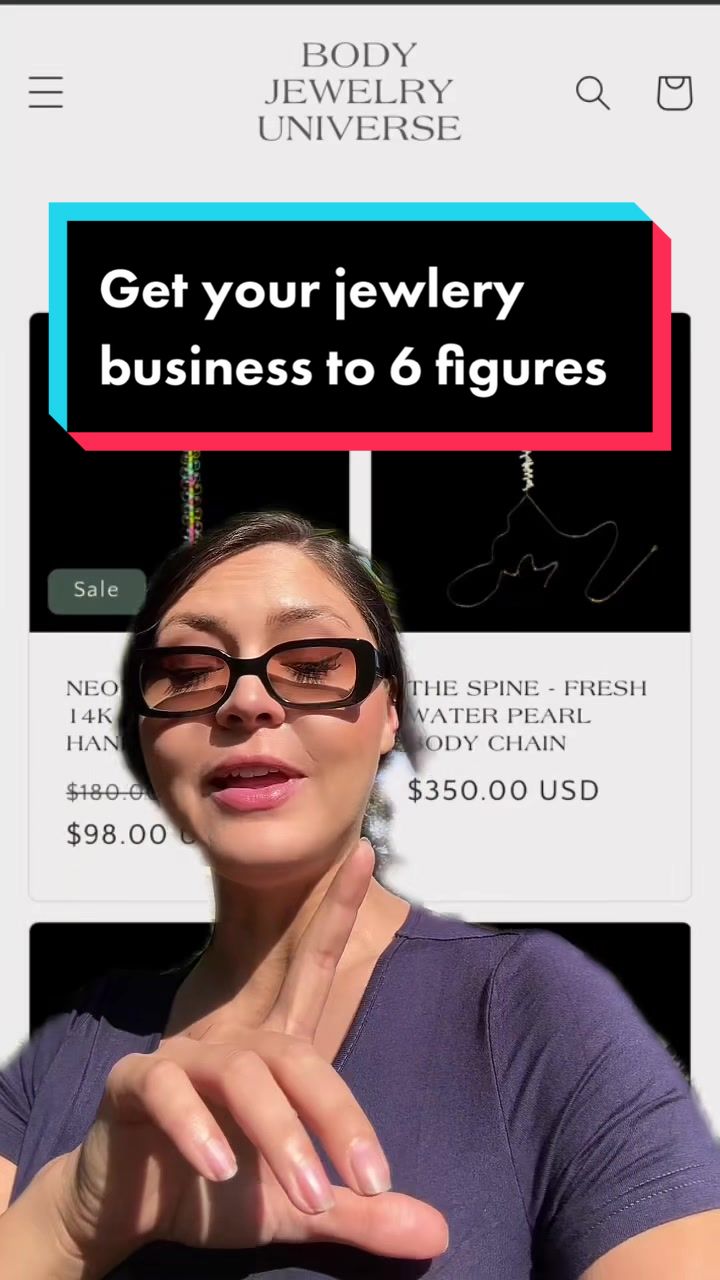
The creator critiques a viewer's jewelry e-commerce website, identifying key issues like the lack of a hero image, inconsistent photography, and a non-luxury user experience despite luxury pricing. She then contrasts this with a successful competitor's website, highlighting their strong branding, consistent visuals, and effective product presentation as a model for improvement.
- 1State specific audience problem
- 2Diagnose core strategic error
- 3Showcase 'bad' example's flaws
- 4Contrast with 'good' example's strengths
- 5Deliver aspirational call to action
ConceptsGood vs BadBreakdown
ElementsOn-screen comment hookText Overlay
[05]
Hook analysis
What stops the scroll in the first 3 seconds
Title hook · 45%
Why your jewelry isn't selling
Verbal hook · 35%
Gonna show you exactly why your jewelry isn't selling.
Visual hook · 20%
A speaker is presented as a digital cutout layered over a screenshot of a user's comment, creating an immediate visual pattern interrupt and providing context.
[06]
Hook template
Steal this for your own video
Here is exactly why your [product or service] isn't selling.
- — Here is exactly why your handmade candles aren't selling.
- — Here is exactly why your online fitness program isn't selling.
- — Here is exactly why your freelance photography packages aren't selling.
[07]
Hook and payoff
The promise the opener makes, and how the video pays it back
Hook
A direct promise to solve a specific, high-stakes problem for a niche audience, creating immediate relevance and value.
Payoff
A concluding mandate that frames the entire lesson as the essential path to achieving a highly desirable, aspirational goal, solidifying the value of the advice.
[08]
Narrative framework
The structural pattern this video runs on
Framework
The Comparative Case Study
Deconstructing a user-submitted 'bad' example by identifying a core strategic flaw, then contrasting it with a 'good' example to provide a clear, actionable blueprint for success.
- 1
The Surface-Level Diagnosis
Identify an immediate, obvious technical flaw in the subject's work to establish credibility and provide a tangible entry point to the critique.
- 2
The Core Thesis Declaration
State the central, strategic mistake that underpins all the smaller flaws. This elevates the critique from tactical to conceptual and frames the entire argument.
- 3
The Psychological Justification
Explain the target audience's mindset and expectations to give weight and logic to the core thesis, proving why the strategic error is so damaging.
- 4
The Evidence Gauntlet (Negative)
Present a rapid-fire sequence of specific examples from the subject's work that prove the core thesis is correct, building a case against the current approach.
- 5
The Ideal Benchmark Introduction
Pivot to a successful competitor or ideal example to serve as a clear point of comparison and a model for improvement.
- 6
The Anatomy of Success (Positive)
Systematically break down the winning elements of the ideal example, directly contrasting them with the previously identified flaws to create a clear roadmap.
Themes
- Brand Perception
- Luxury Marketing
- User Experience
- Conversion Optimization
Techniques
- Website Critique
- Comparative Analysis
- Direct Address
Post caption
Replying to @Yasmin how to increase sales for your jewelry business ❤️ #growyourbusinessontiktok #conversionrateoptimization #ecommercesellers #businessgrowthontiktok #smallbusiness2023 #marketing101business #onlinebusinesstips2023
Text overlays
title · beginning
Why your jewelry isn't selling
contextual · beginning
Reply to Yasmin
DO MINE BODY JEWELRY UNIVERSE
informational · beginning
No landing or hero image
informational · beginning
Selling luxury without a luxury experience WILL NOT WORK
informational · middle
Luxury shoppers are unforgiving
informational · middle
They demand premium experiences and that translates to everything
informational · middle
More photos of product in use
informational · middle
Inconsistent photos
informational · middle
Luxury brands rarely, if ever discount
informational · end
Good hero image + landing area
informational · end
Product + brand storytelling
informational · end
Consistent photography
informational · end
Photos of jewelry in-use
Transcript
Gonna show you exactly why your jewelry isn't selling. Reverse problem is you have no landing area. When shoppers get to your site, this is the first thing they see. But your real big problem is that you're trying to sell at a luxury price point without a luxury experience. Tier thing about luxury shoppers is they are very unforgiving. They demand the best experience from head to toe and that includes through websites too. If we look at your listings, you only have four product photos. You need photos of the product in use. Next, your listing photos are inconsistent. Again, not luxury. Now if you're committed to the luxury price point, you cannot have this discount. This will dilute your brand. Luxury brands don't do that. Let's look at your competitor, the future rocks. Pay attention to this beautiful image with a tight focus on jewelry. Follow it up with a statement about the rings. Listing photos are all the same. They have photos of the product in use exactly how a high end woman might wear it. This is what you need to do if you wanna hit 6 figure.