@johndeere
TikTok · Talking Head Edit
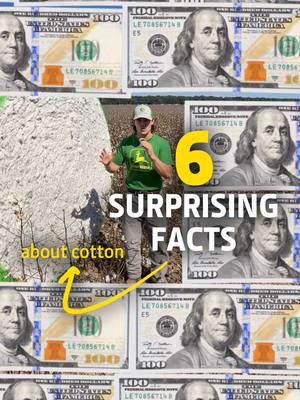
@johndeere cotton is so money….literally

@johndeere
TikTok · Talking Head Edit
@johndeere cotton is so money….literally
Performance
Video #7520 · Talking Head Edit
[01]
The creator stands in a cotton field and presents a series of rapid-fire facts about cotton. He illustrates each fact with visual gags and graphics, explaining that a single bale can make 300,000 hundred-dollar bills, that cotton fiber is called lint, that a bale weighs over 6,000 pounds (mostly waste), and that every part of the plant is used. He concludes by noting cotton's use in electronics and that it's naturally a tall perennial tree.
[02]
[03]
 1.7M25.8×Cheap vs expensive cotton explained@fineasjackson · Breakdown
 4.5M241×Explains why linen prices vary@fineasjackson · Breakdown
 278.1K19.4×Explain hoodie quality and pricing@fineasjackson · Breakdown
 367.6K8.5×Explaining an ancient, forgotten fabric@fineasjackson · What Is X?
 673K1.6×Explaining the true cost of t-shirts@frontoffice.co · Breakdown
 1.6M2×Explaining luxury t-shirt manufacturing process@alextwma · Opportunity Explainer
 1.3M1.6×Explaining why one fabric improves@alextwma · Breakdown
 524.1K1.2×Invention's history and modern impact@frontoffice.co · Origin Story
 1.5M72.1×Explaining why cashmere prices vary@fineasjackson · Breakdown
 662.2K42.8×Text-guided upcycling craft tutorial@makeanddocrew · Process
 593K41.9×Explaining the satin marketing loophole@fineasjackson · Breakdown
 266.1K28×Historical breakdown of wool types@gents.studios · Hot Take
[04]
[05]
What stops the scroll in the first 3 seconds
Title hook · 25%
Fast facts about cotton.
Verbal hook · 25%
Fast facts about cotton.
Visual hook · 50%
A man stands next to a massive, perfectly cylindrical bale of harvested cotton in a vast cotton field under a clear blue sky, creating a strong sense of scale and curiosity.
[07]
The promise the opener makes, and how the video pays it back
Hook
A direct, declarative statement announcing a series of 'fast facts' or 'surprising things' about a specific topic, setting immediate expectations for quick, engaging content.
Payoff
The Foundational Reframe: A final, surprising fact that fundamentally changes the viewer's basic understanding of the subject's nature or origin, serving as a 'mind-blown' moment.
[08]
The structural pattern this video runs on
Framework
The Rapid-Fire Revelation
To present a series of surprising facts about a single topic, where each fact is immediately followed by a memorable and often exaggerated visual demonstration to enhance retention and entertainment.
The Relatable Analogy
Connects the subject to a universally understood and valuable concept (like money) to establish an immediate, surprising link for the audience.
The Terminology Twist
Redefines a commonly known aspect of the subject with its correct or technical term, giving the viewer a piece of 'insider knowledge' that makes them feel smarter.
The Scale Deconstruction
Presents an impressive, large-scale statistic to create awe, then immediately breaks it down to reveal a more complex or surprising composition.
The Zero-Waste Breakdown
Demonstrates the complete utility of the subject by breaking it into its constituent parts and showing a valuable, often unseen, use for each one.
The High-Tech Revelation
Reveals a surprising, often high-tech or counter-intuitive application for the subject, connecting it to a completely different and unexpected domain.
cotton is so money….literally
title · beginning
Fast facts about cotton.
informational · beginning
300,000 $100 bills
informational · beginning
US currency is made up of 75% cotton
informational · middle
lint
informational · middle
6,000 pounds
informational · middle
fiber
informational · middle
oil
informational · middle
mulch
informational · end
electronics like TV screens
informational · end
grow up to 10 feet tall
Fast facts about cotton. A single bale of cotton can be processed into the fiber needed to make $300,100 bills, as US currency is made up of 75% cotton. The part that we recognize as cotton is actually referred to as lint, the fibers that are eventually spun into fabric. A single bale of cotton can weigh over 6,000 pounds, but over half of that weight comes from sticks, stems, and seeds that need to be sorted out later. Nothing on a cotton tree goes to waste. The lint is used for fiber, the seeds are used for feed and oil, and the stock is ground into mulch. Cotton cellulose is so pure, pure, it's even used in electronics like TV screens. Cotton is really a perennial tree that can grow up to 10 feet tall if unmanaged.